




Oracle Stock Forecast: $630 Billion AI Order Backlog Awaits Revaluation, Can the Stock Continue to Recover?
TradingKey - On August 13 US Eastern Time, Oracle (ORCL) shares closed at $156.22, touching an intraday high of $159.26. The company's stock has rebounded sharply since dropping to a period low of $114.50 on July 28.
Based on the closing price on August 13, the gain over this period reached approximately 36.4%, reclaiming the $150 mark. Even using $150 as a benchmark, the rebound exceeded 30%, indicating that market pessimism surrounding its AI infrastructure business is easing.
However, this rally follows a sharp correction. Oracle's stock had previously reached a period high of $249.37 on June 1, before dropping to $114.50 in less than two months, representing a cumulative drawdown of about 54%.
The market's primary concern is not a lack of AI computing power demand, but rather the capital expenditures, debt financing, and potential equity dilution pressures Oracle must incur to fulfill its massive cloud computing orders: in the fourth quarter of fiscal 2026, the company's Remaining Performance Obligations (RPO) surged to $638 billion, up 363% year-over-year. However, whether these high-growth orders can be converted into revenue and cash flow as planned remains the core valuation dispute.
Now, as the computing demand and financing capabilities of clients like OpenAI are re-evaluated, the market is reassessing the value of Oracle's massive backlog of AI orders. Whether Oracle can complete its valuation transition from a traditional enterprise software company to an AI infrastructure provider is becoming key to determining the next phase of its stock performance.
Why Is Oracle Stock Rising?
The core bullish thesis behind Oracle's stock price lies in the market's potential reevaluation of the value of its massive AI compute order backlog.
Gil Luria, head of technology research at D.A. Davidson, noted that the market previously viewed Oracle as an "AI winner" after it disclosed a partnership with OpenAI in September 2025, when its order backlog surged from around $150 billion to $450 billion; however, market concerns subsequently emerged over whether those long-term compute commitments could be fulfilled, given OpenAI's limited revenue and capital strength at the time.
As OpenAI secures new financing and clarifies that certain infrastructure agreements are flexible, Luria believes its ability to pay critical compute bills has significantly strengthened, thereby increasing the certainty of Oracle's future revenue realization.
Oracle's AI compute-related order backlog has currently reached approximately $630 billion, but in Luria's view, the market assigns almost no valuation premium to this future contracted revenue. If AI customers continue converting long-term compute commitments into actual revenue, the market may reprice this massive order backlog, driving Oracle's valuation shift from a traditional software company to an AI infrastructure provider.
JPMorgan Sees 30% Upside for Oracle Stock
JPMorgan believes that the market is still pricing Oracle within the framework of a traditional enterprise software company and has not fully reflected the value of its transformation into an AI infrastructure provider.
JPMorgan analyst Samik Chatterjee reiterated an "Overweight" rating on Oracle with a $200 price target, implying more than 30% upside from the current stock price of around $150.
The core logic behind Chatterjee's assessment is the expansion potential of Oracle Cloud Infrastructure (OCI) and its IaaS business.
JPMorgan expects related revenue to grow from $18 billion in fiscal year 2026 to $180 billion in fiscal year 2030. Order backlog also provides growth visibility, with the company's remaining performance obligations (RPO) reaching $638 billion in the latest quarter, including partnership agreements from customers such as OpenAI and Meta.
JPMorgan projects that Oracle's revenue and earnings per share will achieve average annual growth rates of approximately 33% and 29%, respectively, through fiscal year 2030. Although large-scale data center construction brings financing, debt, and potential equity dilution pressures, the bank believes the market may be overly focused on short-term capital expenditure risks while underestimating the potential for AI infrastructure investments to translate into future revenue, profits, and valuation rerating.
Oracle Stock Price Forecast: Expected to Rise to $164
After rebounding from near its interim low ($114.50), Oracle's stock price has consecutively reclaimed its 5-day, 10-day, 20-day, and 40-day moving averages, maintaining its short-term recovery trend. However, the stock price has recently pulled back after peaking, and is currently constrained by a resistance band formed by the 0.5 Fibonacci retracement level ($154.91) and the 80-day moving average near $156.72. This current stage is a breakout verification phase following the rebound and cannot yet be directly defined as a medium-term trend reversal.
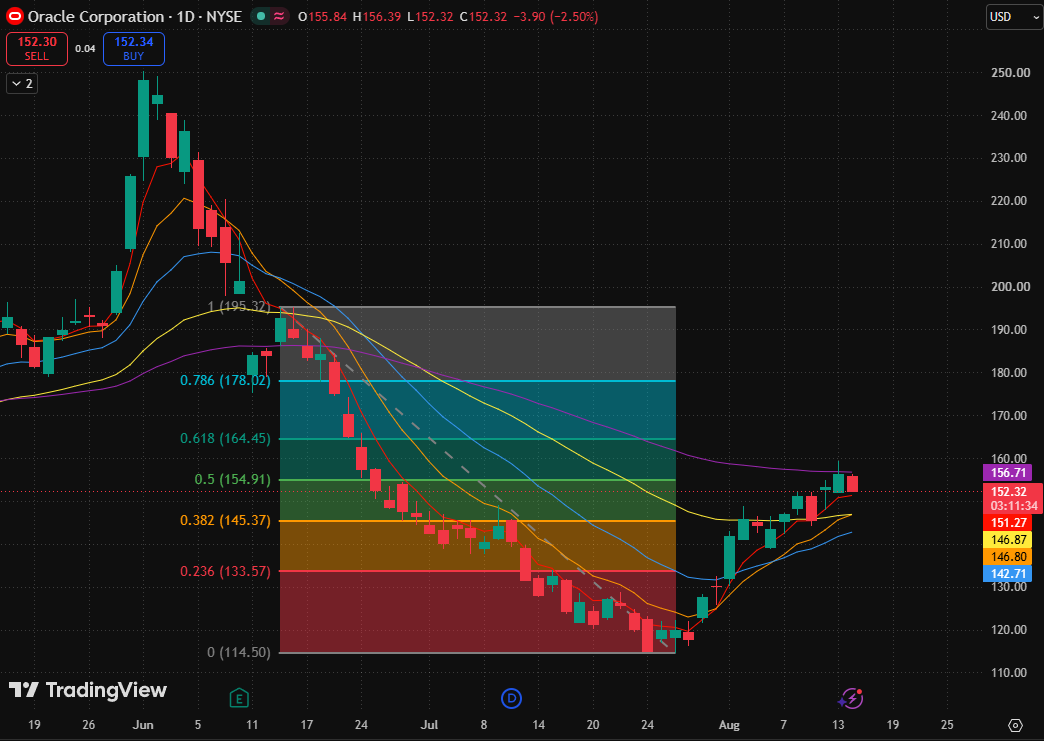
Oracle daily chart. Source: TradingView
In terms of moving averages, the 5-day and 10-day moving averages continue to rise, while the 20-day and 40-day moving averages have shifted into downside support, reflecting an improvement in low-level buying interest. However, the 80-day moving average remains near $156.72, creating overhead confluence resistance alongside the 0.5 Fibonacci retracement level. Only if the daily chart can consistently hold above the $154.91–$156.72 range will this rebound have the potential to further evolve into a broader trend recovery.
For short-term support, the primary focus is the 0.382 Fibonacci retracement level ($145.37), which is also close to the 10-day and 40-day moving averages, serving as a key boundary determining the strength of the rebound structure. If the price holds firm after a pullback, the stock will still have a foundation to retest the $154.91–$156.72 resistance band.
On the upside, the stock price needs to break through the 0.5 Fibonacci retracement level ($154.91) and the 80-day moving average. If it establishes a firm position above them, the next target could be the 0.618 Fibonacci retracement level ($164.45), with further resistance located at the 0.786 Fibonacci retracement level ($178.02).
The primary risk at present is that although ORCL has completed its rebound from low levels, the $154.91–$156.72 zone converges key Fibonacci retracement levels, the 80-day moving average, and a previous high-volume region. The latest daily pullback indicates that overhead selling pressure has not been fully absorbed. If the daily price falls back below the 0.382 Fibonacci retracement level ($145.37), the rebound structure will cool significantly, with a potential retest toward $133.57.
Recommended Articles


