




Elon Musk Says SpaceX Has a Massive Competitive Advantage in AI That Amazon, Google, and Microsoft Can't Touch
Key Points
Elon Musk thinks Space Exploration Technologies can produce better returns on capital than the biggest cloud platforms.
Amazon CEO Andy Jassy said it takes three years to break even on servers and networking equipment.
SpaceX said it can break even on its cloud computing spend in less than a year.
- 10 stocks we like better than Space Exploration Technologies ›
One thing that stood out in Space Exploration Technologies' (NASDAQ: SPCX) first quarterly earnings report as a publicly traded company was just how much it's spending to build out new AI compute capacity. The company's AI-related capital expenditures doubled sequentially to $15.8 billion, and management said it expects to continue spending at a similar level through the end of the year.
To be sure, that capex spending is still dwarfed by what hyperscalers such as Amazon (NASDAQ: AMZN), Alphabet (NASDAQ: GOOG) (NASDAQ: GOOGL), and Microsoft (NASDAQ: MSFT) are laying out on data centers. Each of those three spent between $41 billion and $55 billion last quarter alone. But they're also generating huge amounts of revenue from their cloud computing units, with massive backlogs of contracted business.
Missed Nvidia in 2009? This Rare Signal Is Flashing Again. In 2009, a "Double Down" signal flashed for a little-known chipmaker called Nvidia. For the first time in years, that same "Total Conviction" signal is flashing for a company 1/100th the size of Nvidia. Continue »
However, SpaceX CEO Elon Musk believes his company can deploy capital much more efficiently than the hyperscalers can, thanks to a unique competitive advantage.
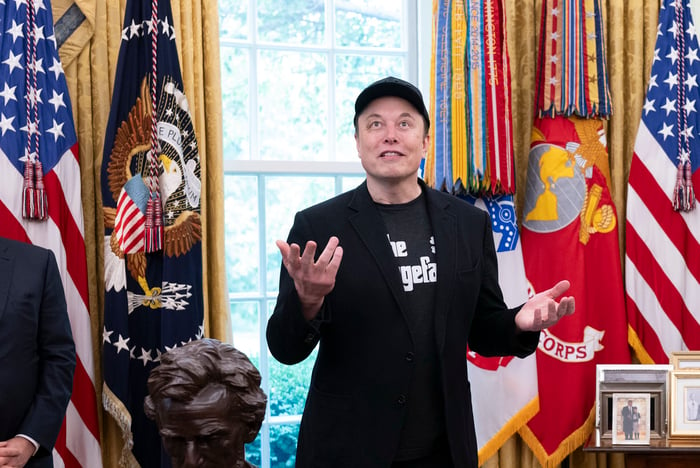
SpaceX CEO Elon Musk. Image source: The White House.
What is SpaceX's advantage in artificial intelligence?
Musk argues that SpaceX has an engineering advantage over everyone else competing in the cloud computing business. His premise is that it can deploy the engineering talent pool and intellectual property base that supported the development of its rocket operations to efficiently build new data centers that produce high returns on investment.
"We're finding that even a small amount of what we've learned building rockets, which are incredibly difficult, applied to data centers, yields tremendous benefits," Musk said on the company's first earnings call. He noted its cooling systems are well ahead of what's needed.
The payoff potential appears substantial.
"The current economics have translated into a less than one-year payback on our new capital deployments for compute," CFO Bret Johnsen said during his prepared remarks.
That stands in stark contrast to comments from Amazon CEO Andy Jassy, who outlined the economics for Amazon Web Services' massive build-out.
"Data center capital is spent starting two years before we can put servers into them to start monetizing," he explained. That's just the physical limitations it's seeing in building new data centers; it can't even begin to monetize them for two years, let alone break even in one year.
"For servers and networking equipment, on average, it takes a little less than three years to break even on that investment," Jassy added. Even if the cost of a data center were zero, Jassy said it would take nearly three years to break even on the equipment it buys to equip those buildings. Results from Microsoft and Alphabet suggest similar timelines for their operations.
There's a huge gap in SpaceX's accounting and Amazon's accounting. Is SpaceX, a company that practically entered the cloud computing space yesterday, really so much more efficient at engineering and capital deployment that it can produce results three times better than those of the hyperscalers?
Why investors should be skeptical of Musk's claims
Musk has never shied away from making bold claims about where his businesses are headed, and when they will pass various milestones. More often than not, the results fall short of his predictions. There's reason to be skeptical about SpaceX's ability to establish a meaningful competitive advantage in AI compute based on its engineering talent alone.
While Johnsen's claim that it's producing very fast paybacks on its current investments may be accurate, it's not clear that it will be able to scale up as efficiently. SpaceX had existing infrastructure that it used to provide more compute capacity to third-party customers like Anthropic and Alphabet's Google last quarter. That's not necessarily repeatable.
What's more, it simply doesn't make sense that SpaceX could easily retain such top talent in the face of competition from hyperscalers. As mentioned, Alphabet, Amazon, and Microsoft are spending three times as much on capital expenditures as SpaceX. Their businesses are heavily reliant on efficient returns on that capital spending. They would surely pay up for top talent if it meant improving their return on capital severalfold.
SpaceX is merely in a position to provide some AI compute at a time when there's a severe shortage of it. Alphabet has signed a contract with the company for compute because the long-term potential of serving large customers like Anthropic now with its own infrastructure by offloading some of its internal AI compute needs to a third party is too good to pass up.
Alphabet can end its contract with SpaceX as soon as it builds enough capacity for itself. That could result in some excellent short-term revenues for SpaceX, but it doesn't indicate a long-term competitive advantage in cloud computing.
Should you buy stock in Space Exploration Technologies right now?
Before you buy stock in Space Exploration Technologies, consider this:
The Motley Fool Stock Advisor analyst team just identified what they believe are the 10 best stocks for investors to buy now… and Space Exploration Technologies wasn’t one of them. The 10 stocks that made the cut could produce monster returns in the coming years.
Consider when Netflix made this list on December 17, 2004... if you invested $1,000 at the time of our recommendation, you’d have $421,511!* Or when Nvidia made this list on April 15, 2005... if you invested $1,000 at the time of our recommendation, you’d have $1,381,960!*
Now, it’s worth noting Stock Advisor’s total average return is 981% — a market-crushing outperformance compared to 216% for the S&P 500. Don't miss the latest top 10 list, available with Stock Advisor, and join an investing community built by individual investors for individual investors.
See the 10 stocks »
*Stock Advisor returns as of August 15, 2026.
Adam Levy has positions in Alphabet, Amazon, and Microsoft. The Motley Fool has positions in and recommends Alphabet, Amazon, and Microsoft. The Motley Fool has a disclosure policy.
Recommended Articles


