




Alphabet vs. Oracle: Which Is the Better AI Stock to Own for the Next 5 Years?
Key Points
Alphabet's cloud business is growing rapidly, driven by robust consumer engagement and new product launches.
Oracle expects its revenues to increase at a compound annual rate of 31% over the next five years.
Both stocks trade at similar valuations.
- 10 stocks we like better than Alphabet ›
Cloud computing has become ground zero for artificial intelligence (AI) development. The large cloud infrastructure companies provide platforms where developers can create their AI apps, which is where the magic happens.
Alphabet (NASDAQ: GOOG) (NASDAQ: GOOGL) and Oracle (NYSE: ORCL) are the third- and fourth-largest cloud infrastructure companies globally, according to Statista, accounting for 14% and 4% of the market, respectively. They're both enjoying high growth in AI and are well-positioned for the future. But which is the better AI stock to buy now and hold for the next five years?
Missed Nvidia in 2009? This Rare Signal Is Flashing Again. In 2009, a "Double Down" signal flashed for a little-known chipmaker called Nvidia. For the first time in years, that same "Total Conviction" signal is flashing for a company 1/100th the size of Nvidia. Continue »
The case for Alphabet
Alphabet is a leader in artificial intelligence thanks to its widely used large language model (LLM), Gemini. It has an edge in its Google Search-native integration as well as its Android and Chrome integrations, bringing it straight to where users already are.

Image source: Google.
Gemini use continues to increase, and Google has been rapidly releasing new features and upgrades that offer greater value. Some second-quarter highlights included the launch of Gemini 3.6 Flash, which offers better cost efficiency for budget customers, and the rollout of the AI video generator Omni. Since Omni's debut in May, there has been a 40% increase in the number of daily active users creating videos on Gemini. Strong AI-driven engagement led to an 82% year-over-year increase in Google Cloud revenue in the second quarter.
Alphabet has been reporting consistently strong performances in terms of both revenue growth and operating margin.
| Metric | Q2 2026 | Q1 2026 | Q4 2025 | Q3 2025 |
|---|---|---|---|---|
| Revenue growth (YOY) | 24% | 22% | 18% | 16% |
| Operating margin (YOY) | 34% | 36.1% | 31.6% | 30.5% |
Data source: Alphabet quarterly reports. YOY = year over year.
However, the market was not happy to hear that management was boosting its already lofty plans for capital expenditures this year by $15 billion. Previously, the company had guided for capex in the range of $180 billion to $190 billion. But on the Q2 earnings call, Alphabet updated that to a $195 billion to $205 billion range, and warned that it was planning for even higher outlays next year. Alphabet says this kind of spending on AI infrastructure is a necessity if it's going to stay competitive, and says that it will pay off -- eventually.
In Alphabet's favor, it has several interconnected businesses in markets where it's a leader, starting with Search, where it has a breathtaking 90% market share, and including mobile operating system Android and video streaming platform YouTube.
"Our AI investments are redefining what's possible across every part of our business," said CEO Sundar Pichai on the Q2 earnings call, and considering all of its businesses, there's going to be a lot happening at Alphabet over the next five years. It also doesn't hurt the investment case that Berkshire Hathaway has recently made Alphabet one of its top stock holdings.
The case for Oracle
Oracle has been a leader in database storage for years, and it has lately turned to AI, like many other tech companies. It's building out data centers to capitalize on the opportunity, but its stock tanked last year as the market reacted to massive spending that sent its free cash flow into negative territory. The stock is now 53% off its recent high.
So far, Oracle's business has continued to demonstrate momentum despite what you might expect based on its plunging stock price.
| Metric | Q4 Fiscal 2026 | Q3 Fiscal 2026 | Q2 Fiscal 2026 | Q1 Fiscal 2026 |
|---|---|---|---|---|
| Revenue growth (YOY) | 21% | 22% | 14% | 12% |
| Operating margin (YOY) | 32% | 32% | 29% | 29% |
Data source: Oracle quarterly reports. Oracle's fiscal 2026 ended May 31. YOY = year over year.
Oracle's cloud platform works differently from Alphabet's. It has partnerships with all of the large cloud companies so that its user base has many options, and they can toggle between platforms through a unified interface on Oracle's network.
It also has its legacy database business, which is benefiting from changes in AI. Oracle rolled out more than 1,000 AI agents in the second quarter, making its offerings more efficient and valuable.
Unlike most other large cloud companies, which have the cash to invest in their AI build-outs, Oracle is raising capital to invest in capturing a share of the opportunity. It raised between $45 billion and $50 billion in its fiscal 2026 through a combination of debt issuance and stock sales, and plans to raise another $40 billion in fiscal 2027.
Management isn't worried about the debt, since it has a backlog of funded contract value in its remaining performance obligations (RPO), which will lead to high quarterly revenue growth. In its latest fiscal quarter, RPO increased 363% year over year to $638 billion, and management gave a five-year outlook anticipating a 31% compound annual growth rate.
The verdict
For one last comparison, let's take a look at how Alphabet and Oracle stack up across several valuation metrics.
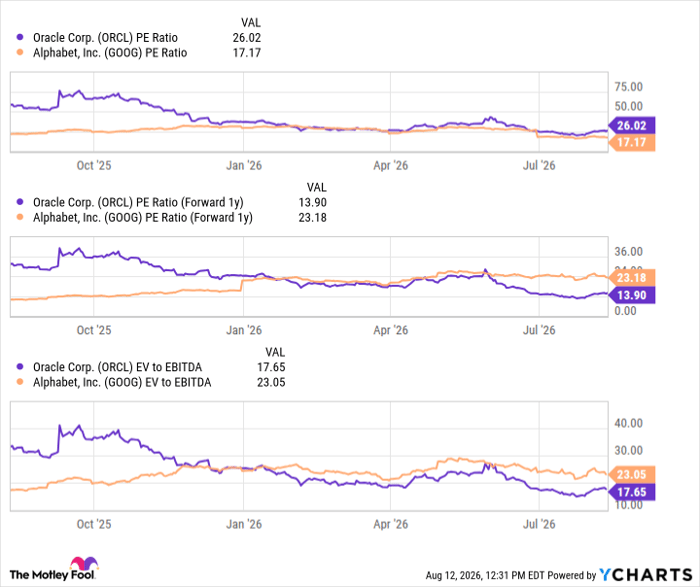
ORCL PE Ratio data by YCharts.
The answer to the question of which of these stocks is more expensive depends on the metric you're looking at, but the differences aren't significant enough to say one is much more expensive than the other, so I would call this comparison a wash.
Both companies are growing at similar rates today, and they both have large opportunities in cloud computing. However, I see Alphabet as having the edge. It's cash-flow positive, and its other businesses are flourishing, providing it with a cushion and a way forward beyond the AI realm. While the platform-agnostic position Oracle occupies thanks to its deals with all the cloud computing leaders is an advantage, the progress Alphabet has made in developing money-generating AI apps is an advantage in its own right, too.
Both companies are seeing tailwinds in AI and cloud development, but Alphabet has more to gain as AI enriches the value of a host of services across its enterprise. Therefore, it should be the better stock to own over the next five years.
Should you buy stock in Alphabet right now?
Before you buy stock in Alphabet, consider this:
The Motley Fool Stock Advisor analyst team just identified what they believe are the 10 best stocks for investors to buy now… and Alphabet wasn’t one of them. The 10 stocks that made the cut could produce monster returns in the coming years.
Consider when Netflix made this list on December 17, 2004... if you invested $1,000 at the time of our recommendation, you’d have $421,943!* Or when Nvidia made this list on April 15, 2005... if you invested $1,000 at the time of our recommendation, you’d have $1,382,819!*
Now, it’s worth noting Stock Advisor’s total average return is 983% — a market-crushing outperformance compared to 216% for the S&P 500. Don't miss the latest top 10 list, available with Stock Advisor, and join an investing community built by individual investors for individual investors.
See the 10 stocks »
*Stock Advisor returns as of August 15, 2026.
Jennifer Saibil has no position in any of the stocks mentioned. The Motley Fool has positions in and recommends Alphabet, Amazon, Berkshire Hathaway, Microsoft, and Oracle. The Motley Fool has a disclosure policy.
Recommended Articles


