




Palantir Just Crushed Earnings Again. These 2 Legacy Defense Stocks Are the Cheaper Way to Play the Same Budget.
Key Points
Palantir is trading at an expensive multiple of earnings.
General Dynamics and Lockheed Martin are two steady defense contractors for the modern age.
Shares of both stocks trade at reasonable prices, with steady capital returns to shareholders.
- 10 stocks we like better than Palantir Technologies ›
Palantir Technologies (NASDAQ: PLTR) saw its stock soar this month after reporting another strong earnings result. It now has a market cap larger than every defense contractor in the world.
However, because of its high price-to-earnings ratio (P/E) and price-to-sales ratio (P/S), investors would be smart to avoid buying Palantir stock after shares have soared hundreds of percentage points in the past few years.
Missed Nvidia in 2009? This Rare Signal Is Flashing Again. In 2009, a "Double Down" signal flashed for a little-known chipmaker called Nvidia. For the first time in years, that same "Total Conviction" signal is flashing for a company 1/100th the size of Nvidia. Continue »
Instead, someone looking to bet on growth in U.S. defense spending should consider these two legacy providers. Here's why Lockheed Martin (NYSE: LMT) and General Dynamics (NYSE: GD) are solid buys with the market near all-time highs.

Image source: Getty Images.
Replenishing inventories for missile defense
Lockheed Martin is a defense contractor specializing in fighter jets and missile systems, with its F-35 line serving as the current workhorse fighter jet for the United States and its allies. The F-35 program has long lead times and maintenance requirements, which will lead to durable recurring revenue for the business over the coming decades.
Second, Lockheed Martin is the maker of THAAD missile interceptors, which have been used extensively in the conflict with Iran, so much so that the United States just awarded Lockheed Martin a $35 billion contract to quadruple the production rate of these interceptors. This is the main reason the company's backlog hit a record $230 billion at the end of last quarter.
This backlog is being converted into revenue quickly, with management upgrading its full-year guidance to over $80 billion and boosting free cash flow to over $7 billion. With the growing need for Lockheed Martin's programs and the steady demand for the F-35, the company should see consistent sales growth in the years ahead.
Steady revenue from submarine contracts
Another company with steady, long-term contracts with the United States is General Dynamics. It's the main contractor for building nuclear-powered and nuclear-armed submarines, which are a priority program for the U.S. Navy. The new Columbia-class submarines will be built over the next two decades, will have a service life that extends into most of this century, and will cost almost $10 billion each to build. This will provide General Dynamics with high-quality revenue for years to come.
Outside of nuclear submarines, General Dynamics operates Gulfstream, a leading private aviation company, and has many contracts for software, cybersecurity, and other IT services for the United States government.
Combined, General Dynamics saw its backlog rise to $136.5 billion last quarter, with a book-to-bill ratio of 1.4. This means that for every dollar General Dynamics billed for under contracts, it was able to book $1.40 in new contract value.
Revenue grew 8% year over year last quarter, and full-year revenue guidance was just raised to $55.7 billion. With these nuclear submarine contracts, General Dynamics should be delivering solid growth for shareholders for years to come, with high predictability.
Data by YCharts.
Why these two defense contractors are solid buys
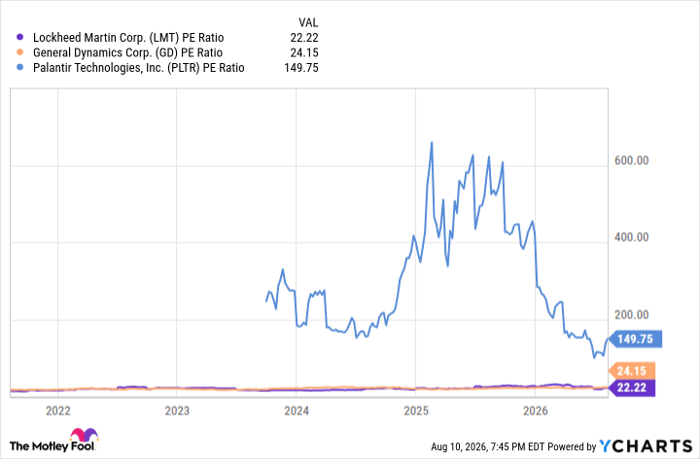
When debating which stock to add to your portfolio, you might argue that Palantir is a better buy because of its rapid revenue growth. However, with a P/E ratio of 150, a lot of future growth is already priced into the stock.
On the other hand, General Dynamics and Lockheed Martin trade at P/E ratios of 24 and 22, respectively, with steady, long-term contracts. Both companies return capital to shareholders through share buybacks, reducing shares outstanding and increasing earnings per share (EPS), while Palantir's shares outstanding have risen 20% in the last five years.
Plus, both of these legacy providers pay a nice dividend as a cherry on top. Combine it all together, and General Dynamics and Lockheed Martin should deliver better returns at lower risk than owning Palantir over the next decade.
Should you buy stock in Palantir Technologies right now?
Before you buy stock in Palantir Technologies, consider this:
The Motley Fool Stock Advisor analyst team just identified what they believe are the 10 best stocks for investors to buy now… and Palantir Technologies wasn’t one of them. The 10 stocks that made the cut could produce monster returns in the coming years.
Consider when Netflix made this list on December 17, 2004... if you invested $1,000 at the time of our recommendation, you’d have $411,427!* Or when Nvidia made this list on April 15, 2005... if you invested $1,000 at the time of our recommendation, you’d have $1,335,252!*
Now, it’s worth noting Stock Advisor’s total average return is 965% — a market-crushing outperformance compared to 215% for the S&P 500. Don't miss the latest top 10 list, available with Stock Advisor, and join an investing community built by individual investors for individual investors.
See the 10 stocks »
*Stock Advisor returns as of August 12, 2026.
Brett Schafer has no position in any of the stocks mentioned. The Motley Fool has positions in and recommends Palantir Technologies. The Motley Fool recommends Lockheed Martin. The Motley Fool has a disclosure policy.
Recommended Articles


