




Tesla Stock Price Prediction: Cathie Wood's ARK Expects SpaceX Merger by 2026, Can Shares Recover?
TradingKey - Tesla (TSLA) and SpaceX (SPCX) merger speculation continues to gain momentum. Notably, on "The Brainstorm," a podcast under Cathie Wood's Ark Invest, several guests noted that if Tesla and SpaceX move forward with a merger in the future, Tesla's China business could become a complex regulatory variable. SpaceX involves U.S. national security and satellite projects, while Tesla's Shanghai Gigafactory is a key manufacturing and export hub, meaning certain technology and business dealings may face stricter scrutiny.
However, Ark Invest analysts believe the China business is not an insurmountable obstacle and could be managed by establishing relatively independent asset and operational boundaries. While the Shanghai factory remains a core asset for Tesla, as the company shifts its focus toward Robotaxi, autonomous driving, and robotics, the impact of the China business on its future valuation may decline, and a deal could potentially be announced before the end of 2026.
Market rumors previously suggested that Tesla might sell or spin off its China operations to pave the way for a merger with SpaceX. Elon Musk publicly denied this in July, calling the claims "absurd fake news," and Tesla China also responded that the reports were untrue.
Currently, business ties between the two companies are growing. SpaceX purchased $295 million worth of Tesla Megapack energy storage batteries in the second quarter, bringing first-half purchases to $329 million. Additionally, Tesla's previous $2 billion investment in xAI was converted into SpaceX equity after xAI was integrated into SpaceX. There is still no official announcement on whether Tesla and SpaceX will ultimately proceed with a merger.
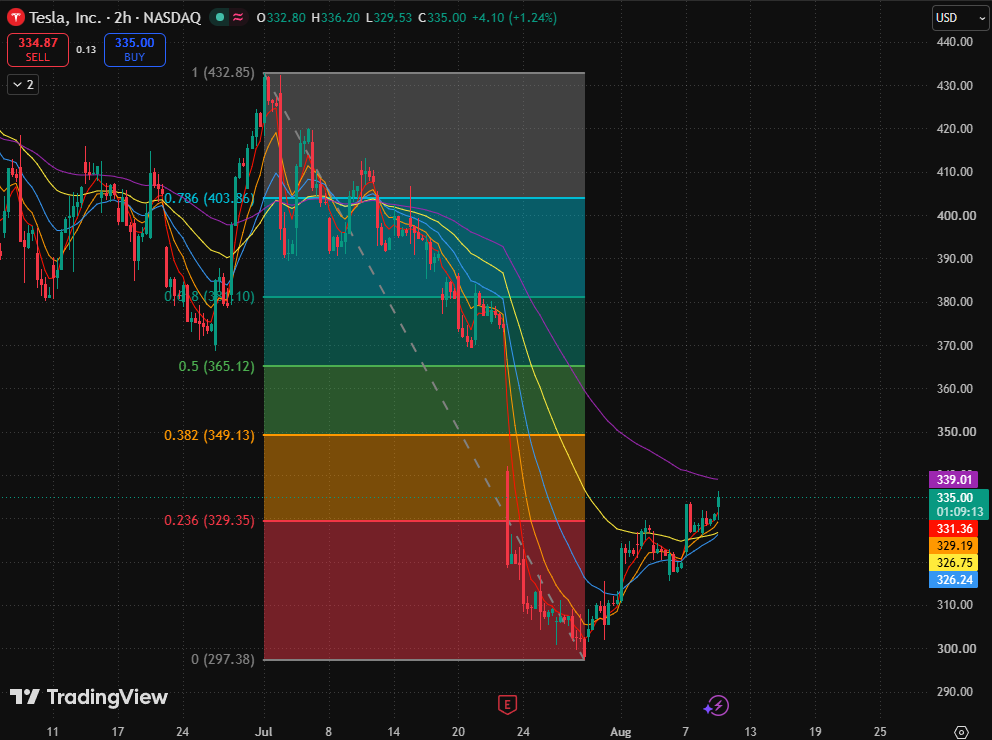
Tesla 2-Hour Price Chart, Source: TradingView
Since reaching a local low ($297.38) on July 29, Tesla's stock price has continued to rebound. It has now reclaimed the 0.236 Fibonacci retracement level ($329.35).
In the short term, the price has simultaneously returned above the 5-day, 10-day, 20-day, and 40-day moving averages, indicating that the recovery following the sharp drop is continuing. However, as the stock price approaches the 80-day moving average and the previous breakdown zone, the current move is closer to a corrective rebound within a downtrend, and a medium-term trend reversal cannot yet be confirmed.
For short-term support, focus primarily on the 0.236 Fibonacci retracement level ($329.35), which has transitioned from previous resistance into the key dividing line between strength and weakness for the current rebound. If the price holds firm after a pull-back on the 2-hour chart, the stock remains poised to challenge the $339–$349 resistance zone.
If the rebound meets resistance in this zone and falls back below the 0.236 Fibonacci retracement level ($329.35), it would indicate weakening short-term momentum, and the price may retest around $326 or even the previous low of $297.38.
If there is an effective breakout above the 80-day moving average near $339, the next resistance targets the 0.382 Fibonacci retracement level ($349.13), followed by the 0.5 Fibonacci retracement level ($365.12). Only consecutive recoveries of $349.13 and $365.12 will help confirm that this rebound is evolving into a clearer trend recovery.
Recommended Articles


