




2 Unstoppable Artificial Intelligence (AI) Stocks That Will Join Amazon in the $3 Trillion Club by 2027
Key Points
Taiwan Semiconductor is investing more money into production facilities due to huge demand.
Broadcom has a major demand wave coming in 2027, adding to an already strong 2026.
- 10 stocks we like better than Taiwan Semiconductor Manufacturing ›
The $3 trillion club got a little more crowded following second-quarter earnings. Microsoft regained its position at this level and is nearly at the $4 trillion mark. Amazon briefly entered the $3 trillion club following the strong reception of its earnings, but has since dropped below the $3 trillion threshold. By the end of 2027, I'd expect both of these two to be solidly into the $4 trillion club, but with two additional members.
Which two will join them? I think it will be Taiwan Semiconductor Manufacturing (NYSE: TSM) and Broadcom (NASDAQ: AVGO). These two have a ways to go, with TSMC currently valued at $2.2 trillion and Broadcom at $2 trillion. There's enough business momentum to propel these two into the $3 trillion club by 2027, which would make them excellent investments right now.
Missed Nvidia in 2009? This Rare Signal Is Flashing Again. In 2009, a "Double Down" signal flashed for a little-known chipmaker called Nvidia. For the first time in years, that same "Total Conviction" signal is flashing for a company 1/100th the size of Nvidia. Continue »

Image source: Getty Images.
The AI race is pushing these two higher
Both Taiwan Semiconductor and Broadcom are benefiting from the AI build-out.
Taiwan Semiconductor (TSMC) is at the heart of AI computing, as the major names in the computing industry don't manufacture any of their own chips; they only design them. TSMC is the top logic chip manufacturer in the world and manufactures chips for its clients. So, the company doesn't really care whose computing unit is currently the most popular. As long as there is increased AI spending, its business will continue growing as well.
Business looks bright for the future, so Taiwan Semiconductor recently announced an additional $100 billion investment in its U.S. facility in Arizona. That's a major investment, and management clearly thinks that it can receive a strong return on that investment due to extreme AI demand from U.S. companies.
One of Taiwan Semiconductor's clients is Broadcom. In a way, Broadcom is similar to TSMC. The fastest-growing and most important part of Broadcom's business is custom AI chips. Broadcom has partnered with AI hyperscalers to help them design computing units for AI workloads that they do not have the capabilities to make in-house. Then, Broadcom helps these hyperscalers manufacture the chips and manage the supply chains. This has proven to be a great business for Broadcom to be in, as it grew at a 143% pace during Q2 to $10.8 billion. But that's just small potatoes compared to where it's heading.
Next year, management estimates that its AI semiconductor business will surpass $100 billion in revenue. That's a huge growth rate and shows that several AI hyperscalers are starting to select Broadcom's AI computing chips over traditional graphics processing unit (GPU)-based computing. That bodes well for Broadcom, but can it get to a $3 trillion market cap by 2027?
The math supports both stocks getting to $3 trillion by 2027
For Broadcom to reach a $3 trillion valuation mark, its valuation must expand by 50%, or its earnings must grow by 50% with the same valuation. Taiwan Semiconductor is in the same boat, except its figure is 36%. From a trailing earnings perspective, Broadcom is very expensive at 70 times earnings, while Taiwan Semiconductor is fairly valued at 30 times earnings.
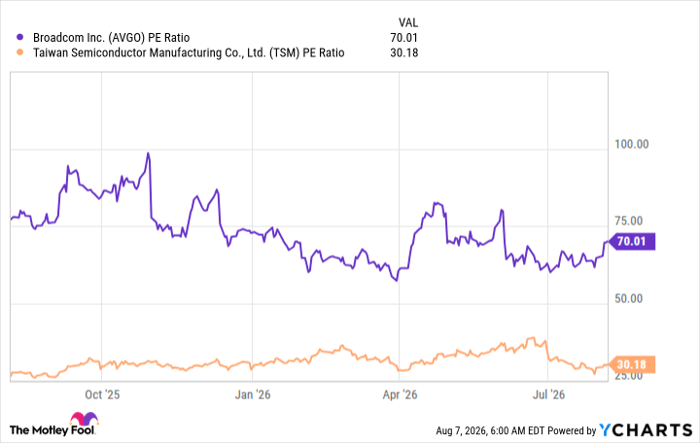
AVGO PE Ratio data by YCharts. PE = price-to-earnings.
Taiwan Semiconductor is projected to grow its revenue at a 42% pace in 2026 and a 33% pace in 2027. With TSMC already being priced at a reasonable level, I think it's fair to say that TSMC will be able to grow enough to get into the $3 trillion club by the end of 2027, or at least 2028.
Broadcom has some more work to do. If it needs to trade for 35 times earnings, it must double its earnings now, then increase them by 50% more to get to the $3 trillion mark. Over the past 12 months, Broadcom's earnings have totaled $6 per share. At the end of fiscal 2027, Wall Street analysts expect its earnings per share to total $19.49.That's well over a triple, easily allowing Broadcom to meet the requirements of reducing its valuation and growing its earnings on top of that.
I think there's a strong chance that each of these companies will reach the $3 trillion mark before 2027 is over, and for sure by 2028. That would result in rapid gains in just a year and a half of investing, making them excellent stocks to buy now.
Should you buy stock in Taiwan Semiconductor Manufacturing right now?
Before you buy stock in Taiwan Semiconductor Manufacturing, consider this:
The Motley Fool Stock Advisor analyst team just identified what they believe are the 10 best stocks for investors to buy now… and Taiwan Semiconductor Manufacturing wasn’t one of them. The 10 stocks that made the cut could produce monster returns in the coming years.
Consider when Netflix made this list on December 17, 2004... if you invested $1,000 at the time of our recommendation, you’d have $411,427!* Or when Nvidia made this list on April 15, 2005... if you invested $1,000 at the time of our recommendation, you’d have $1,335,252!*
Now, it’s worth noting Stock Advisor’s total average return is 965% — a market-crushing outperformance compared to 215% for the S&P 500. Don't miss the latest top 10 list, available with Stock Advisor, and join an investing community built by individual investors for individual investors.
See the 10 stocks »
*Stock Advisor returns as of August 11, 2026.
Keithen Drury has positions in Amazon, Broadcom, Microsoft, and Taiwan Semiconductor Manufacturing. The Motley Fool has positions in and recommends Amazon, Broadcom, Microsoft, and Taiwan Semiconductor Manufacturing. The Motley Fool has a disclosure policy.
Recommended Articles


