




Will Microsoft Show Strength Again? Earnings May Be Inflection Point for AI Investment Returns
Why Azure Re-Acceleration, Copilot Scaling, and Model Commoditization Actually Benefit Microsoft
Microsoft's latest earnings report has brought two controversies to the forefront: Was Azure's previous slowdown due to weakening demand or capacity constraints? Azure here can be simply understood as Microsoft's cloud computing platform, and one of the most direct monetization channels for the company's data center and AI compute investments. On the other hand, as AI brings in more revenue, will Microsoft become more profitable, or will it be dragged down by inference, depreciation, and data center costs into a company with worse cash flow?
The answers are not yet fully revealed, but the return chain has become much clearer. Capital expenditures are converting into sellable compute capacity more quickly; new contracts are starting to diversify away from a single large customer; even if enterprises switch models, they are likely to remain within Microsoft's data and governance framework; and Copilot is attempting to translate this platform control into seat and usage-based revenue. This is the most important change in this earnings report.
Microsoft reported its FY2026 Q4 for the period ending June 30, 2026, corresponding to the second calendar quarter of 2026; next quarter's FY2027 Q1 guidance corresponds to the third calendar quarter. To facilitate comparison with company disclosures, Microsoft's own fiscal quarter terminology will be used throughout the rest of this text.
Key Data for This Quarter | FY2026 Q4 |
Revenue | $90 billion, up 18% year-over-year |
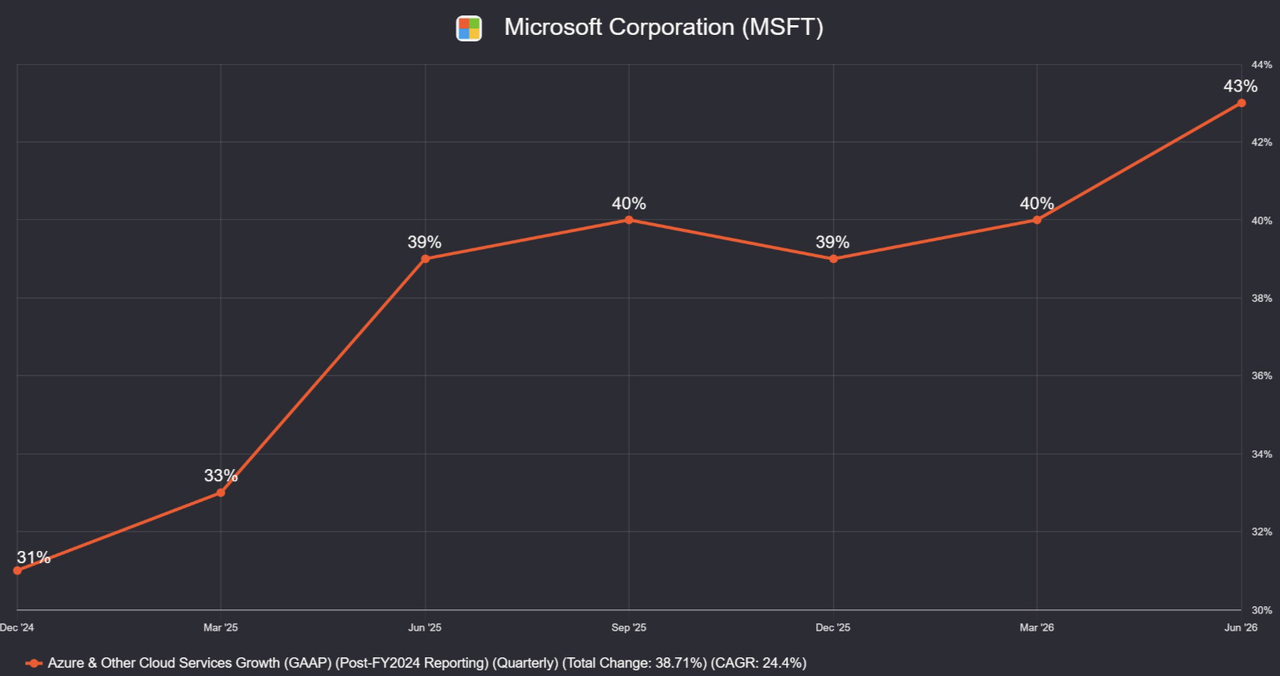
Azure and other cloud services | Up 43% year-over-year, next quarter guidance of approximately 45% |
Demand excluding OpenAI | Commercial bookings up 18% year-over-year, RPO up 25% year-over-year |
Microsoft 365 Copilot | Paid seats exceeding 30 million |
Capital Expenditures / Free Cash Flow | $41.0 billion / $19.6 billion |
RPO stands for remaining performance obligations, which can be simply understood as contracted but unrecognized revenue. Microsoft did not just beat expectations on a single product this quarter: growth, breadth of bookings, enterprise AI adoption, and cash flow all performed better than previous concerns.
Azure Re-accelerates: Looking First at Supply Release
Azure's demand did not suddenly return this quarter. In FY2026 Q2, CFO Amy Hood had already stated that if all the newly online GPUs at the time had been allocated to Azure, Azure's growth metric could have exceeded 40%. Microsoft chose to reserve some compute power for Microsoft 365 Copilot, GitHub Copilot, and internal R&D, meaning Azure's growth rate was also a result of capacity allocation.
By the fourth quarter, supply-side constraints began to ease significantly. Microsoft added 31 data centers and approximately 1 GW of capacity in a single quarter, bringing the full-year total to 88 new data centers; the time required for new GPUs to go from arrival to online in major regions was shortened by nearly 50% over the past fiscal year; and since the beginning of 2026, Copilot workload throughput has increased fourfold.
New hardware begins generating revenue faster, and existing hardware can handle more tasks. Management directly attributed Azure's upside this quarter to efficiency improvements in CPUs and GPUs as well as the earlier delivery of new capacity, noting that the freed-up capacity was quickly consumed by customers within the quarter. When compute power remains in short supply, efficiency can both reduce costs and generate additional revenue.
Microsoft did not disclose how much the efficiency improvements contributed to growth, and the 43% metric also includes GitHub and other 'other cloud services', so it should not be interpreted entirely as pure AI compute. However, the guidance of approximately 45% for next quarter, along with management's expectation of continued acceleration in the first half of FY2027, indicates that short-term growth has real capacity support. The bull thesis does not require Azure to surge all the way to 50%; with annual revenue exceeding $100 billion, growth of near 40% is already strong enough.
Source: Fiscal.ai
Supply improvements explain why Azure was able to accelerate, but they do not yet answer the question of growth quality. As long as the largest buyer remains OpenAI, customer concentration must be discussed separately.
High Concentration in OpenAI, but Compute Demand is Spilling Over
Microsoft disclosed for the first time that revenue from its commercial arrangement with OpenAI was $24.1 billion in FY2026, which includes revenue sharing and represents approximately 7.3% of Microsoft's total annual revenue. The company did not break down how much came from compute, training and inference services, or revenue sharing, so there is no need to make precise guesses about the composition in the absence of evidence.
A more useful question is: if OpenAI reduces its procurement, is there a second tier of buyers for this compute capacity?
Microsoft's own bookings provide part of the answer. Excluding OpenAI, commercial bookings still grew 18% and RPO grew 25%; the entirety of this quarter's quarter-on-quarter increase in RPO ($51 billion, +8.1% QoQ) came from customers outside of frontier model companies. OpenAI remains the core customer in existing AI revenue, but it no longer dominates new contracts.
External transactions also indicate that a visible market has formed for high-end AI compute. SpaceX signed a compute agreement with Anthropic covering approximately 325,000 Nvidia GPUs, priced at $1.25 billion per month; Meta is also in discussions with Anthropic over a two-year compute rental deal worth up to $10 billion. While the latter is still under negotiation, the two cases collectively illustrate that companies with large-scale available compute capacity do not lack external inquiries or potential buyers.
Microsoft's own contract protections are more direct. Management previously stated that most newly purchased GPUs are already covered for most of their useful life; contracts with some of the largest customers even cover the full useful life of the GPUs. As software continues to optimize, the same hardware can deliver higher efficiency in later stages, offering the potential for margin improvement over time.
This evidence does not prove that Microsoft can redeploy all OpenAI capacity at any time and at original pricing. The risk Microsoft carries is how long reconfiguration would take, whether price cuts would be required, and OpenAI's performance capability, rather than 'no one taking over if OpenAI stops buying'. I prefer to view OpenAI as the first super-anchor customer of Microsoft's AI infrastructure: it reduces the risk of early idle capacity for new buildouts, but it is not the only destination.
The existence of secondary buyers for compute only proves that the assets are liquid. For Microsoft to capture value-add beyond compute leasing, it must get customers to keep their data, permissions, and workflows within its own platform.
Models Can Be Replaced, but Enterprise State is Hard to Migrate
Enterprises are adopting multi-model architectures—using OpenAI today, and potentially adding Anthropic, open-source models, or Microsoft's proprietary models tomorrow. Models can be swapped overnight, but employee relationships, document permissions, project histories, and approval rules cannot be rebuilt overnight.
These hard-to-migrate elements can be collectively referred to as the 'state' required for enterprises to run AI. AI sovereignty is also not just about which country data is stored in, but whether enterprises can maintain control over their own data, model choices, costs, identity permissions, and business continuity.
Microsoft Foundry is Microsoft's enterprise-facing AI application and agent development platform, responsible for model selection, data integration, evaluation, deployment, and governance. The platform currently offers over 11,000 models; since the beginning of 2026, the number of customers using multiple model providers simultaneously has increased fivefold. Microsoft has also decoupled context, memory, and operational permissions from any single model, allowing models to be replaced without requiring enterprise systems to be rebuilt.
This also brings cost advantages. Simple tasks can be routed to cheaper small models, while complex tasks call upon frontier models. Microsoft disclosed that in a security workload, a multi-model combination achieved comparable or better results at roughly half the cost. The commoditization of models only enhances the value of Microsoft's control layer when data, permissions, and workflows remain managed by Microsoft.
Microsoft also plans to embed 6,000 industry and engineering experts into customer projects. Over the past year of testing, they have completed more than 330 projects covering 164 customers. This team provides deployment capability rather than model capability: helping customers integrate AI into real data, compliance requirements, and business processes. If these projects can crystallize into reproducible agents, data models, and platform usage, they will strengthen the moat; if they rely primarily on manual labor delivery, they will resemble low-margin consulting.
Customers may swap models, but they are unlikely to want to rebuild their data, identity, and governance frameworks. However, platform stickiness only holds financial value when translated into actual usage. Copilot is currently the most critical monetization pathway.
Copilot Begins Turning Platform Control into Multi-layered Revenue
This quarter, Microsoft 365 Copilot paid seats exceeded 30 million, with net seat additions more than doubling quarter-on-quarter. The number of customers with over 50,000 seats grew more than sevenfold year-over-year, and enterprise customers deploying Copilot to the majority of their information workers increased by nearly 75% quarter-on-quarter; average weekly usage intensity is already close to Outlook and Teams, and the time from deployment to reaching an 80% monthly active rate has shortened from months to days.
This data first addresses the concern of 'buying but not using'. Copilot is moving from small-scale pilots into daily operations. Its distribution advantage stems from a simple fact: Copilot is not a new application that enterprises need to promote separately; instead, it is built directly into existing entry points like Word, Excel, Outlook, and Teams, inheriting established data, identities, and permissions.
Nadella gave an example during the conference call: handing a PDF to Copilot to generate a Power BI dashboard. Behind a single request, data models enter Fabric and OneLake, code is saved to GitHub, and the agent's identity and permissions are managed by Agent 365. Agent 365 is Microsoft's control layer for managing agent identities, security, and permissions. The significance of this example is not that Microsoft has many products, but that a single enterprise task can simultaneously trigger application, data, development, governance, and cloud computing revenue.
In the past, Office was primarily billed based on how many people used it. In the AI era, Microsoft can also bill based on how much work passes through the platform. The company is expanding its business model from a pure seat-based model to 'seats plus usage'; after adding pay-as-you-go billing, GitHub Copilot's consumption revenue was stronger than expected, with margins improving within the quarter and Copilot revenue growing over 60% quarter-on-quarter. Premium offerings like Copilot, E5, and E7 have also driven up Microsoft 365 average revenue per user (ARPU).
This pathway is not yet fully reflected in the financial statements. Microsoft 365 Commercial Cloud's adjusted growth rate was still around 16% this quarter, indicating that seat growth is running ahead of revenue. Management expects that as Copilot, E7, and usage-based billing expand, the growth rate will gradually increase throughout FY2027. The ceiling for Copilot is not how many chat assistants are sold, but how much enterprise work flows through Microsoft's platform, generating multiple layers of revenue along the way.
More workflows bring a larger revenue pool, but also more inference costs. The next step to watch is whether incremental revenue can outrun depreciation, energy, and data center expenses.
Gross Margin Has Yet to Rebound, While Operating Profit First Shows Resilience
Microsoft Cloud's gross margin was 65% this quarter, still lower than the same period last year. Positive changes appeared in the Intelligent Cloud segment, where Azure resides: while Azure accelerated from 39% constant-currency growth in the previous quarter to 43%, the segment's gross margin rebounded from 56.4% to 57.1%, and its operating margin recovered from 39.7% to 40.6%. This does not prove that Azure's standalone margin has bottomed out, but the growth acceleration did not continue to drag down the segment margin.
The full-year earnings data is even clearer:
Metric | FY2025 | FY2026 | Change |
Gross Margin | 68.80% | 67.90% | -0.9 percentage points |
Operating Expense Ratio | 23.20% | 21.20% | -2.0 percentage points |
Operating Margin | 45.60% | 46.80% | +1.2 percentage points |
Azure and AI usage increases indeed dragged down gross margin, but the operating expense ratio fell even more. FY2026 revenue grew by 18%, and operating profit grew by 21%. At least at the corporate level, AI investments have not yet disrupted Microsoft's legacy operating leverage. The above ratios are all calculated based on Microsoft's annual income statement data.
Quantifiable improvements have also emerged on the cost side. Performance per dollar for Maia 200 increased by 30%, and performance per watt increased by 40% when Microsoft's proprietary MAI model ran on it; Token usage in certain GitHub Copilot scenarios decreased by 10%. A token is the basic unit of measurement for a model to process information. While these figures cannot be extrapolated to all businesses, they show that Microsoft is reducing the cost of completing the same task across three levels: chips, models, and software.
Capital expenditure remains an unclosed loop. Microsoft extended the estimated useful lives of its data centers and office buildings from 15 years to 25 years, shifting more future leases from finance leases to operating leases. Consequently, the capital expenditure metric for calendar year 2026 was reduced from approximately $190 billion to $175 billion; management clearly stated that actual investment plans have not been reduced.
This quarter's $41 billion in capital expenditure includes $5.6 billion in finance leases; calculated as operating cash flow minus cash purchases of property and equipment, free cash flow was $19.6 billion. Therefore, this free cash flow metric did not deduct the full economic cost of all newly added leased assets in the quarter at once. Full-year FY2026 free cash flow is approximately $67 billion, down from $71.6 billion in the previous year.
My baseline assumption is not an immediate rebound in gross margin, but rather that it first stops deteriorating, followed by expense leverage driving earnings per share (EPS). If gross margin and free cash flow subsequently improve, that will constitute the second round of earnings revisions.
At around 25x forward P/E, the bet is on cash flow catching up with profit
Based on the closing price of $499.86 on August 6, 2026, Microsoft's market capitalization is approximately $3.72 trillion; after a simple adjustment by subtracting interest-bearing debt from year-end cash and short-term investments, the enterprise value is approximately $3.68 trillion, with approximately 7.427 billion shares outstanding.
Valuation Metrics | Current Level |
FY2027 Consensus EPS / Forward P/E | $19.67 / 25.4x |
FY2028 Consensus EPS / Forward P/E | $23.44 / 21.3x |
FY2026 Free Cash Flow | Approximately $67 billion |
Market Cap / Free Cash Flow | Approximately 55.6x |
Over the past three months, consensus EPS estimates for FY2027 and FY2028 were revised upward from $19.43 and $22.87 to $19.67 and $23.44, respectively. The first round of earnings upward revisions has already occurred. Valuation multiples in the table are calculated based on the latest stock price, FactSet consensus, and Microsoft's cash flow data.
This is not a significantly undervalued stock. From an earnings perspective, a forward P/E of around 25x roughly matches mid-to-high double-digit earnings growth; from a cash flow perspective, over 55x remains expensive. The gap between the two is the core risk investors currently bear: whether the data centers and chips invested in today can allow cash flow to catch up with profits in the future.
This earnings report increases that probability. Azure has clear supply support, non-OpenAI orders are spreading, Copilot is starting to turn a single task into multiple layers of revenue, and cost efficiency is also improving. Benchmark returns do not require further valuation expansion, only earnings realization; excess returns depend on cloud gross margin bottoming out and free cash flow recovery.
Is Microsoft showing strength again?
My answer leans toward yes. Microsoft has not yet proven that every dollar of AI investment can yield high returns, but from sellable computing power, customer diversification, and platform control to application monetization, this chain is much more complete than it was a quarter ago.
Microsoft also doesn't have to win every generation of models. The cheaper and more replaceable models become, the more agents and automated tasks enterprises can deploy; as long as data, permissions, governance, and workflows continue to run within Microsoft's ecosystem, Microsoft will have the opportunity to monetize more workloads.
For those who already hold Microsoft, I tend to let the winner run. The basis here is not that the stock price just rose, but that the quality behind earnings expectations is improving.
For those who do not yet hold Microsoft, I also do not think they have missed out. A 25.4x FY2027 P/E does not offer an absolute margin of safety, and a 55.6x free cash flow multiple serves as a reminder that cash returns are still to be realized; however, looking at Azure's growth visibility, Copilot's commercialization path, and the conditions for margin bottoming together, Microsoft's current risk-reward ratio remains attractive.
'Let the winner run' is not about chasing gains that have already occurred, but rather about not rushing to exit when a winner's fundamentals continue to strengthen just because it has recently proven itself.
Disclaimer: The analysis in this article represents only a research framework based on existing public information and does not constitute any investment advice.
Recommended Articles


