




PLTR Stock Price Forecast: Shares Set to Break $200 in Short Term After Earnings Beat
TradingKey - Recently, Palantir ( PLTR) saw its stock price surge following the release of its latest earnings, with shares skyrocketing nearly 30% on Tuesday. The company's latest quarterly results showed that demand for its Artificial Intelligence Platform (AIP) continues to expand, with both its US commercial and government businesses maintaining rapid growth. Meanwhile, the company raised its full-year revenue guidance, prompting investors to once again lift their expectations for PLTR's long-term growth prospects.
Why PLTR Stock Is Rising?
The core reason behind the recent surge in Palantir's stock price is that its latest financial results show its AI business is accelerating commercialization, with both revenue growth and profitability exceeding market expectations.
The latest earnings report shows that Palantir's second-quarter revenue reached $1.94 billion, up approximately 93% year-over-year, higher than analysts' expectations of $1.81 billion; adjusted earnings per share reached $0.41, higher than the market estimate of $0.34. The company also raised its full-year revenue guidance to between $8.15 billion and $8.158 billion, a significant increase from previous forecasts.
In terms of business structure, the US market remains the primary source of growth for Palantir. In the second quarter, the company's US revenue grew by over 100% year-over-year to approximately $1.57 billion. Within this, US commercial revenue grew 149% year-over-year to approximately $764 million, reflecting expanding demand from corporate clients for Palantir's artificial intelligence platform. Meanwhile, US government business revenue increased by about 90% year-over-year to $809 million, as demand for defense, government data analytics, and AI decision-making systems continued to drive order growth.
Palantir CEO Alex Karp stated that the company is entering a stage of rapid deployment for artificial intelligence applications, as more and more businesses seek to improve operational efficiency through AI, rather than just remaining in the model testing phase.
In addition, another shift drawing market attention is the growing demand for "sovereign AI." As enterprises and government agencies place greater emphasis on data security and seek to deploy AI systems in their own environments, the advantages of Palantir's platform have garnered further attention. The company has also previously collaborated with Nvidia ( NVDA) and other companies to strengthen its AI infrastructure ecosystem layout.
In terms of profitability, Palantir also continues to maintain strong cash-generating capabilities. The company's adjusted free cash flow in the second quarter reached approximately $1.22 billion, indicating that its AI software business is establishing a high-margin model.
Can PLTR Stock Continue to Rise?
From a long-term perspective, institutions remain bullish on Palantir's growth potential in the AI software sector, but its high valuation also means that its future stock price will need to continuously rely on earnings delivery.
Wall Street analysts believe Palantir's largest room for growth comes from the expansion of enterprise AI applications. As enterprises transition from early AI experimentation to actual deployment phases, software companies that can help enterprises rapidly adopt AI may command higher value. Institutions like Bank of America maintain "Buy" ratings, with price targets as high as $255.
Wedbush analyst Dan Ives has long been bullish on Palantir, viewing the company as a major beneficiary in the AI application space, with its AIP platform expected to become one of the key infrastructures for enterprise AI deployment.
However, some institutions also warn investors to pay attention to valuation risks. Palantir's stock price has rallied significantly in recent years, and the market currently values the company significantly higher than traditional software peers. This means that future stock price gains will require not only revenue growth but also earnings growth that consistently exceeds market expectations.
Looking at future growth, investors need to pay attention to these three points:
First, whether U.S. commercial revenue can continue to maintain high-speed growth. Currently, the U.S. commercial business has become Palantir's fastest-growing segment. If enterprise AI application demand continues to expand, the company is expected to further increase its commercial customer count and contract sizes.
Second, whether its government business remains stable. Palantir has long been deeply entrenched in government and defense markets, where government contracts offer high stability. If global defense digitalization and military AI application demand continue to rise, it will continue to support the company's revenue.
Third, whether the AI software business model can continue to scale. Compared to AI chip companies that rely on hardware demand, Palantir's advantage lies in its software business model. Once enterprise customers establish long-term usage habits, the company's revenue will have greater sustainability.
PLTR Stock Price Technical Analysis
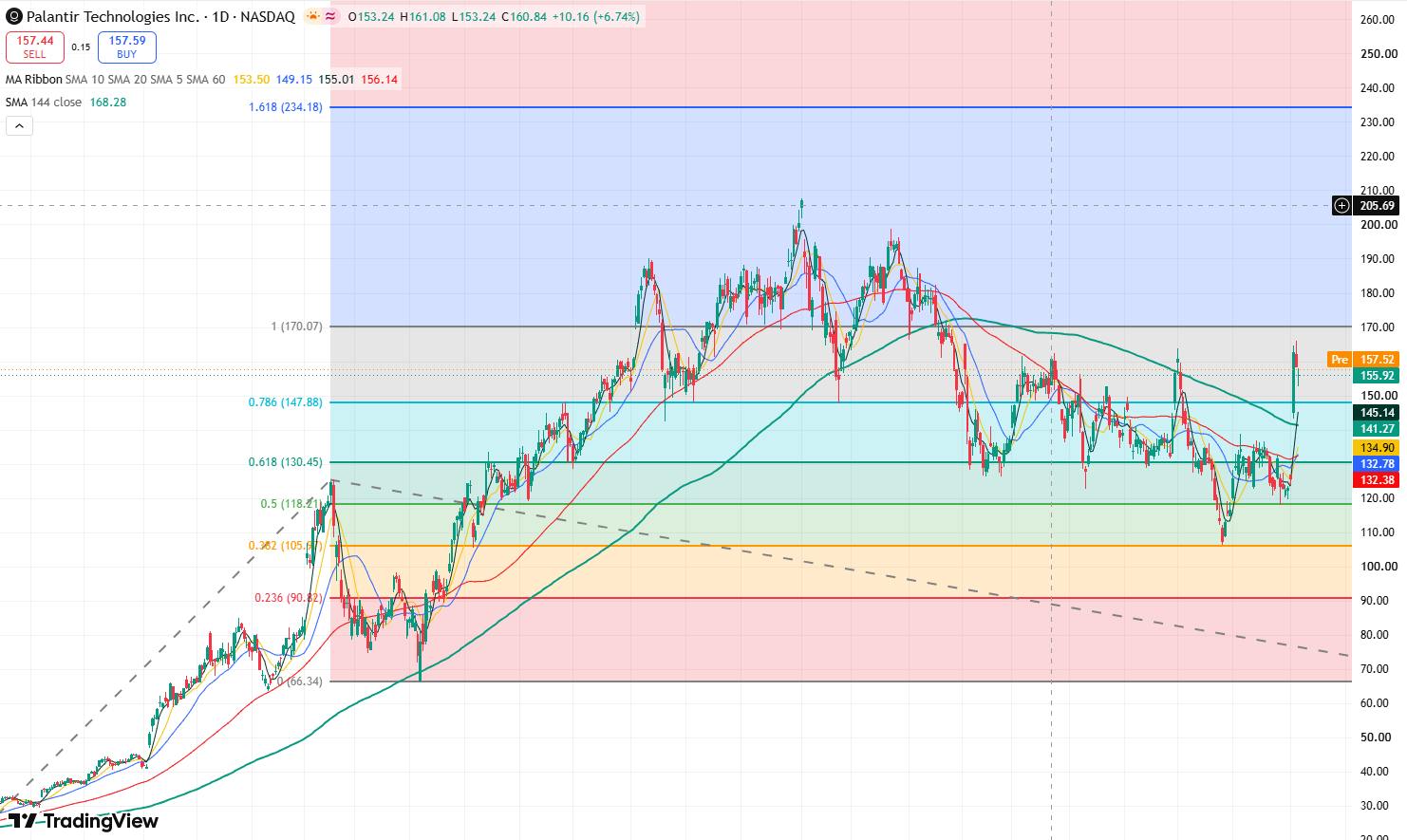
PLTR daily stock price chart, Source: TradingView
Looking at PLTR's daily stock price chart, the stock surged nearly 30% on Tuesday, driven by better-than-expected earnings. The stock gapped up, breaking above the resistance of the 144-day moving average, which significantly enhanced the market's bullish momentum.
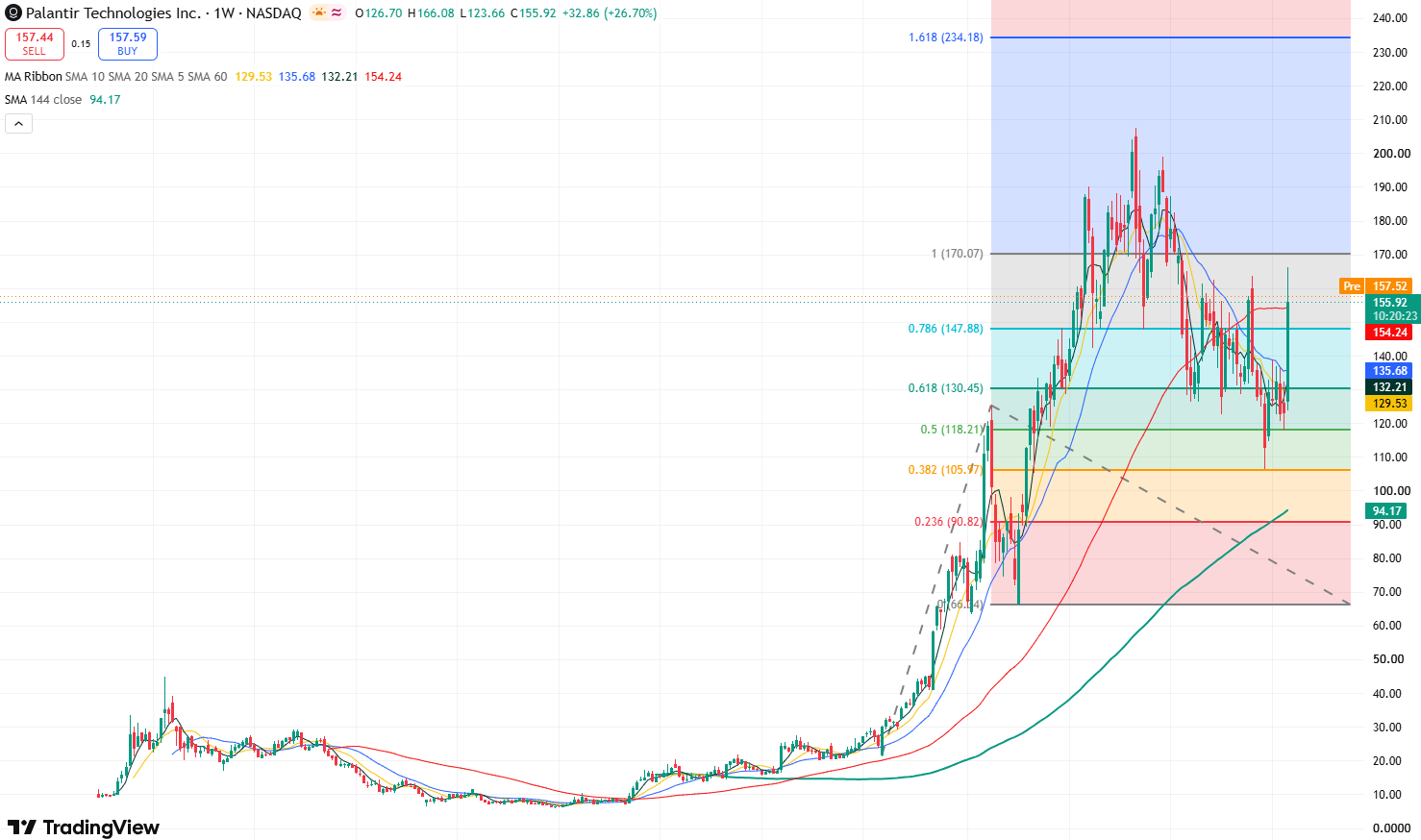
PLTR weekly stock price chart, Source: TradingView
Looking at PLTR's weekly stock price chart, the stock broke through the resistance of the 60-week moving average, further boosting bullish momentum. The primary resistance level to watch on the upside is $170. If it breaks above this level, upside room toward the $200 mark will open up, with a potential to test the Fibonacci 1.618 extension level at $234.
On the downside, if the stock price comes under pressure and pulls back below $170, it may test the $130 support level in the short term, and further down, it could drop toward the $120 support level.
Recommended Articles


