




Advanced Micro Devices vs. Sandisk: Comparing the Latest Quarterly Revenue Trends as AI Demand Spikes Sales
Key Points
When reviewing the most recently reported historical data, Sandisk currently displays a steeper upward trajectory in overall reported revenue compared to Advanced Micro Devices.
Both Advanced Micro Devices and Sandisk posted positive quarter-over-quarter revenue increases for most of the last eight reported periods, although the two companies experienced different degrees of sequential expansion across the observed timeline.
Individual investors analyzing these ongoing financial trends should carefully watch whether the total revenue gap between the two companies continues to narrow or begins to widen in upcoming consecutive quarters.
- 10 stocks we like better than Advanced Micro Devices ›
The AI explosion is presenting exciting opportunities for companies that previously may have been considered tier two players in their sectors. Advanced Micro Devices (NASDAQ:AMD) is a huge business that took in more than $34 billion in revenue in its fiscal 2025. Sandisk is smaller in terms of sales, but it is also fast growing. In its last full fiscal year, 2025, it gathered up more than $20 billion in revenue.
Meanwhile, the share price of Sandisk (NASDAQ:SNDK) has far outperformed AMD’s, even as the latter has nearly tripled over the past 12 months. Sandisk has gained a whopping 2,900% return in its share price. Investors are well-served ot examine what revenue trends may be underpinning such explosive stock growth
Advanced Micro Devices: Steady Sequential Revenue Gains Over the Past Year
Advanced Micro Devices primarily generates revenue by designing and selling microprocessors and graphics processing units.
It launched new customized processing units and secured additional data center capacity agreements in July 2026, while also publishing several routine security mitigations throughout the active spring season and reporting an approximately 14% net income margin for the quarter ended March 28, 2026.
Sandisk: A Rapid Upward Trajectory in Top-Line Revenue Over Recent Quarters
Sandisk earns revenue by designing and manufacturing advanced flash memory storage solutions and solid-state drives.
It released a new technical specification for open-standard hardware and began sampling new generations of memory components in August 2026 without reporting any major adverse operational events, and posted about a 77% net income margin for the quarter ended July 3, 2026.
Why Tracking Top-Line Revenue Matters for Everyday Individual Investors in the Modern Stock Market
Revenue here refers to the data provider's standardized income-statement revenue line item, and tracking this essential financial metric helps everyday individuals understand whether a specific business is successfully expanding its overall volume of generated sales over time before accounting for any subsequent operational expenses, corporate taxes, debt obligations, or baseline manufacturing costs required to keep the enterprise functioning smoothly.
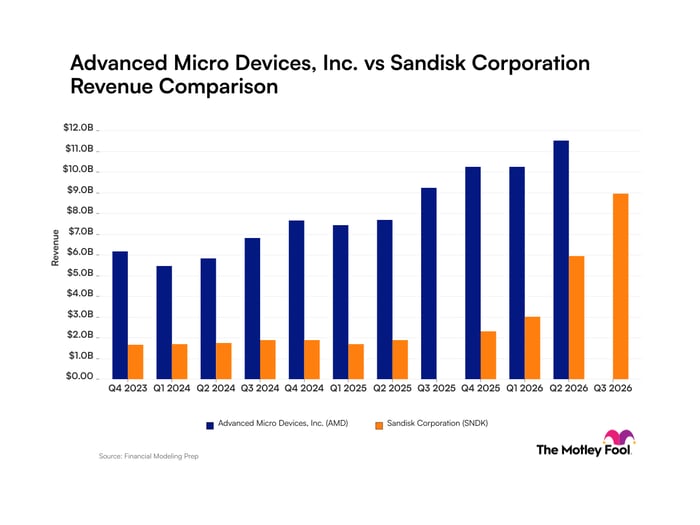
Comparing Quarterly Revenue Data for Advanced Micro Devices and Sandisk Over Eight Periods
| Quarter (Period End) | Advanced Micro Devices Revenue | Sandisk Revenue |
|---|---|---|
| Q4 2024 | $7.7 billion (period ended Dec. 2024) | $1.9 billion (period ended Dec. 2024) |
| Q1 2025 | $7.4 billion (period ended March 2025) | $1.7 billion (period ended March 2025) |
| Q2 2025 | $7.7 billion (period ended June 2025) | $1.9 billion (period ended June 2025) |
| Q3 2025 | $9.2 billion (period ended Sept. 2025) | $2.3 billion (period ended Oct. 2025) |
| Q4 2025 | $10.3 billion (period ended Dec. 2025) | $3.0 billion (period ended Jan. 2026) |
| Q1 2026 | $10.3 billion (period ended March 2026) | $6.0 billion (period ended April 2026) |
| Q2 2026 | $11.5 billion (period ended June 2026) | $9.0 billion (period ended July 2026) |
| Q3 2026 | Not yet reported | Not yet reported |
Data source: Company filings.
Foolish Take
For many years, AMD was seen as a second-tier imitator of chips from Intel Corp (NASDAQ:INTC), but the business has found its identity as a major chip supplier by innovating and overcoming chip design flaws at the turn of the century.
In particular, AMD is a supplier to AI data centers, which seem to have an endlessly voracious demand for silicon. As the chart shows, this has led to sequential gains in every quarter of AMD’s fiscal 2025. Often, seasonality is evident in company revenue due to the typical timing of customer orders. As its growing quarterly revenue shows, there is no seasonality for AI demand, at least not yet. The first two quarters of 2026 show AMD is well on its way to a blockbuster year of sales, which Wall Street sees coming in at nearly $51 billion.
Sandisk is also been a huge beneficiary of the AI explosion. The company had been a respected but essentially niche player in flash memory, like the cards that go into digital cameras. But it has revived itself with an increasing focus on more sophisticated memory products for large customers, such as hyperscalers, and cloud. The high demand for premium products has also meant that Sandisk has been able to charge more for its run-of-the-mill memory products, given tight memory supply throughout the tech supply chain. The recent quarterly sales figures show explosive growth in memory product production and a reason for the remarkably strong share performance.
Data source: Company filings. Data as of Aug. 6, 2026.
Should you buy stock in Advanced Micro Devices right now?
Before you buy stock in Advanced Micro Devices, consider this:
The Motley Fool Stock Advisor analyst team just identified what they believe are the 10 best stocks for investors to buy now… and Advanced Micro Devices wasn’t one of them. The 10 stocks that made the cut could produce monster returns in the coming years.
Consider when Netflix made this list on December 17, 2004... if you invested $1,000 at the time of our recommendation, you’d have $400,155!* Or when Nvidia made this list on April 15, 2005... if you invested $1,000 at the time of our recommendation, you’d have $1,345,502!*
Now, it’s worth noting Stock Advisor’s total average return is 956% — a market-crushing outperformance compared to 214% for the S&P 500. Don't miss the latest top 10 list, available with Stock Advisor, and join an investing community built by individual investors for individual investors.
See the 10 stocks »
*Stock Advisor returns as of August 6, 2026.
Brendan Coffey has no position in any of the stocks mentioned. The Motley Fool has positions in and recommends Advanced Micro Devices and Intel. The Motley Fool has a disclosure policy.
Recommended Articles


