




OpenAI Asks Court to Dismiss Apple Lawsuit, Calling Allegations ‘Baseless’
TradingKey - On August 5, Eastern Time, OpenAI filed a motion in federal court to dismiss Apple ( AAPL )'s trade secret theft lawsuit, calling Apple's allegations "baseless." OpenAI's lawyers stated in court filings that OpenAI "did not use, nor did it need to access, any of Apple's trade secrets."
Apple previously sued OpenAI on July 10, accusing it of stealing hardware secrets through systematic poaching of Apple employees to accelerate its entry into the consumer hardware sector. Apple claimed that more than 400 former Apple employees have worked at OpenAI since 2021, covering key areas such as product design, hardware R&D, and supply chain management.
The complaint listed two specific conducts:
First, OpenAI's Chief Hardware Officer Tang Yew Tan (who had served at Apple for over 24 years) allegedly requested candidates to discuss unreleased products and even bring actual hardware to interviews for "demonstrations and explanations";
Second, former Apple engineer Chang Liu allegedly used an authentication vulnerability to access Apple's internal network after resigning, downloading dozens of confidential files, including technical specifications and engineering presentations for unreleased products.
On August 3, OpenAI published a public post on its official website "Apple is getting this wrong" , refuting Apple's allegations one by one and releasing relevant emails and chat records as counter-evidence.
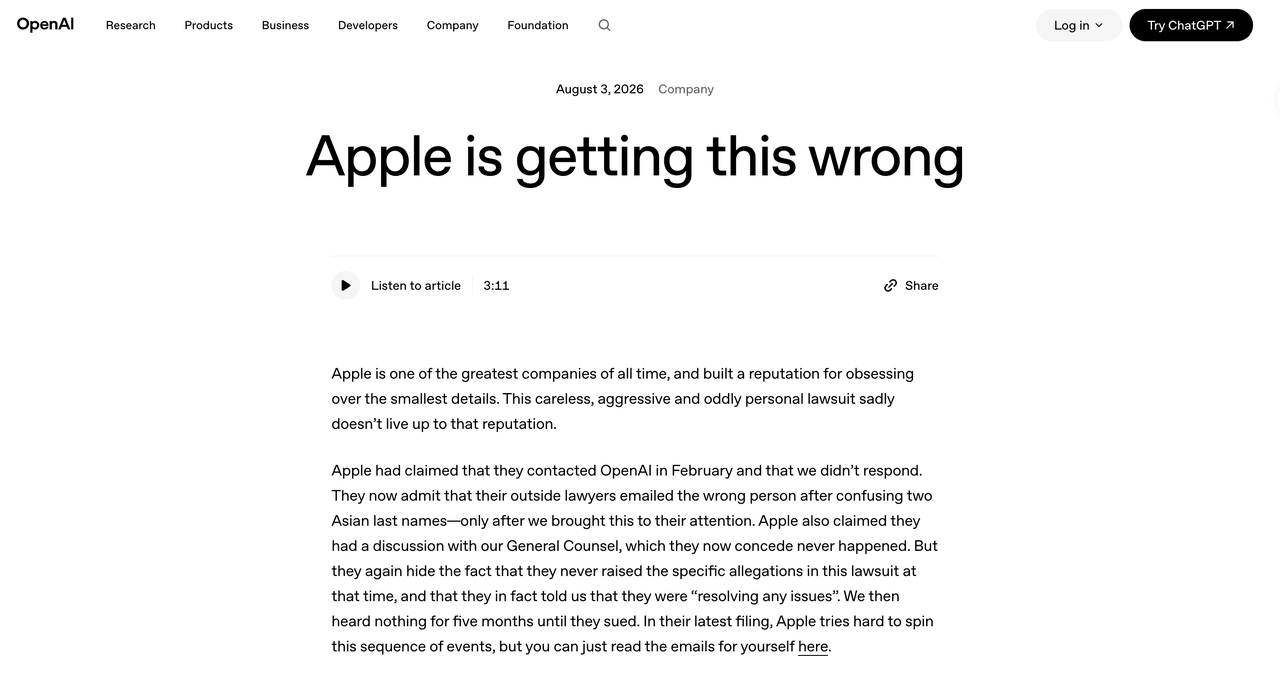
[Source: OpenAI Official Website]
Regarding the accusation of theft against former engineer Chang Liu, OpenAI disclosed key chat records in its rebuttal. The logs show that it was actually a current Apple employee who initiated contact with Chang Liu to ask for help locating files, rather than Chang Liu actively stealing them. Furthermore, upon his departure, Chang Liu had proactively suggested that former colleagues remain connected to the relevant account for handover purposes, and he did not actively access any confidential documents himself.
Based on this, OpenAI pointed out that Apple's internal IT permission management has serious security vulnerabilities, leaving residual access rights for employees even after departure, and emphasized that Chang Liu "did not even know these files existed," making it impossible for those files to be used in OpenAI's R&D.
In addition, regarding the allegations against Tang Yew Tan, OpenAI stated that Tang "always made it clear that he did not want and could not use any confidential information from other companies."
According to OpenAI's disclosure, Apple claimed to have proactively reached out in February but received no response. This situation arose because Apple's outside counsel misspelled the surname of an Asian employee when sending the letter, causing it to go undelivered. After OpenAI pointed this out, the other party admitted the operational error. However, Apple made no further contact over the following five months until recently filing a lawsuit directly against OpenAI.
In this motion to dismiss, OpenAI argued that its hardware products are fundamentally different in design and purpose from Apple's consumer electronics, and that Apple's request for an injunction is "based on false information and unnecessary."
Under the U.S. Defend Trade Secrets Act, the burden of proof for such lawsuits is high, requiring the plaintiff to prove that the defendant actually obtained and used specific confidential information with clear economic value.
Currently, Apple has applied for a preliminary injunction, requesting the court to bar OpenAI from using its alleged trade secrets and to allow forensic examination of OpenAI's devices. Meanwhile, Apple stated in subsequent investigations that it has discovered another 11 former Apple employees who might be involved in similar conduct.
According to the court schedule, Apple must submit a written response to OpenAI's motion to dismiss by August 19, 2026. Related hearings are scheduled to be held in San Jose federal court on October 1, 2026.
Recommended Articles


