




Alphabet, Microsoft, Amazon, and Oracle Just Gained $1.9 Trillion in 3 Days. Here's Why Microsoft's Run Isn't Over.
Key Points
Recent earnings reports alleviated investors’ concerns about cloud demand and AI spending.
Microsoft has the best free cash flow and operating margins of the cloud majors.
Even after its latest run-up, Microsoft is still an impeccable value.
- 10 stocks we like better than Microsoft ›
Alphabet (NASDAQ: GOOG) (NASDAQ: GOOGL) reported earnings on July 22. The next day, the stock closed down 7.1% in response to higher capital expenditure (capex) guidance and fears of margin compression and lower free cash flow (FCF). As of the July 23 market close, cloud computing giants Alphabet, Microsoft (NASDAQ: MSFT), Amazon (NASDAQ: AMZN), and Oracle (NYSE: ORCL) were all badly underperforming the major indexes year to date, with Alphabet and Amazon up a little over 1%, Microsoft down 21.1%, and Oracle down 38.4%.
A lot has changed since. As of market close on Aug. 3, Amazon is now up 23% year to date, Alphabet is up 19.3%, Microsoft has recovered all of its losses and is up 0.8%, and Oracle is clawing back with a 27.2% year-to-date decline.
Missed Nvidia in 2009? This Rare Signal Is Flashing Again. In 2009, a "Double Down" signal flashed for a little-known chipmaker called Nvidia. For the first time in years, that same "Total Conviction" signal is flashing for a company 1/100th the size of Nvidia. Continue »
Here's why investor sentiment has shifted, and why Microsoft is the best cloud stock to buy in August.

Image source: Getty Images.
Justifying record capex
In just three market sessions, from July 29 close to Aug. 3 close, these four cloud computing giants gained a combined mind-numbing $1.857 trillion in market cap -- which is like creating a company as valuable as Broadcom out of thin air.
Microsoft added a staggering $720 billion -- even more than Amazon.
|
Company |
July 29 Market Cap |
Aug. 3 Market Cap |
Gain Over 3 Sessions |
|---|---|---|---|
|
Alphabet |
$4.118 trillion |
$4.568 trillion |
10.9% |
|
Microsoft |
$2.901 trillion |
$3.621 trillion |
24.8% |
|
Amazon |
$2.444 trillion |
$3.062 trillion |
25.3% |
|
Oracle |
$339.1 billion |
$408.41 billion |
20.4% |
Data source: YCharts.
The glass-half-empty outlook on Microsoft, and to a similar extent Oracle, is that artificial intelligence (AI) is disrupting legacy software tools and that their cloud computing spending will take a while to pay off, thereby taking a sledgehammer to FCF in the near term. Oracle is an extreme example of betting big on cloud. Spending on its database build-out far exceeds cash flows from the database and data management software segments. So, in addition to being FCF negative, Oracle has taken on considerable debt.
In comparison, Alphabet, Microsoft, and Amazon were initially able to absorb higher spending in the earlier stages of the AI data center build-out. But they have continued to increase their capex spending and guidance quarter after quarter. So investors got spooked when Alphabet raised its full-year capex guidance to a new range of $195 billion to $205 billion, rivaling Amazon's. This is especially unusual considering that Alphabet's quarterly FCF turned negative for the first time in over a decade.
Amazon and Microsoft's earnings reports the following week eased investor concerns and sparked a broader rally across the cloud computing titans. Amazon reported $8.82 billion in negative quarterly FCF -- even more cash burn than Alphabet. It also provided details on the sheer profitability of the cloud business model and how initial upfront costs are well worth it, given the long useful life of data centers and the cost savings from Amazon's custom AI chips and networking. Amazon Web Services (AWS) achieved its fastest growth in 18 quarters, proving that demand isn't slowing down. Long-term contracts provide a clear roadmap for generating a return on AI infrastructure spending.
Amazon's results and management commentary on the earnings call helped restore investor confidence in AI-driven cloud demand, and sent a clear message that temporary negative FCF is simply the price of unlocking long-term gains from this paradigm-shifting opportunity in cloud computing.
Microsoft is a well-rounded cash cow
Even after its massive gain, Microsoft remains the best buy of the four cloud computing giants. Like Amazon, Microsoft reported excellent growth, including an 18% year-over-year increase in overall revenue and 27% increase in Microsoft Cloud revenue. Despite rising expenses, Microsoft still achieved ultra-high gross margins of 67% and a 45% operating margin. It also generated $19.6 billion in FCF, which was down 23% year over year due to higher capex. That was still plenty to cover $6.8 billion in dividends and $3.4 billion in stock buybacks.
As it did last quarter, Microsoft also noted that roughly two-thirds of capex is going to short-lived assets -- primarily central processing units and graphics processing units -- to support Azure demand and replace outdated equipment.
Microsoft isn't burning through cash as quickly as its cloud computing peers, and its margins are higher thanks to strong cloud growth and consistent results from its productivity and business processes segment.
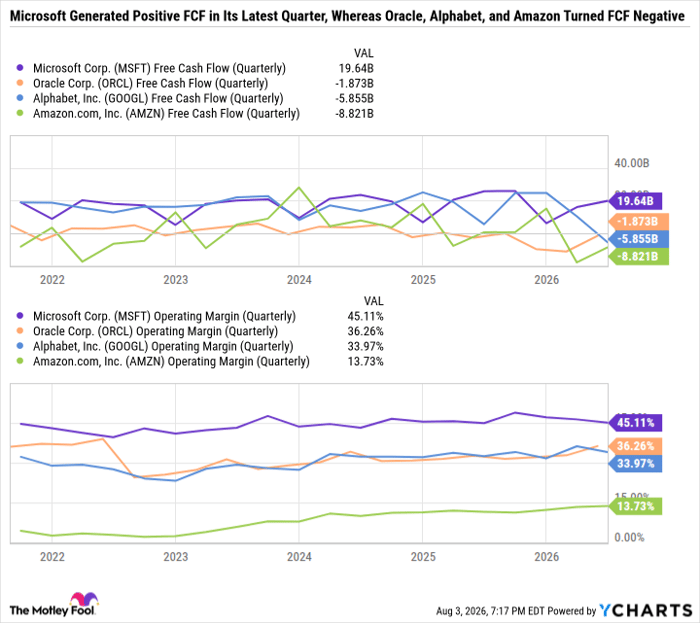
Data by YCharts.
Microsoft also provided upbeat guidance for fiscal year 2027, which began July 1, 2026. It expects double-digit revenue and operating income growth that will outpace mid- to high-single-digit growth in operating expenses. It also expects to remain FCF-positive despite higher capex and to see operating margins fall by less than one percentage point.
Microsoft has plenty of room to run
Microsoft is growing at a breakneck rate. That growth is sustainable because it has protected its margins and FCF, and the stock isn't overpriced. Microsoft trades at 24.9 times forward earnings estimates, compared to 21.2 for the S&P 500 (SNPINDEX: ^GSPC). That's a reasonable premium, considering the quality of Microsoft's business and that the stock just gained 24.8% in three trading sessions.
There are good arguments for why Alphabet, Amazon, Microsoft, and Oracle are strong buys now. However, Microsoft is uniquely positioned to invest aggressively in AI without derailing its balance sheet or fundamentals -- making it arguably the most balanced buy for investors looking to load up on a top tech stock in August.
Should you buy stock in Microsoft right now?
Before you buy stock in Microsoft, consider this:
The Motley Fool Stock Advisor analyst team just identified what they believe are the 10 best stocks for investors to buy now… and Microsoft wasn’t one of them. The 10 stocks that made the cut could produce monster returns in the coming years.
Consider when Netflix made this list on December 17, 2004... if you invested $1,000 at the time of our recommendation, you’d have $396,758!* Or when Nvidia made this list on April 15, 2005... if you invested $1,000 at the time of our recommendation, you’d have $1,300,820!*
Now, it’s worth noting Stock Advisor’s total average return is 939% — a market-crushing outperformance compared to 211% for the S&P 500. Don't miss the latest top 10 list, available with Stock Advisor, and join an investing community built by individual investors for individual investors.
See the 10 stocks »
*Stock Advisor returns as of August 5, 2026.
Daniel Foelber has positions in Broadcom and Oracle and has the following options: long September 2028 $100 calls on Oracle. The Motley Fool has positions in and recommends Alphabet, Amazon, Broadcom, Microsoft, and Oracle. The Motley Fool has a disclosure policy.
Recommended Articles


