




SanDisk Stock Price Forecast: Could Upcoming FY2026 Q4 Earnings Boost Shares to $1,700?
TradingKey - On August 5, Eastern Time, SanDisk ( SNDK) is set to release its fourth-quarter and full-year fiscal 2026 financial results after the market close. The market will use this to gauge whether the growth cycle, driven by AI data center investments, rising NAND prices, and supply tightness, can continue.
The current market focus lies on the evolution of AI inference storage architecture and the company's fiscal 2027 guidance. Amid Wall Street's generally aggressive guidance, post-earnings volatility risks still warrant caution. Currently, Wall Street expects SanDisk's adjusted earnings per share to be $34.80, slightly above the company's guidance. However, beyond the earnings data itself, more attention needs to be paid to AI memory demand, NAND pricing, and guidance.
The most important long-term catalyst for SanDisk is the rapid expansion of AI inference workloads. In its Q3 earnings report, the company projected that inference, inference models, agentic AI, key-value (KV) caching, and RAG applications will require significantly more high-performance NAND storage. As hyperscalers build out AI infrastructure, enterprise SSD demand is expected to remain a primary growth driver for years to come.
Evercore analyst Amit Daryanani believes that SanDisk's five New Business Model (NBM) agreements enhance the company's long-term revenue visibility. He estimates these deals will generate approximately $62 billion in committed revenue over the coming years, including more than $11 billion in customer guarantees and prepayments.
On the other hand, NAND pricing remains the biggest factor affecting SanDisk's profitability. Higher NAND prices boost the company's margins and earnings, while declining prices put pressure on financial performance.
The company's New Business Model (NBM) is expected to reduce the historical cyclicality of the NAND industry. These multi-year agreements offer a combination of committed demand, supply assurance, financial guarantees, and fixed and variable pricing, giving SanDisk higher revenue visibility, pricing stability, and more sustainable margins. The company expects the share of its contract business to increase over time.
Daryanani believes that investors are underestimating SanDisk's long-term earnings and free cash flow potential. He expects NAND pricing to remain favorable as demand continues to outstrip supply in 2026 and 2027.
It is worth noting that even if the current quarter's results are stellar, the stock could still face downward pressure if management provides conservative guidance for fiscal 2027, or fails to clearly articulate the actual effectiveness of long-term supply agreements under its 'New Business Model' (NBM) in smoothing out industry cyclicality.
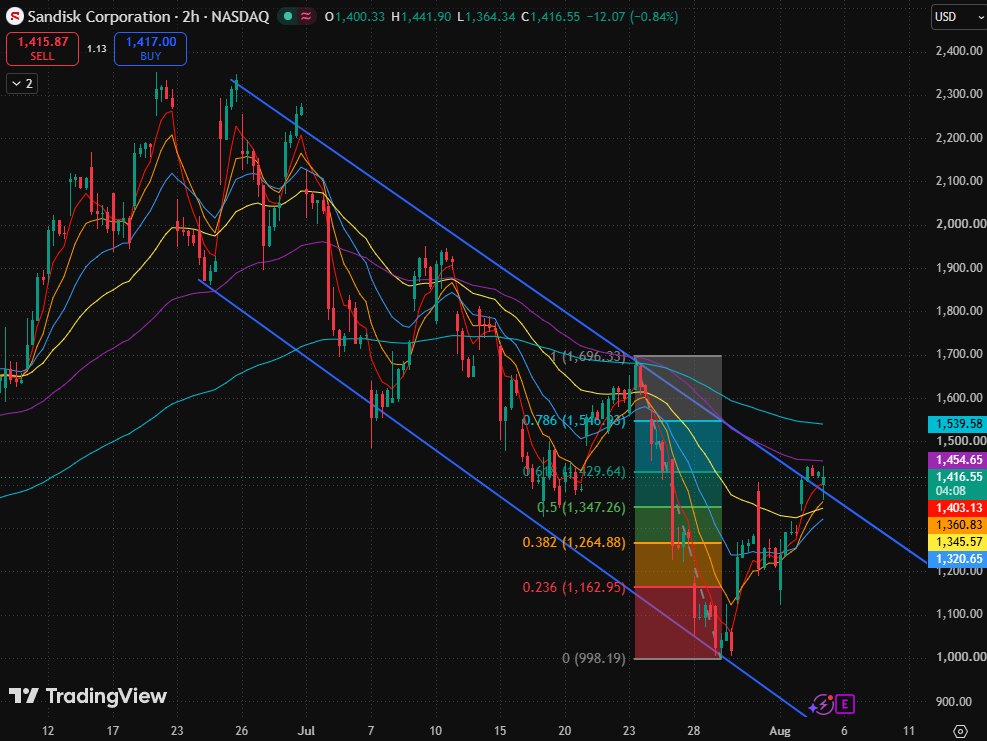
SanDisk 2-Hour Stock Chart, Source: TradingView
Looking at SanDisk's stock chart, the price has staged a rapid recovery from its recent low of $998.19, reclaiming several short-term moving averages and heading toward the upper bound of the descending channel. Near-term rebound momentum is strong, but the price is currently in a dual resistance zone of the 0.618 Fibonacci retracement level ($1,429.64) and the upper boundary of the channel, making the current stage a critical validation window for the transition from a 'rebound to trend recovery'.
In terms of moving averages, short-term averages have clearly sloped upward, and the price has returned above the moving average cluster of around $1,360–$1,415, indicating improved buying support at lower levels and a stronger rebound trend. However, longer-term moving averages remain concentrated around $1,454.65–$1,539.58, indicating that overhead resistance from trapped buyers has not been fully digested; furthermore, the upper bound of the descending channel has not been decisively broken, so a medium-term trend reversal cannot be confirmed solely based on the magnitude of the rebound.
The primary overhead resistance is located at $1,429.64. If the price breaks above this level and holds, while also effectively breaking through the upper bound of the descending channel, the rebound is expected to extend further toward the 0.786 retracement level at $1,546.73, with a potential return to the previous high near $1,700.
On the downside, near-term support is first seen at the short-term moving averages near $1,415, and further down at the support zone of $1,360.83–$1,347.26. If this zone holds, the foundation for the current recovery remains in place. However, a break below $1,347.26 would warn of a potential retest of $1,264.88.
Recommended Articles


