




12 Words From Amazon CEO Andy Jassy That Should Have Artificial Intelligence (AI) Investors Cheering
Key Points
During its recent earnings call, Amazon announced that it is raising its 2026 capex budget to $220 billion.
CEO Andy Jassy says the spending is required to build out new data centers and bring more AI capacity online.
In the long run, Jassy expects Amazon's data centers to generate compelling returns despite current pressures.
- 10 stocks we like better than Amazon ›
Amazon's (NASDAQ: AMZN) second-quarter earnings had investors on edge, fixated above all else on the company's capital expenditure (capex) outlook. This figure came in at roughly $220 billion for the full year, a meaningful increase from the previously stated $200 billion. According to management, higher memory costs are driving the surge.
The question hanging over Amazon's financials is whether such heavy spending can still be justified. During the earnings call, Amazon CEO Andy Jassy made some comments that offer a pointed answer.
Missed Nvidia in 2009? This Rare Signal Is Flashing Again. In 2009, a "Double Down" signal flashed for a little-known chipmaker called Nvidia. For the first time in years, that same "Total Conviction" signal is flashing for a company 1/100th the size of Nvidia. Continue »

Amazon CEO Andy Jassy. Image source: Amazon.com.
How are capex and free cash flow related?
Heavy capital spending and free cash flow are linked by a simple accounting equation. Free cash flow equals cash generated from operations minus capital expenditures. When Amazon accelerates investment in data center infrastructure and servers, capex rises and free cash flow compresses.
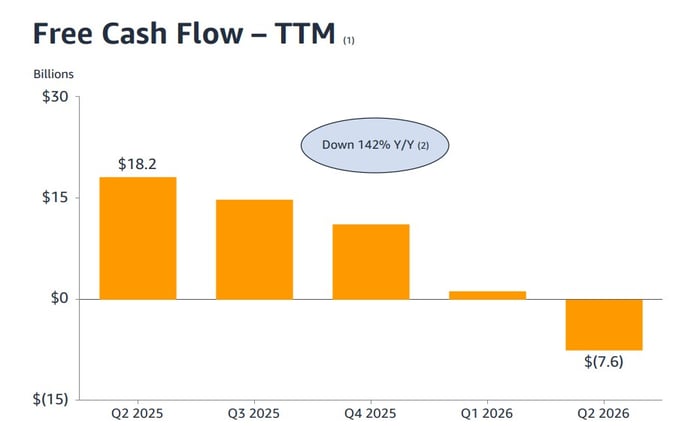
Image source: Investor Relations.
In the trailing 12 months that ended with the second quarter, Amazon's free cash flow swung to an outflow of $7.6 billion. The swing was driven by a $66.1 billion year-over-year increase in property and equipment purchases, the bulk of which was tied to artificial intelligence infrastructure.
The company's core profitability engine, Amazon Web Services (AWS), saw revenue reach $42.2 billion in the quarter, up 37% year over year. Meanwhile, operating income from AWS jumped 64% to $16.6 billion. The contrast here is hard to overlook.
Even though Amazon's largest source of cash flow is running harder than ever, the simultaneous build-out of AI capacity is so large that free cash flow is turning negative. This inverse relationship is not a sign of operational weakness; rather, it is the arithmetic reality of front-loading a multi-year investment whose returns are expected to arrive only after new facilities and servers are brought online and filled with new customer workloads.
Jassy explains the economics of AI data centers
During the earnings call, Jassy spent considerable time explaining why the current surge in infrastructure spending should ultimately pay off. He noted that data centers have useful lives of 30 years or more. Inside each facility, Amazon can cycle through five or six generations of servers. After the first generation, the unit economics improve because the initial capital outlay does not have to be repeated.
In the near term, however, Amazon is building several data centers at the same time -- ahead of the point at which these facilities can generate revenue. The result is elevated capex and pressure on free cash flow until new capacity is monetized and the servers have been utilized for a few years.
Amazon has navigated a similar cycle before, during the first wave of cloud computing. With that said, achieving meaningful profitability took longer, as cloud demand ramped up more gradually than the blistering pace of AI adoption.
Jassy made it clear that even with the revised $220 billion budget, Amazon still does not expect to have enough capacity to satisfy all of its AI demand in 2026. He anticipates the same bottleneck will persist into 2027 as enterprise customers remain early in the process of moving inference workloads into production.
A $1 trillion opportunity awaits
Perhaps the most striking remark of the earnings call came when Jassy updated the long-term ambitions for AWS. Management previously believed Amazon's cloud unit could grow into a business generating a few hundred billion dollars of annual revenue. Management now believes this figure will at least double and that AWS could "very possibly be a trillion-dollar annual revenue business for us in time."
These words matter because it frames the current capital-intensive nature of AI infrastructure not as a speculative bet but as one of necessity for a market of extraordinary scale. It also suggests that AI demand is neither a short-lived spike nor a maturing cycle already approaching saturation.
Instead, Jassy's remark suggests that AI remains in an early phase whose duration is measured in years -- even decades -- rather than quarters. The deliberate phrase "in time" underscores that the trillion-dollar potential of AWS is an ultra-long-horizon thesis rather than a near-term forecast.
This gives patient investors ample opportunity to accumulate Amazon stock while the company continues to invest, grow, and compound. Against this backdrop, Amazon functions less as a momentum trade and more as a blue chip compounder whose competitive position in cloud and AI is being reinforced precisely by the underlying spending that is currently pressuring its cash flow. While the path forward will not be without volatility, the clarity Jassy provided makes a prudent, multi-year accumulation strategy appear well-grounded.
Should you buy stock in Amazon right now?
Before you buy stock in Amazon, consider this:
The Motley Fool Stock Advisor analyst team just identified what they believe are the 10 best stocks for investors to buy now… and Amazon wasn’t one of them. The 10 stocks that made the cut could produce monster returns in the coming years.
Consider when Netflix made this list on December 17, 2004... if you invested $1,000 at the time of our recommendation, you’d have $396,758!* Or when Nvidia made this list on April 15, 2005... if you invested $1,000 at the time of our recommendation, you’d have $1,300,820!*
Now, it’s worth noting Stock Advisor’s total average return is 939% — a market-crushing outperformance compared to 211% for the S&P 500. Don't miss the latest top 10 list, available with Stock Advisor, and join an investing community built by individual investors for individual investors.
See the 10 stocks »
*Stock Advisor returns as of August 5, 2026.
Adam Spatacco has positions in Amazon. The Motley Fool has positions in and recommends Amazon. The Motley Fool has a disclosure policy.
Recommended Articles


