




Andy Jassy Just Delivered Incredible News for Amazon Stock Investors
Key Points
Amazon has a dominant positions in industries like e-commerce, cloud computing, digital advertising, streaming, and more.
CEO Andy Jassy recently made a comment about the Amazon Web Services (AWS) cloud platform that should excite every shareholder.
Amazon stock just soared to a record high, but it's still relatively inexpensive.
- 10 stocks we like better than Amazon ›
Amazon (NASDAQ: AMZN) stock returned nothing during the first seven months of 2026. But it has risen by 25% to a fresh record high since July 30, when the company reported its second-quarter operating results.
Amazon had a great quarter across the board, with its e-commerce, cloud computing, and digital advertising businesses producing accelerating revenue growth. But while discussing these results during his conference call with investors, Chief Executive Officer Andy Jassy made one particular comment about the company's cloud business that whipped Wall Street into a frenzy.
Missed Nvidia in 2009? This Rare Signal Is Flashing Again. In 2009, a "Double Down" signal flashed for a little-known chipmaker called Nvidia. For the first time in years, that same "Total Conviction" signal is flashing for a company 1/100th the size of Nvidia. Continue »
Here's what he said and why it could spark a sustained rally in Amazon stock.
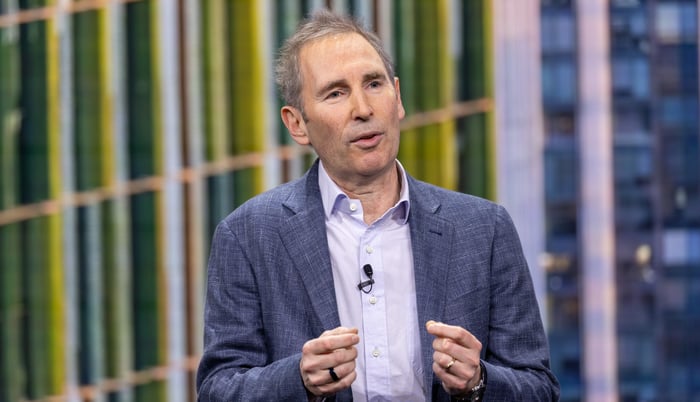
Amazon CEO Andy Jassy. Image source: Amazon.com.
Amazon Web Services could become a trillion-dollar business
Amazon Web Services (AWS) is Amazon's industry-leading cloud computing platform. It offers hundreds of services to help businesses thrive in the digital age, but its expanding portfolio of artificial intelligence (AI) tools is the main driver of the recent acceleration in its revenue growth.
AWS operates data centers worldwide that house thousands of chips and components specifically designed to process AI workloads. Many of these chips come from suppliers like Nvidia, but Amazon also designed its own, including Trainium2, which delivers up to 30% better price-performance than the competition. Trainium3, which recently started shipping, improves price performance by another 30% to 40%.
Every AI developer wants the fastest processing speeds at the lowest price, which is why Amazon's chip business now has $25 billion in annualized revenue. But developers also want access to a library of ready-made models from leading labs like Anthropic to accelerate their AI software projects, and AWS Bedrock offers more than 100 of them.
To further speed up development, programmers are leaning on AI coding assistants like Anthropic's Claude Code. But AWS now offers its own alternative, Kiro, which is 50% more cost-effective than the competition, so usage unsurprisingly tripled sequentially during the second quarter.
All of this led to $42.2 billion in AWS revenue during the second quarter, a 37% increase from the same quarter last year. That growth rate accelerated for the fourth consecutive period, highlighting the platform's incredible momentum.

But it could get better because AWS ended the second quarter with a staggering $496 billion order backlog from customers waiting for more data center capacity to come online. That figure grew in the triple-percentage digits year over year, suggesting the platform's revenue growth could accelerate.
In the past, Jassy predicted AWS would eventually generate a few hundred billion dollars in annual revenue. But he now thinks it could bring in $1 trillion per year in the future, implying substantial potential growth.
Should investors buy Amazon stock today?
Amazon plans to spend an enormous amount of money on building more data centers during the next few years, including $220 billion in 2026 alone, to convert its enormous order backlog into revenue. The company can't deduct these costs up front because data centers have a useful life of several years so that it will depreciate them over time instead. That means the money it spends this year could affect earnings in 2027, 2028, 2029, and beyond.
That won't be a problem if Amazon generates a return on all of that spending in the form of soaring AWS revenue. But earnings drive stock prices and any missteps could lead to sluggish (or negative) returns for investors.
Amazon delivered earnings of $12.44 per share during the last four quarters, placing its stock at a price-to-earnings (P/E) ratio of about 22. The Nasdaq-100 has a P/E ratio of 32.7, so Amazon might be undervalued compared to a basket of its big-tech peers.
But there is a caveat. During the first half of 2026, just over $69 billion of Amazon's $120.7 billion in pretax profit came from paper gains on its investment in Anthropic, which is unrelated to the company's operations. Wall Street analysts actually expect Amazon's earnings to decline in 2027 because they don't think Anthropic will continue to increase in value at the same pace.
Therefore, Amazon looks more expensive (though still attractive) on a forward basis, with a P/E of 27.7.
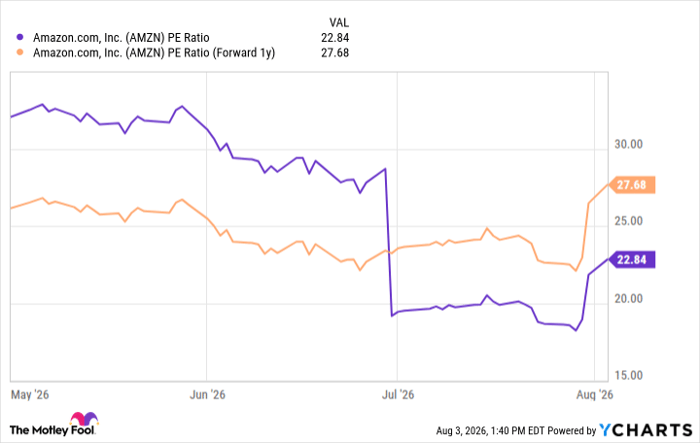
AMZN PE Ratio data by YCharts
With all that said, given AWS's blistering growth and the trillion-dollar opportunity ahead, I think Amazon stock could be a great long-term addition to any portfolio.
Should you buy stock in Amazon right now?
Before you buy stock in Amazon, consider this:
The Motley Fool Stock Advisor analyst team just identified what they believe are the 10 best stocks for investors to buy now… and Amazon wasn’t one of them. The 10 stocks that made the cut could produce monster returns in the coming years.
Consider when Netflix made this list on December 17, 2004... if you invested $1,000 at the time of our recommendation, you’d have $395,463!* Or when Nvidia made this list on April 15, 2005... if you invested $1,000 at the time of our recommendation, you’d have $1,268,290!*
Now, it’s worth noting Stock Advisor’s total average return is 927% — a market-crushing outperformance compared to 211% for the S&P 500. Don't miss the latest top 10 list, available with Stock Advisor, and join an investing community built by individual investors for individual investors.
See the 10 stocks »
*Stock Advisor returns as of August 5, 2026.
Anthony Di Pizio has no position in any of the stocks mentioned. The Motley Fool has positions in and recommends Amazon and Nvidia. The Motley Fool has a disclosure policy.
Recommended Articles


