




2 Unstoppable Growth ETFs Worth Buying and Holding Through Every Market Cycle
Key Points
The Nasdaq-100 has produced a stunning annualized return of over 14% since the start of 1995.
The Vanguard Growth ETF (VUG) provides broader exposure than the Invesco Nasdaq 100 ETF (QQQM).
There's a lot of overlap in VUG and QQQM's top holdings, so you may want to pick one or the other.
- 10 stocks we like better than Invesco NASDAQ 100 ETF ›
Growth ETFs are a great way to get exposure to the high return potential of growth stocks while minimizing some of the risks and volatility that tend to come with them. The key, though, is to ensure your growth ETF is set up for sustained success and not riding a temporary wave.
Two growth ETFs you can comfortably hold through thick and thin are the Invesco Nasdaq 100 ETF (NASDAQ: QQQM) and Vanguard Growth ETF (NYSEMKT: VUG). They have both stood the test of time and are positioned to continue doing so.
Where to invest $1,000 right now? Our analyst team just revealed what they believe are the 10 best stocks to buy right now, when you join Stock Advisor. See the stocks »
Image source: Getty Images.
Leaning on the Nasdaq-100
QQQM mirrors the Nasdaq-100 index, which tracks the 100 largest non-financial companies trading on the Nasdaq stock exchange. It only began trading in October 2020, but we can look at the Nasdaq-100's performance to get an idea of how resilient (and lucrative) it has been.
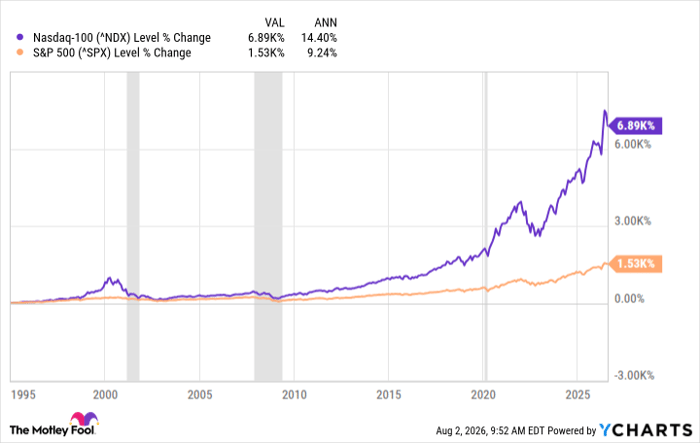
Since the beginning of 1995, the Nasdaq-100 has averaged 14.4% annual returns, outpacing the S&P 500's 9.2% average in that time. Arguably more impressive is that it has done so despite going through three recessions (those resulting from the dot-com bubble, financial crisis, and COVID-19).
^NDX data by YCharts
Growth exposure for very cheap
VUG is broader than QQQM, holding 147 stocks vs. 105, and includes companies from all major sectors. Since it began trading in January 2004, VUG has averaged 10.9% annual returns, outpacing the S&P 500 but underperforming QQQM.
Over those 22 years, VUG has shown consistent performance and weathered plenty of market downturns. It declined by 33% in 2022 and is up nearly 140% since then.
Since VUG isn't limited to companies on the Nasdaq exchange, it provides access to blue chip stocks that have been great for growth over the years. And with an expense ratio of only 0.03%, VUG is one of the cheapest ETFs on the market. That's only $0.30 per $1,000 invested, ensuring you can keep more of your gains to yourself over the years.
Be aware of the overlap between them
If you're investing in both ETFs, be mindful of the stock overlap: 53% of stocks in QQQM are also in VUG, and 37% of stocks in VUG are also in QQQM. The noteworthy overlap, however, is in the top holdings they share. Eight of their top 10 holdings are the same:
| Company | Percentage in QQQM | Percentage in VUG |
|---|---|---|
| Nvidia | 8.05% | 12.60% |
| Apple | 7.51% | 11.64% |
| Microsoft | 5.72% | 7.60% |
| Amazon | 4.84% | 4.46% |
| Alphabet (Class A) | 3.44% | 5.74% |
| Alphabet (Class C) | 3.22% | 4.52% |
| Broadcom | 3.06% | 4.27% |
| Meta Platforms | 2.73% | 3.40% |
Data source: Vanguard and Invesco. QQQM percentages as of July 31; Vanguard percentages as of June 30.
Investing in both means you'd be getting heavy concentration in the same stocks, which can be redundant and detract from some of the benefits of investing in broad ETFs. You can't go wrong with either, but if you want a more concentrated ETF and don't mind a lack of financial stocks, QQQM is a good choice. If you want broader, cheaper growth exposure, VUG is a good choice.
Should you buy stock in Invesco NASDAQ 100 ETF right now?
Before you buy stock in Invesco NASDAQ 100 ETF, consider this:
The Motley Fool Stock Advisor analyst team just identified what they believe are the 10 best stocks for investors to buy now… and Invesco NASDAQ 100 ETF wasn’t one of them. The 10 stocks that made the cut could produce monster returns in the coming years.
Consider when Netflix made this list on December 17, 2004... if you invested $1,000 at the time of our recommendation, you’d have $395,463!* Or when Nvidia made this list on April 15, 2005... if you invested $1,000 at the time of our recommendation, you’d have $1,268,290!*
Now, it’s worth noting Stock Advisor’s total average return is 927% — a market-crushing outperformance compared to 211% for the S&P 500. Don't miss the latest top 10 list, available with Stock Advisor, and join an investing community built by individual investors for individual investors.
See the 10 stocks »
*Stock Advisor returns as of August 4, 2026.
Stefon Walters has positions in Apple and Microsoft. The Motley Fool has positions in and recommends Alphabet, Amazon, Apple, Broadcom, Meta Platforms, Microsoft, Nvidia, and Vanguard Growth ETF. The Motley Fool has a disclosure policy.
Recommended Articles


