




Oracle (ORCL) Stock Forecast: $638B Backlog, Down 28% YTD, Up 9% Today - Is the Recovery Real?
TradingKey - Oracle (NYSE: ORCL) gained 9.22% to close at $141.85 on August 3. This was the best single-day gain for Oracle in months. The catalyst for this gain was a Google Cloud partnership, winning a $400 million HR modernization contract to CACI, expanding Oracle Health to Ontario's hospitals, and the release of Gemini AI to Oracle Fusion and NetSuite. At $141.85 per share, Oracle is up from 52 week low of $114.50 but is still down 28% for the year. Oracle'sCloud Infrastructure Services revenue grew 93% for its most recent quarter.
The Backlog That Defines the Investment Case
The $638 billion in Performance Obligation backlog is record high. Average analyst target price is $265.03. Investors identify Oracle's record $638 billion in Performance Obligation backlog as the primary investment case. This is amplified due to the year on year 363% growth driven by the three primary AI contracts from OpenAI, Meta, and xAI.
Approximately 12% ($76 billion) of this Backlog is expected to convert to revenue in the next 12 months. Taking into account the company’s most recent annual revenue of $67.4 billion, there is strong, contractually committed, customer revenue visibility.
Despite the positive impact the buyout is predicted to have, Morningstar suggests that some execution risk is still present. Oracle is expected to have some difficulties meeting the high demand for Nvidia GPU chips.
Even with the attraction of new customers like OpenAI and xAI, who agreed to use their service over AWS, Azure and Google Cloud, due to the current limitations of GPU supply, it may take some time to fill the backlogs. They projected solid growth for Fiscal Q1 FY 2027, suggesting a revenue increase of 27% to 29% overall, and a cloud growth of 57% to 63%. The projections suggest a positive outlook, but the demand for GPUs may impact future revenues.
What Drove Monday's 9% Surge
Monday's 9.22% increase was a result of the July 30 Google Cloud partnership embedding Gemini AI into Oracle Fusion and NetSuite, at no additional cost for infrastructure; a new $400 million OPM contract with CACI as a complement to the $7 billion defense deal from July; and the contract to supply Ontario hospitals via Oracle Health. The broader market assisted as Microsoft, Amazon and Samsung signaled strong AI infrastructure demand and revalued Oracle's 93% IaaS and record $638 billion backlog growth. Additionally, on August 3, TipRanks issued a new Buy rating, noting that there was renewed optimism for Oracle's AI strategy as a positive outlook.
The Year-to-Date Decline and Why It Happened
Despite services like Oracle’s public cloud IaaS growing by 93% and Oracle’s fiscal year growth rate reaching 47% and $638 billion in revenue protection orders (RPOs), the organization is down 28% year-to-date. This annual decline mirrors what happened to organizations like Alphabet and Micron. During this time, Alphabet core services experienced a growth rate of 24% while the stock declined post-earnings by 15%.
Earnings for Micron grew by 41% and the stock still fell by the same percentage. The drops affecting these organizations are mostly attributed to negative cash flow caused by a surge in capital expenditures, as often seen with companies like Oracle and Meta.
During the company’s highest stock price at $345.72 (52-week high) within the public cloud toward AI infrastructure, the market was lacking confidence in AI infrastructure costs. This combined with the company’s debt financing plans and negative free cash flow created the company’s biggest liabilities. The contracted AI demand for the company is $638 billion.
ORCL Technical Setup
On the daily chart, Oracle rebounding from its swing low at $114.50 and retraced the 23.6% Fibonacci level at $133.74, is now approaching the 38.2% retracement at $145.50 as the next main resistance area. RSI is also bullish above 50.
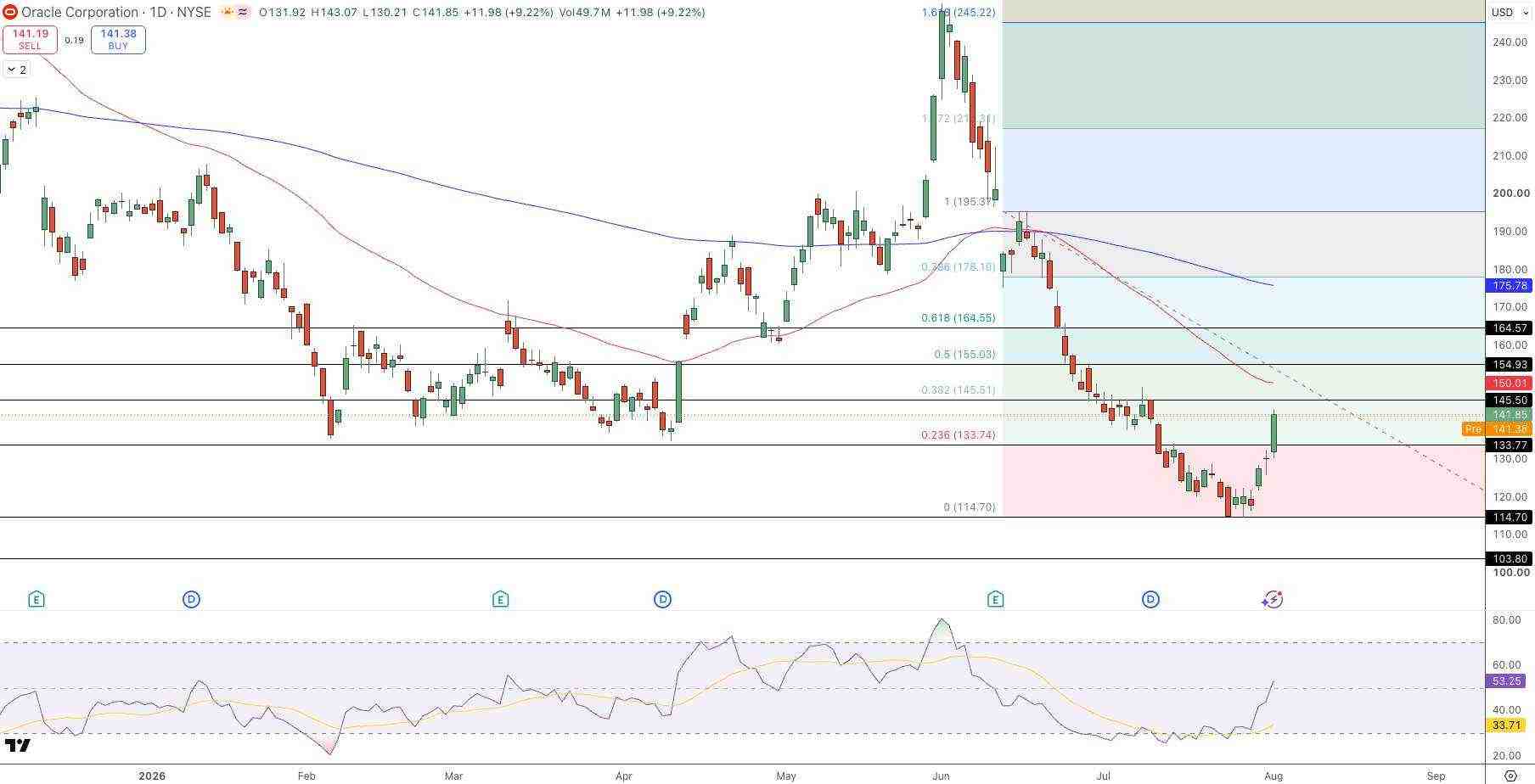
ORCL Price Chart - Source: Tradingview
The first important moving average resistance is located between the 50 day EMA at $150.01, followed by the 100 day EMA at $175.78. $145.50 continues to be a key level to hold above for a potential upside target to the $154.93 and $164.57 levels.
The swing low at $133.74 would be the level to the downside for Oracle, coming in to support the trend, with a bust of lower support at $114.70. After hours trading is coming in at $142.62.
Key Levels
- Close August 3: $141.85 (+9.22%). After-hours: $142.62. 52-week: $114.50 - $345.72
- Overview: Down 28%. Recovered from low of $114.50. Still 59% below 52-week high
- Q4 FY2026 Estimates: Revenue up 21% at $19.2B. IaaS up 93% at $5.8B. Cloud revenue now 52% of total for first time.
- Backlog: $638B RPO (up 363% YoY, +$85B sequential). 12% conversion within 12 months ($76B)
- New Contracts: Google Gemini into Fusion/NetSuite. CACI $400M OPM contract. Ontario Hospitals. $7B defense deal.
- For FY2027 Expectations: $90B total revenue. Cloud up 57-63%. Non-GAAP EPS $8.05
- Analyst Mean: $265.03 at 87% upside from $141.
- Resistance: $145.50 (38.2% Fib), $150.01 (50 EMA), $154.93, $164.57, $175.78 (100 EMA)
- Support: $133.74 (23.6% Fib), $114.50 (swing low)
Why Oracle Is Down 28% YTD Despite a $638B Backlog
Oracle’s stock tripled when it hit $345.72 this past year, which was its record high. Then, AI companies began to become public, driving up the market and fueling the excitement over AI. Investors started to believe AI would replace a lot of core functions of businesses.
But as Alphabet, Meta, and Micron’s stocks started to plummet later on that year, along with the remainder of the market, Oracle’s heavy debt financing along with negative free cash flows became a new investor concern. Topping the $638 billion backlog means very little when the strongest contracts take over a year to become revenue and a measly 12% is projected to convert. Yet that is the biggest concern for investors. The market continues to wait for the company to have real IaaS growth with positive free cash flows while proving it can execute strong contracts and not rely on debt and equity.
OCI and the Google Partnership Explained
Oracle Cloud Infrastructure (OCI) builds services competitively against AWS, Azure, and Google Cloud. OCI focuses specifically on affordable AI training workloads and GPU availability, gaining clients like OpenAI and xAI during capacity issues. With the partnership between Google’s Gemini AI and Oracle Fusion and NetSuite, enterprise users have the opportunity to utilize AI without having to migrate clouds. This partnership earns OCI value, and Oracle is not required to construct its own foundation models. Google truly has the upper hand as their Gemini AI will have access to all of Oracle's clients within their ERP and finance suite.
Bottom Line
Oracle’s 9.22% gain on Monday with a closing price of $141.85 bounces from the $114.50 52 week low toward the $145.50 Fibonacci resistance. The most significant contracted AI demand is shown through the $638 billion RPO backlog in enterprise technology. IaaS grew 93% in fiscal Q4. Guidance for FY2027 predicts a $90 billion revenue target with cloud growth of 57% to 63%. The 28% year-to-date decline is due to an increase in free cash flow and slow backlog conversion, not a loss in demand.
The Google Gemini partnership and the $7 billion defense contract as well as the $400 million CACI contract are the near-term catalysts for the build to September’s earnings. Execution of the backlog cites a $141 average analyst target with estimated gains of 87% from the current price.
Recommended Articles


