




S&P Global Grew Revenue 10% and Still Missed on Earnings. Except, Maybe It Didn't.
Key Points
S&P Global shares fell immediately following the release of its second-quarter earnings on Tuesday.
The prompt for the pullback, however, was an imperfect comparison of Q2's numbers to last year's results.
Although several analysts lowered their price targets on reduced revenue guidance, most remain quite bullish.
- 10 stocks we like better than S&P Global ›
It wasn't exactly the result the market had hoped to see from S&P Global (NYSE: SPGI) this week. Although its second-quarter top line grew 10% to nearly $4.15 billion to top analysts' estimates of $4.11 billion, per-share earnings of $4.12 fell short of most consensus estimates. The financial company also dialed back its sales and profit guidance for the full year.
Investors understandably flinched, dragging the stock down by more than a little bit in response. Yet, there may be some confusion surrounding all the numbers S&P Global dropped on Tuesday. Things aren't nearly as bad as the headlines suggest. Here's why.
Where to invest $1,000 right now? Our analyst team just revealed what they believe are the 10 best stocks to buy right now, when you join Stock Advisor. See the stocks »
The rest of the (somewhat confusing) story
You know S&P Global, although you know it better as Standard & Poor's -- the company that manages and licenses the S&P 500 index, rates bonds, researches stocks, and sells an array of market data and intelligence.

Image source: Getty Images.
There's one thing it doesn't do anymore, though. That's manage an automotive market data business, including Carfax. It spun off this arm on July 1 as a stand-alone company called Mobility Global (NYSE: MBGL).
And this seems to be a source of confusion. S&P Global reported both its pre- and post-spinoff Q2 results, and did so on a GAAP and non-GAAP basis (with the non-GAAP numbers being more representative of the current condition of the company's business).
As its press release adds, "In the second quarter, adjusted operating profit increased 15% [on pro forma revenue growth of 11%] to $1.998 billion, and adjusted diluted EPS increased 23% to $4.83." Apples-to-apples operating margins also improved, from 52.3% in the second quarter of last year to 54.3% this time around.
In other words, S&P Global is not only doing fine without Mobility Global in the picture, but it's actually doing better -- as was intended and expected. Any second-quarter earnings miss is largely due to neither analysts nor investors knowing exactly what the company's income statement was supposed to look like after its mobility business was removed from the mix.
Now that the reset's done, future results should be more aligned with forecasts. To this end, SPGI stock recovered in the latter part of Tuesday's trading session once investors finally started connecting the dots.
More good than bad
It wasn't all great news. Updated guidance suggests revenue will grow somewhere between 5.9% and 7.9% in 2026. That's down from previous guidance of 6.3% to 8.3%, mostly due to slowing growth from its energy markets information platform, which only saw 3% year-over-year revenue growth last quarter.
As CEO Martina Cheung explains, "The Iran conflict has complicated contract renewals among some very large customers, and we have intentionally chosen to be flexible on price increases and other terms for affected customers during such a challenging time."
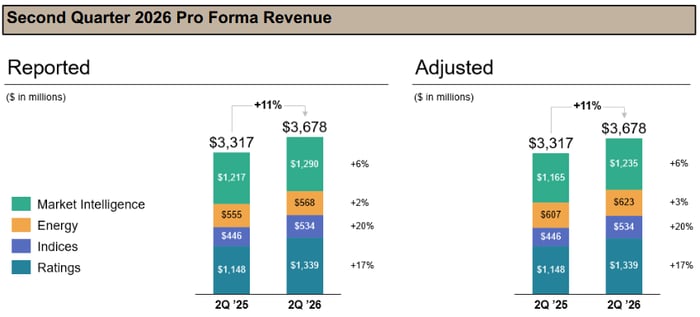
Image source: S&P Global Q2 2026 results report.
Even so, there's still arguably more upside than downside within this stock from here. Analysts think so, anyway. Although some of them lowered their price targets following last quarter's results and updated 2026 guidance, most still rate SPGI as a strong buy, with a consensus target of $ 518.17, nearly 28% above the stock's current price. That's not a bad tailwind to plug into here.
Should you buy stock in S&P Global right now?
Before you buy stock in S&P Global, consider this:
The Motley Fool Stock Advisor analyst team just identified what they believe are the 10 best stocks for investors to buy now… and S&P Global wasn’t one of them. The 10 stocks that made the cut could produce monster returns in the coming years.
Consider when Netflix made this list on December 17, 2004... if you invested $1,000 at the time of our recommendation, you’d have $386,727!* Or when Nvidia made this list on April 15, 2005... if you invested $1,000 at the time of our recommendation, you’d have $1,232,139!*
Now, it’s worth noting Stock Advisor’s total average return is 906% — a market-crushing outperformance compared to 208% for the S&P 500. Don't miss the latest top 10 list, available with Stock Advisor, and join an investing community built by individual investors for individual investors.
See the 10 stocks »
*Stock Advisor returns as of August 3, 2026.
James Brumley has no position in any of the stocks mentioned. The Motley Fool has positions in and recommends Mobility Global and S&P Global. The Motley Fool has a disclosure policy.
Recommended Articles


