




Chevron vs. ExxonMobil: Which Dividend Compounds Better Over the Next 10 Years?
Key Points
ExxonMobil and Chevron are two of the energy sector’s biggest names, as well as two of its top dividend payers.
While both would be fine positions for almost any portfolio, there is one distinct difference worth considering.
The longer you intend to own this income-producing holding, the more this difference matters.
- 10 stocks we like better than Chevron ›
For most busy investors, choosing between ExxonMobil (NYSE: XOM) and Chevron (NYSE: CVX) can feel like there's not much of a difference. Both are major integrated oil names, doing everything from exploring to drilling to refining. And both stocks pay a decent dividend.
As experienced investors can attest, however, given enough time, little differences can have a big cumulative impact.
Missed Nvidia in 2009? This Rare Signal Is Flashing Again. In 2009, a "Double Down" signal flashed for a little-known chipmaker called Nvidia. For the first time in years, that same "Total Conviction" signal is flashing for a company 1/100th the size of Nvidia. Continue »
To this end, anyone considering taking on a long-term stake in either company might want to look very carefully before choosing. That's especially true if you're buying one of them now for the dividend income it will generate in the future.
Comparing and contrasting
The two oil and gas giants really are quite similar in many ways. ExxonMobil is much bigger, producing $30.1 billion in earnings last year versus Chevron's $12.3 billion. Although Chevron technically operates more wells, ExxonMobil manages more massive projects, such as in the Permian basin. But most of both bottom lines ultimately come from these two companies' comparable upstream businesses.
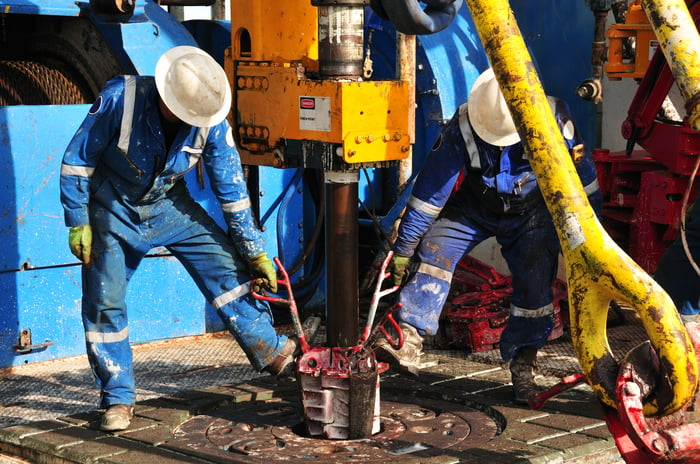
Image source: Getty Images.
By energy stock standards, though, these two organizations are managed differently in ways that most investors might not fully recognize.
As an example, Chevron is rethinking how to effectively and efficiently get its products to end users who need it the most. Whereas at one point it would have simply delivered this natural gas to a utility provider that then resells it to a retail customer, in June the company announced it would be delivering gas directly to a data center site that will in turn be using it to power a natural gas turbine that generates much-needed electricity onsite. It intends to expand this business model, too. Chevron, however, also arguably faces more geopolitical risk. It's got major operations in and around turbulent Venezuela, for instance.
Then there are the differences that are more evident to investors, like Chevron's higher dividend yield, but less generous stock buybacks.
ExxonMobil is measurably different in another way. For instance, it's investing heavily in carbon capture technology. These investments are just starting to be commercialized, putting it into a business that Precedence Research expects to grow at an annual pace of nearly 20% through 2035. Moreover, reducing fossil fuels' carbon emissions prolongs crude oil's marketable lifespan. Meanwhile, the company is generally regarded as being less exposed to geopolitical shock risk, if only because its larger size translates into so much more cash flow. Last year's operating cash flow was a whopping $52 billion, in fact, having grown an average of 10% per year since 2019.
Still, income investors can't help noticing that ExxonMobil's forward-looking dividend yield of only 2.6% is markedly less than Chevron's 3.7%. That's enough of a difference to matter in the long run.
Except there's one more crucial detail to consider here.
Not too complicated of a decision
As the old cliché goes, past performance is no guarantee of future results. It is a pretty good indication of what the future probably holds, however.
To this end, over the course of the past 10 years, ExxonMobil has upped its quarterly per-share payout by 37%, from $0.75 to $1.03. Not bad. It's also raised its annual dividend for 43 consecutive years. Even better.
For investors looking to compound dividend income into net growth, though, Chevron's payments have improved from $1.07 per share 10 years ago to $1.78 now. That's much better growth of 66%. And, at 39 straight years, the company's track record of annual dividend increases is almost as strong as ExxonMobil's. In other words, from a purely mathematical perspective (assuming the past is any indication of what the future holds, which it is), Chevron's likely to be the better compounder, made even better by a yield that's measurably higher than what you'd start with by owning a stake in ExxonMobil.
Oh, there's the qualitative stuff to weigh as well, like Chevron's exposure to geopolitical tensions, and ExxonMobil's preparation for a distant future. If nothing else, the latter has a written plan through 2030 to grow its earnings and improve its cash flow. Even if it's only a plan, it's a plan with a specific goal in mind, which is a powerful direction in and of itself.
On balance, though -- aside from their dividend profiles -- Chevron and ExxonMobil are still more alike than different despite their nuanced differences like their growth initiatives, or even their stocks' respective valuations. Indeed, even their forward-looking P/E ratios are both right around 15, and both companies' dividend payments are supported more than well enough by cash flow.
So don't make this more complicated than it needs to be. Chevron is the better dividend compounder of these two energy names right now. Just be sure to keep an eye on everything else that might affect either company's ability to continue funding their dividend payments as well as fully funding their current growth efforts.
Should you buy stock in Chevron right now?
Before you buy stock in Chevron, consider this:
The Motley Fool Stock Advisor analyst team just identified what they believe are the 10 best stocks for investors to buy now… and Chevron wasn’t one of them. The 10 stocks that made the cut could produce monster returns in the coming years.
Consider when Netflix made this list on December 17, 2004... if you invested $1,000 at the time of our recommendation, you’d have $386,727!* Or when Nvidia made this list on April 15, 2005... if you invested $1,000 at the time of our recommendation, you’d have $1,232,139!*
Now, it’s worth noting Stock Advisor’s total average return is 906% — a market-crushing outperformance compared to 208% for the S&P 500. Don't miss the latest top 10 list, available with Stock Advisor, and join an investing community built by individual investors for individual investors.
See the 10 stocks »
*Stock Advisor returns as of August 3, 2026.
James Brumley has no position in any of the stocks mentioned. The Motley Fool has positions in and recommends Chevron. The Motley Fool has a disclosure policy.
Recommended Articles


