




The Fed Held Interest Rates Steady for a 2nd Straight Meeting Under Kevin Warsh, With 3 Officials Dissenting. Here's What Investors Should Expect Next.
Key Points
The Federal Reserve's latest 9-3 decision was the highest number of dissents in a decade.
Rising oil prices from conflicts in the Middle East will likely show higher inflation when July's report is released.
Federal Reserve chair Kevin Warsh isn't keen on providing future guidance on interest rates.
- These 10 stocks could mint the next wave of millionaires ›
Kevin Warsh took over as chair of the Federal Reserve (Fed) in May, and at the two meetings since, the Fed has kept interest rates steady at 3.5%-3.75%, with the most recent meeting on July 29.
Unlike the first meeting, where the vote was unanimous, the July 29 decision came on a 9-3 vote. It's the most dissent in a decade, and Warsh alluded to the disagreements, saying, "I asked for a good family fight, and I got one."
Missed Nvidia in 2009? This Rare Signal Is Flashing Again. In 2009, a "Double Down" signal flashed for a little-known chipmaker called Nvidia. For the first time in years, that same "Total Conviction" signal is flashing for a company 1/100th the size of Nvidia. Continue »
So, with a divided Fed and more geopolitical uncertainty seemingly every passing day, what should investors expect next? Let's take a look.

Federal Reserve Chair Kevin Warsh. Image source: Federal Reserve.
The connection between interest rates and inflation
Interest rates are typically used to control inflation. When inflation is high, the Fed often raises interest rates, and when inflation is low, it typically lowers interest rates. The thought is that higher interest rates make borrowing more expensive, which cools spending and brings prices down.
This June's CPI-U inflation data showed that inflation had cooled from May (down 0.4%), but it was still up 3.5% from June 2025. Ideally, the Fed would like to keep inflation around 2% to maintain economic stability and promote growth without putting the economy on a path to a recession.
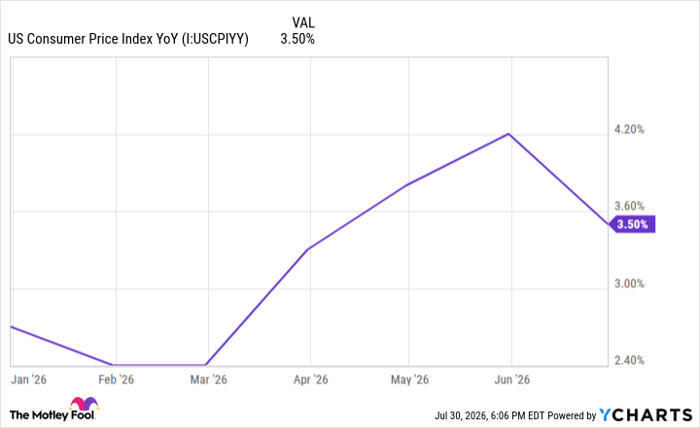
US Consumer Price Index YoY data by YCharts
The thing to watch for now, though, is how escalations in the Middle East -- and their impact on oil prices -- will affect inflation going forward. Gasoline decreased by 9.7% from May to June, fuel oil decreased by 9.2%, and energy as a whole decreased by 5.7%. That won't be the case from June to July.
Crude oil began July around $68.58 per barrel, peaked at $92.19 on July 23, and now sits at just over $84 at the time of writing. Prices have rebounded since June, so there's a good chance we'll see energy inflation (which weighs a lot on total inflation) pick back up.
What should investors expect from the Fed later this year?
One thing Warsh has made clear is that he's not one to provide forward guidance, which is a departure from how former Fed Chair Jerome Powell used to operate. During one of his Senate confirmation hearings, Warsh stated, "I don't believe that I should be previewing for you what a future decision might be," and that's been true so far.
That makes it a bit harder to gauge where the Fed may take interest rates, leading people to make their own projections based on available data.
Inflation is almost certainly going to be up both month to month and year over year, but whether it's enough to increase overall inflation to the point where an interest rate hike is worth it remains to be seen. However, I would lean toward a slight increase at the Fed's September meeting.
Where to invest $1,000 right now
When our analyst team has a stock tip, it can pay to listen. After all, Stock Advisor’s total average return is 906%* — a market-crushing outperformance compared to 208% for the S&P 500.
They just revealed what they believe are the 10 best stocks for investors to buy right now, available when you join Stock Advisor.
See the stocks »
*Stock Advisor returns as of August 2, 2026.
The Motley Fool has a disclosure policy.
Recommended Articles


