




Which Company Will Win the Race to $3 Trillion -- Amazon, Broadcom, or Taiwan Semiconductor?
Key Points
Amazon could generate huge growth from its new data center facilities.
Taiwan Semiconductor is making a ton of money from AI demand.
Broadcom anticipates huge growth from its custom AI chip business next year.
- 10 stocks we like better than Amazon ›
There are three companies that are approaching a $3 trillion valuation mark and may reach it before investors know it. While Microsoft (NASDAQ: MSFT) is technically outside the $3 trillion valuation range, it spent significant time being valued above that threshold. The three stocks that I'm focused on are Amazon (NASDAQ: AMZN), Taiwan Semiconductor (NYSE: TSM), and Broadcom (NASDAQ: AVGO). All three of these companies are in striking distance and could breach the $3 trillion mark as soon as 2027 (or maybe even this year).
But which one will get there first? Let's take a look.
Where to invest $1,000 right now? Our analyst team just revealed what they believe are the 10 best stocks to buy right now, when you join Stock Advisor. See the stocks »

Image source: Getty Images.
Amazon has a significant head start
The market caps of these three vary widely. Amazon is the closest to $3 trillion with a $2.5 trillion market cap. Taiwan Semiconductor is the next closest at a $2.1 trillion market cap. Broadcom is the furthest away at $1.8 trillion, although it has some tricks up its sleeve to make it seem not so far away from a $3 trillion valuation.
All three of these companies are somewhat related as well, as each is a significant player in the artificial intelligence (AI) build-out.
Amazon may seem like an oddball inclusion in the AI space, as most investors are focused solely on its e-commerce business. Still, the reality is that Amazon Web Services (AWS), its cloud computing business, is a major computing provider for AI firms. Amazon plans to spend around $200 billion on data centers this year to meet rising computing demand. Because it's spending so much on AI computing capacity, investors can expect rapid growth from AWS over the next few years, as new computing capacity increases the amount of revenue the business can generate. This will be exactly what Amazon needs to get to the $3 trillion mark.
Taiwan Semiconductor also has a fairly straightforward path. It's the leading maker of logic chips in the world. As long as companies like Amazon continue to spend heavily on AI computing equipment, its foundry services will be needed. That places TSMC in a perfect spot to benefit, and with its CEO, C.C. Wei, telling investors that he sees strong chip demand lasting through at least 2029 or 2030, there is plenty of growth left for TSMC.
Last is Broadcom. Broadcom entered the AI computing scene with its custom AI chips. These are starting to become a lot more popular, and Broadocm anticipates monster growth throughout the rest of 2026 and into 2027 as those custom AI chips move from the design stage to the production phase. This will lead to the fastest growth rate next year among the three, but is it enough to catch up and beat the others to the $3 trillion point?
All three are well positioned
First, let's see if any company has an out-of-line valuation that must be accounted for.
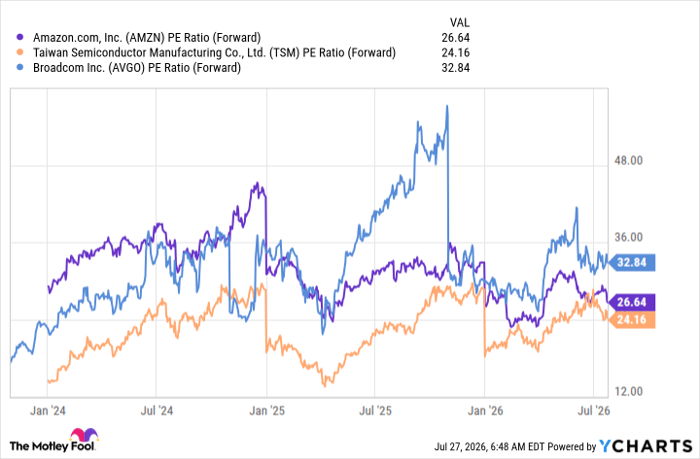
AMZN PE Ratio (Forward) data by YCharts
Although Broadcom is the most expensive, I don't think that's too pricey a valuation for the stock to trade at, and it is reasonable for the growth it expects. On the flip side, TSMC may be the cheapest, but its valuation is right in line with where it has historically traded, and the same can be said for Amazon, too.
As a result, I think stock growth will match business performance, so looking at anticipated growth rates is the best way for investors to project future success. Amazon has the slowest anticipated growth rates, with 15% growth expected this year and 13% next year. Amazon needs to rise 20% to get to the $3 trillion mark in 2027, and that looks well within reach.
Taiwan Semiconductor expects 42% revenue growth this year and 32% next year. With the stock needing to rise about 43% to reach $3 trillion, I think it's also well positioned to hit the $3 trillion mark, perhaps sooner than Amazon.
Broadcom has the longest way to go, needing to grow 67% to reach the $3 trillion mark. However, Wall Street anticipates 66% growth this year and 63% next year, so it easily has the chops to get to $3 trillion.
My guess is that TSMC will reach $3 trillion first, followed by Broadcom, then Amazon, if analyst projections are accurate. However, I think analysts are way undershooting the effect Amazon's new data centers will have on its revenue, and that Amazon will actually get there first despite a slower projected growth rate.
Should you buy stock in Amazon right now?
Before you buy stock in Amazon, consider this:
The Motley Fool Stock Advisor analyst team just identified what they believe are the 10 best stocks for investors to buy now… and Amazon wasn’t one of them. The 10 stocks that made the cut could produce monster returns in the coming years.
Consider when Netflix made this list on December 17, 2004... if you invested $1,000 at the time of our recommendation, you’d have $390,394!* Or when Nvidia made this list on April 15, 2005... if you invested $1,000 at the time of our recommendation, you’d have $1,209,184!*
Now, it’s worth noting Stock Advisor’s total average return is 899% — a market-crushing outperformance compared to 206% for the S&P 500. Don't miss the latest top 10 list, available with Stock Advisor, and join an investing community built by individual investors for individual investors.
See the 10 stocks »
*Stock Advisor returns as of July 29, 2026.
Keithen Drury has positions in Amazon, Broadcom, Microsoft, and Taiwan Semiconductor Manufacturing. The Motley Fool has positions in and recommends Amazon, Broadcom, Microsoft, and Taiwan Semiconductor Manufacturing. The Motley Fool has a disclosure policy.
Recommended Articles


