




Sandisk Stock Has Surged More Than 2,000% in a Year. History Suggests This Is Where the Stock Could Be in 2028
Key Points
Sandisk's phenomenal surge over the past year has been powered by a big jump in NAND flash prices, and the good news is that this catalyst isn't going away.
Analysts have increased their earnings expectations from Sandisk substantially for the next two years.
The potential increase in Sandisk's earnings points toward a multibagger performance by 2028.
- 10 stocks we like better than Sandisk ›
Though shares of Sandisk (NASDAQ: SNDK) have been under pressure lately, the stock remains one of the top performers on the market over the past year, with gains of over 2,300%, as of this writing.
Sandisk's tremendous gains this year have been driven by a significant surge in the price of NAND flash memory, as the demand for these storage chips has significantly outpaced supply. Artificial intelligence (AI) data center servers are expected to account for 44% of the overall NAND flash demand in 2026, according to market research firm TrendForce.
Missed Nvidia in 2009? This Rare Signal Is Flashing Again. In 2009, a "Double Down" signal flashed for a little-known chipmaker called Nvidia. For the first time in years, that same "Total Conviction" signal is flashing for a company 1/100th the size of Nvidia. Continue »
This AI data center-fueled demand has been the primary factor driving Sandisk's remarkable surge on the stock market. The good news for Sandisk investors is that this historical trend powering the semiconductor stock's tremendous rally is sustainable, and that may help the stock deliver more upside over the next couple of years.

Image source: Getty Images.
NAND flash demand from AI servers is poised to get stronger
AI servers have been using NAND flash-based enterprise solid-state drives (SSDs) to store data for AI workloads amid a severe shortage of traditional hard disk drives (HDDs). Tom's Hardware reported in November 2025 that enterprise-grade HDDs have been on backorder for two years. That shortage may have worsened in 2026 as hyperscalers have been aggressively increasing their outlay on AI data centers, creating stronger SSD demand.
Precedence Research predicts that the AI-powered storage market could jump from just $36 billion in 2025 to $255 billion in 2034, clocking a compound annual growth rate (CAGR) of 24%. However, the supply isn't expected to catch up, with memory giant SK Hynix recently pointing out that memory demand could continue to exceed supply beyond 2030.
Moreover, AI servers will continue to capture a larger share of the NAND flash market. TrendForce estimates that AI data centers will account for 51% of NAND flash demand in 2027. As a result, the historical increase in NAND flash prices that has led to a stunning rally in Sandisk stock seems sustainable.
Phison Electronics, which manufactures NAND flash storage controllers, noted in November 2025 that NAND flash prices more than doubled in the second half of 2026. Gartner is projecting a 234% increase in NAND flash prices this year, which isn't surprising as demand is expected to exceed supply by 4% to 5% in 2026.
As the share of AI servers in NAND flash demand increases to 51% next year, and the number of wafer starts drops by 29% in 2026 and 2027 compared with 2024 levels, according to Taiwan-based consulting firm Isaiah Research, the price of Sandisk's products could continue increasing over the next couple of years. According to another estimate, both SK Hynix and Samsung reduced their NAND flash wafer output in 2025 to serve the fast-growing high-bandwidth memory (HBM) market.
The addition of new NAND flash capacity usually takes 18 months to 24 months, or even longer. So, the rapid increase in NAND flash prices that has led to a big jump in Sandisk's margins over the past year is here to stay.
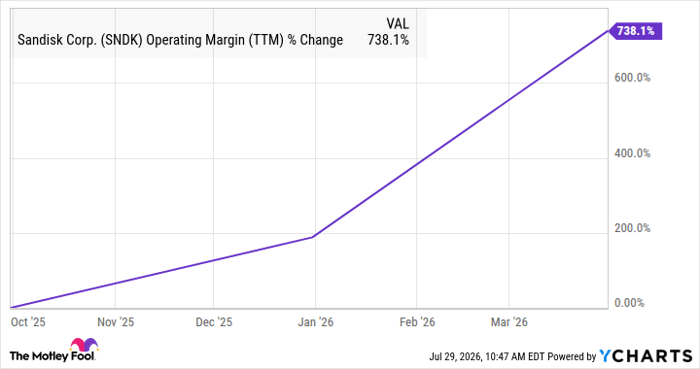
Data by YCharts
Not surprisingly, analysts anticipate Sandisk to maintain outstanding earnings-per-share growth over the long run as well.
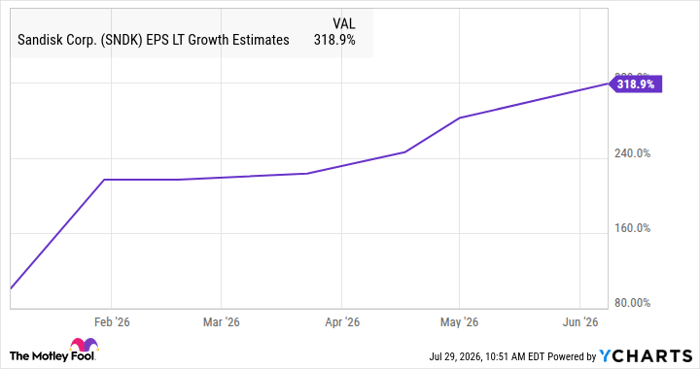
Data by YCharts
The next couple of years should make Sandisk investors richer
As NAND flash demand is projected to continue outstripping supply for the next two years, analysts have become more bullish about Sandisk's earnings growth prospects over this period.
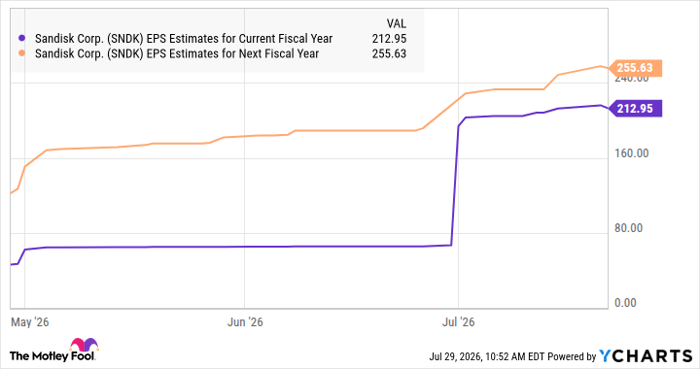
Data by YCharts
The above chart shows that Sandisk's earnings per share could increase by 20% in fiscal 2028 (which will end in June 2028). Of course, that's slower than the projected increase of 219% in Sandisk's earnings per share in the ongoing fiscal year, but don't be surprised to see the company exceeding expectations. That's because Sandisk is striking lucrative long-term agreements with variable pricing options, which are helping it build a solid revenue pipeline with the ability to capture potential memory price increments over the long run.
Assuming Sandisk's earnings reach $255.63 at the end of fiscal 2028 and it trades at even 20 times earnings at that time (a discount to the Nasdaq-100 index's forward earnings multiple of 25), its stock price could increase to just over $5,110. That's almost 5x of where this AI stock is right now, which is why investors can consider buying Sandisk following its 51% decline over the past month.
Should you buy stock in Sandisk right now?
Before you buy stock in Sandisk, consider this:
The Motley Fool Stock Advisor analyst team just identified what they believe are the 10 best stocks for investors to buy now… and Sandisk wasn’t one of them. The 10 stocks that made the cut could produce monster returns in the coming years.
Consider when Netflix made this list on December 17, 2004... if you invested $1,000 at the time of our recommendation, you’d have $390,394!* Or when Nvidia made this list on April 15, 2005... if you invested $1,000 at the time of our recommendation, you’d have $1,209,184!*
Now, it’s worth noting Stock Advisor’s total average return is 899% — a market-crushing outperformance compared to 206% for the S&P 500. Don't miss the latest top 10 list, available with Stock Advisor, and join an investing community built by individual investors for individual investors.
See the 10 stocks »
*Stock Advisor returns as of July 29, 2026.
Harsh Chauhan has no position in any of the stocks mentioned. The Motley Fool recommends Gartner. The Motley Fool has a disclosure policy.
Recommended Articles


