




BYD Delivered 557,090 Battery-Electric Vehicles in Q2 2026. Here Is What That Means for Tesla's Global Dominance.
Key Points
China's electric vehicle company BYD shipped a record-breaking number of battery-electric vehicles in Q2, particularly in one market where Tesla has historically performed well.
The availability of more -- and lower-cost -- options appears to be chipping away at Tesla's pricing power.
Although it's easing into the AI robotics business, for now, investors are mostly pricing in its EV business's new headwind.
- These 10 stocks could mint the next wave of millionaires ›
There's no denying Tesla (NASDAQ: TSLA) ushered electric vehicles (EVs) into the mainstream, even making them cool. And for a long time, being the first to do so meant Tesla was the biggest and best-known name in the business.
Nothing invites competition to a new market like a proven opportunity, though. Now, Tesla's facing a slew of competitors, with one particular EV titan to worry about. That's China's BYD Company (OTC: BYDDY), which shipped 557,090 battery-powered vehicles last quarter alone, topping Tesla's much-improved total of 480,126, and reclaiming the top spot temporarily lost in Q1.
Missed Nvidia in 2009? This Rare Signal Is Flashing Again. In 2009, a "Double Down" signal flashed for a little-known chipmaker called Nvidia. For the first time in years, that same "Total Conviction" signal is flashing for a company 1/100th the size of Nvidia. Continue »
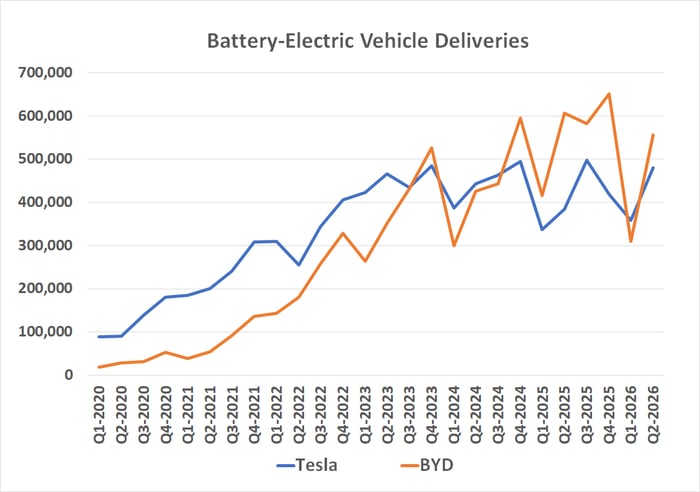
Data source: CNEVPost. Chart by author.
The question is, what does this mean for Tesla shareholders?
Two finer points behind the broad numbers
The numbers in and of themselves don't mean much. A stock's value is relative to that particular company's history and likely future. Both BYD and Tesla could perform well enough to satisfy each organization's shareholders.
In a more qualitative context, though, the two numbers underscore a couple of noteworthy details.
One of these is how, while BYD continues to outsell Tesla in China (as could be expected), it's also doing remarkably well in Europe, where Tesla has historically led. BYD delivered a record-breaking 175,349 electric automobiles to overseas markets in June alone, up nearly 95% year over year, with European demand remaining strong after last year's total shipments to that market growing 270%.

Image source: Getty Images.
The other top talking point from the two companies' recent delivery numbers is one that Tesla supporters are quick to highlight. That's the fact that these two EV names aren't exactly an apples-to-apples comparison. BYD is an integrated manufacturer aiming to build affordable electric vehicles for the masses. While Tesla's Model 3 is also meant to be lower-cost, at a starting price of $36,990 that quickly edges higher with even just a few basic upgrades, Tesla's electric vehicles remain in the upper range of the premium scale.
It would be naïve to believe that the availability of a more affordable option isn't at least poaching some would-be Tesla owners, if not many. The evidence of this dynamic comes in the form of recent price cuts that aren't being matched dollar for dollar with production cost cuts. Unsurprisingly, these materialized in step with the ramp-up of BYD's deliveries.
Connecting the dots
So what does this mean for Tesla's dominance of the EV market, and by extension, for shareholders?
It's simple -- it means Tesla is no longer dominant.
It's still an EV powerhouse to be sure. The advent of its first similarly scaled competition, however, is exposing the downside of some strategic decisions, like the fact that it's not as vertically integrated as BYD is. This more streamlined structure raises its total manufacturing costs, while also limiting its flexibility. And there was little room for either, given how profit margins have been pressured.
As far as the stock's concerned, we're already seeing the impact. Shares have made no net progress since early last year, shortly after BYD first lapped Tesla's deliveries. Although that's not a permanent condition, it does suggest investors are no longer giving the stock the benefit of any doubt. That's fairly new.
Tesla's Q2 earnings report scheduled for July 22 should shed some light on any profit-margin-related concerns, for better or worse.
Don’t miss this second chance at a potentially lucrative opportunity
Ever feel like you missed the boat in buying the most successful stocks? Then you’ll want to hear this.
On rare occasions, our expert team of analysts issues a “Double Down” stock recommendation for companies that they think are about to pop. If you’re worried you’ve already missed your chance to invest, now is the best time to buy before it’s too late. And the numbers speak for themselves:
- Nvidia: if you invested $1,000 when we doubled down in 2009, you’d have $526,675!*
- Apple: if you invested $1,000 when we doubled down in 2008, you’d have $63,609!*
- Netflix: if you invested $1,000 when we doubled down in 2004, you’d have $371,842!*
Right now, we’re issuing “Double Down” alerts for three incredible companies, available when you join Stock Advisor, and there may not be another chance like this anytime soon.
See the 3 stocks »
*Stock Advisor returns as of July 20, 2026.
James Brumley has no position in any of the stocks mentioned. The Motley Fool has positions in and recommends Tesla. The Motley Fool recommends BYD Company. The Motley Fool has a disclosure policy.
Recommended Articles


