




President Trump Just Reimposed the Iran Blockade. Here's What That Means for Oil Stocks.
Key Points
A new blockade will disrupt the supply of a lot of the world's oil.
The U.S. previously tapped into strategic oil reserves to keep prices down, but those reserves are at their lowest level in decades.
Investing in a broad energy or oil ETF is a good way to benefit from overall industry growth.
- 10 stocks we like better than Chevron ›
When the war in Iran began on Feb. 28, Iran immediately cut off most access to the Strait of Hormuz, a vital transport route for about 20% of the world's oil supply. Since then, it has been a cycle of fragile ceasefires, flip-flop messaging, and naval blockades.
On July 14, President Donald Trump reimposed a naval blockade after yet another ceasefire negotiation fell through. And with consistent days of attacks, there are no signs of letting up from either side.
Where to invest $1,000 right now? Our analyst team just revealed what they believe are the 10 best stocks to buy right now, when you join Stock Advisor. See the stocks »
There are many implications of the conflict, and it will inevitably affect the oil industry, but by how much? Likely a bit.

Image source: The White House.
Many oil companies have benefited from a supply shock
This has been a lucrative year for many oil companies. Some have been hurt because of rising crude oil prices, like some pure-play refineries; however, many more have seen profits surge and margins expand.
It's been a matter of supply and demand for oil companies. Blockades and closures of the Strait of Hormuz have caused major supply chain disruptions, and the domino effect has been felt in Americans' wallets at the gas pump.
The U.S. tried to cushion the blow by tapping into its strategic oil reserves, but there's only so much that it could help. And with the oil reserve reportedly at its lowest level since 1983, that doesn't seem like a sustainable strategy over the long term.
Big oil companies will continue raking in cash
At about $79 per barrel, crude oil prices are far from the $100s we saw in March through May, but they're also noticeably higher than the $68 they were hovering near in early July, and they're likely to rise still more.
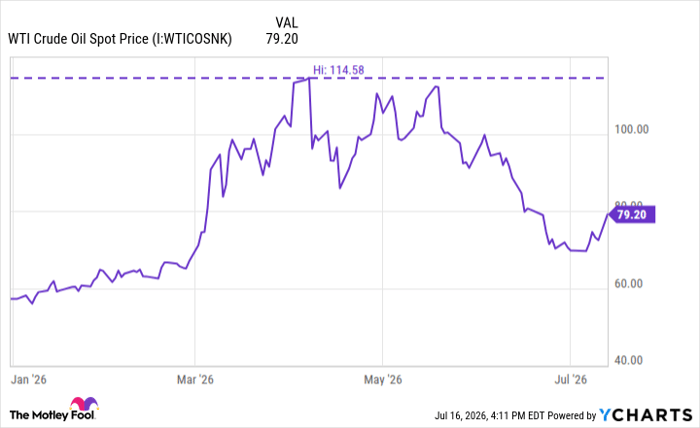
WTI Crude Oil Spot Price data by YCharts
If the blockade continues, I expect $80 to be the floor for crude oil prices for the foreseeable future. This isn't great news for consumers, as higher crude oil prices affect everything from gas prices to travel costs to shipping costs. But, realistically, most oil companies won't be walking around pouting.
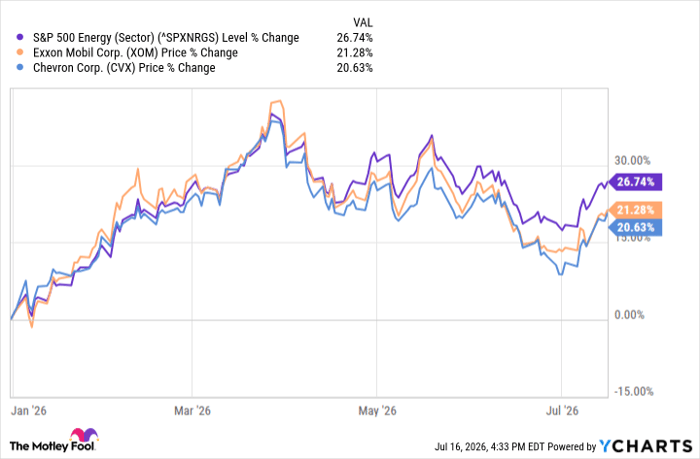
This is especially true for companies like ExxonMobil (NYSE: XOM) and Chevron (NYSE: CVX), whose businesses are built for resilience because they operate in all three phases of the energy pipeline. They explore and extract crude oil, refine and transport it, and sell end products (gasoline, diesel, etc.) that millions of people use every day. Still, they're far from immune to the negative effects of supply shocks.
Chevron is even going so far as to sign on to invest in the construction of pipelines and other transportation infrastructure to help companies and governments bypass the Strait of Hormuz. Chevron didn't just jump on board at the beginning of the war, but you can imagine that the conflict and Trump's lack of consistency have added urgency to the matter.
The president isn't shy about what he wants, though. After a meeting with Iraq Prime Minister Ali al-Zaidi on July 14, Trump said the U.S. would be "taking out a lot of oil," and "the American companies are doing it."
^SPXNRGS data by YCharts
Are oil stocks good investments right now?
Oil stocks have been among the more lucrative investments so far this year, and with the conflict unresolved, I see this continuing through 2026.
If you're looking for a single oil staple you can add to your portfolio, you can't go wrong with either ExxonMobil or Chevron. ExxonMobil is better positioned for earnings growth, but Chevron is a much better option for income and dividend investors.
A better route for many investors, however, is to invest in a broad energy exchange-traded fund (ETF) like the Vanguard Energy ETF (NYSEMKT: VDE) because it covers many different industries tied to oil. ExxonMobil and Chevron make up the bulk of it, accounting for 21.6% and 13.5%, respectively, of its assets.
I wouldn't base an investment in oil stocks on the current Middle East conflict or Trump's policy decisions, as those situations are fluid. Instead, you should invest because of the industry's long-term stability and trajectory. An investment like the Vanguard ETF can be a long-term hold without much second-guessing.
Should you buy stock in Chevron right now?
Before you buy stock in Chevron, consider this:
The Motley Fool Stock Advisor analyst team just identified what they believe are the 10 best stocks for investors to buy now… and Chevron wasn’t one of them. The 10 stocks that made the cut could produce monster returns in the coming years.
Consider when Netflix made this list on December 17, 2004... if you invested $1,000 at the time of our recommendation, you’d have $371,842!* Or when Nvidia made this list on April 15, 2005... if you invested $1,000 at the time of our recommendation, you’d have $1,244,783!*
Now, it’s worth noting Stock Advisor’s total average return is 900% — a market-crushing outperformance compared to 207% for the S&P 500. Don't miss the latest top 10 list, available with Stock Advisor, and join an investing community built by individual investors for individual investors.
See the 10 stocks »
*Stock Advisor returns as of July 20, 2026.
Stefon Walters has no position in any of the stocks mentioned. The Motley Fool has positions in and recommends Chevron. The Motley Fool has a disclosure policy.
Recommended Articles


