




South Korean Stocks Rebound Strongly Triggering Buy-Side Circuit Breaker, KOSPI Rises Over 7%, SK Hynix Surges 12%
TradingKey - During the Asian trading session on July 15, the South Korean stock market rebounded strongly, with the KOSPI Index seeing its intraday gain once exceed 7%. As KOSPI 200 index futures rose rapidly and triggered the mechanism, the Korea Exchange activated the buy-side 'Sidecar' mechanism, suspending program buy orders for 5 minutes. This mechanism is primarily used to mitigate the transmission of sharp index futures volatility to the spot market, which differs from a full circuit breaker that halts all market trading.
Heavyweight semiconductor stocks became the main driving force of this market rally. SK Hynix rose 12% intraday; Samsung Electronics gained nearly 8%, and Hanmi Semiconductor once surged by about 25%. Since SK Hynix and Samsung Electronics hold high weights in the KOSPI Index, the sharp rebound of these two stocks significantly amplified the index's gains.
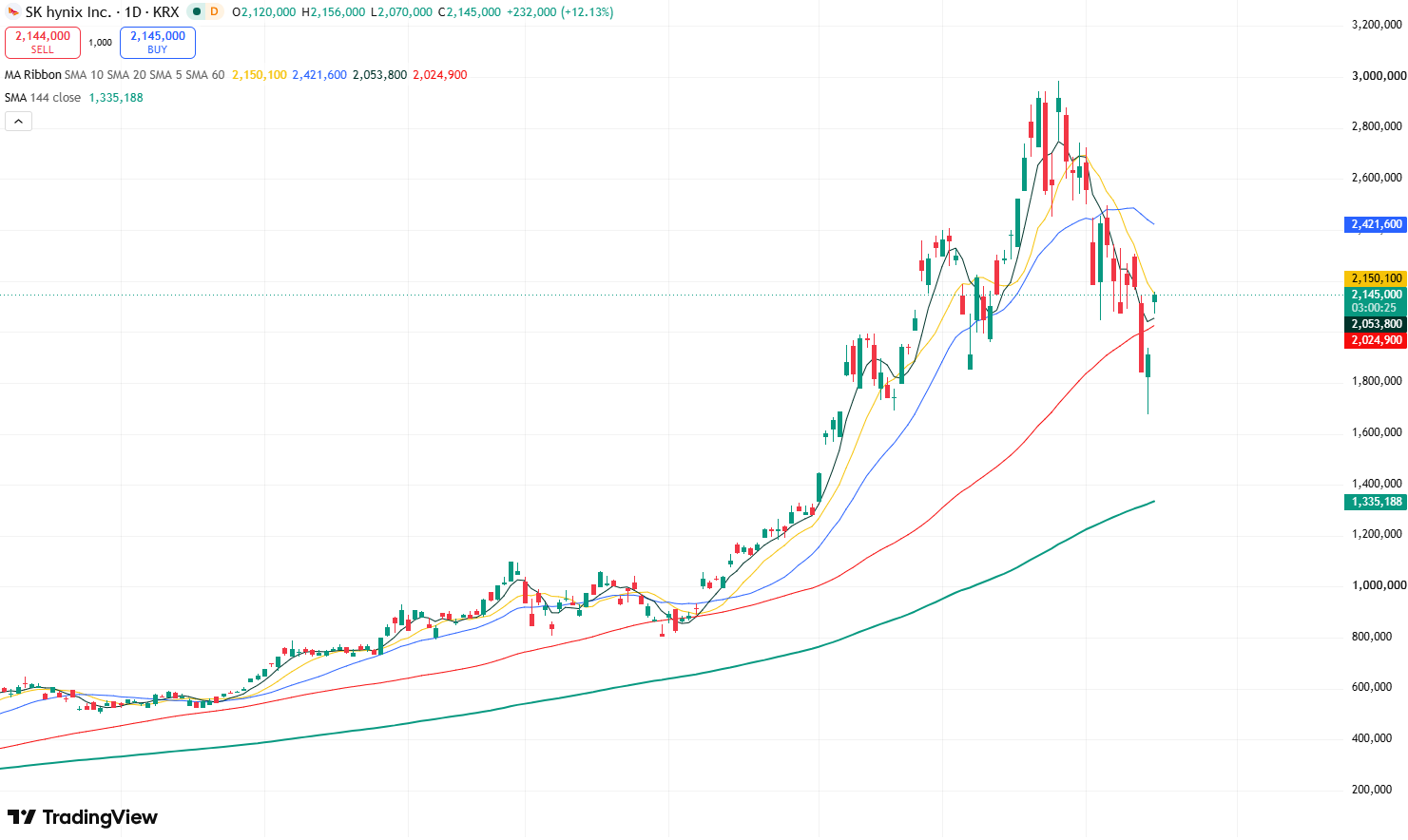
SK Hynix stock price daily chart, Source: TradingView
The rise in South Korean stocks was directly boosted by the overnight performance of US stocks. On July 14, Eastern Time, SK Hynix ADR ( SKH Y) soared 27.29% to $193.92, significantly outperforming its local South Korean shares. Barclays initiated coverage of SK Hynix ADR with an 'Overweight' rating and set a price target of $330, reinforcing US investors' expectations for AI memory chip demand and the company's valuation rerating.
Meanwhile, US inflation data came in below market expectations, boosting the S&P 500 Index and the Nasdaq Composite Index, with risk appetite for tech stocks recovering. Micron Technology ( MU) also rose 4.92% overnight, indicating that capital is flowing back into the memory chip sector.
Analysts believe that demand for DRAM and high-bandwidth memory from AI servers, cloud computing, and mobile devices remains strong. Current suppliers can only meet about 75% to 80% of the demand, and the supply-demand gap may widen further by 2027. However, SK Hynix's US ADR has already shown a high premium relative to its local South Korean shares, and coupled with the recent high volatility of South Korean stocks, the market may still face risks of profit-taking and rapid valuation adjustments in the short term.
Recommended Articles


