




IBM Stock Price Forecast: Revenue Warning Triggers 25% Stock Price Plunge, Can IBM Stock Price Still Rise?
TradingKey - As of July 14, Eastern Time, IBM ( IBM )'s latest stock price stood at $217.07, plunging 25.21% on the day, with the intraday low dropping to $213.22. The rare plunge in IBM's stock price was directly triggered by the company's early warning that its second-quarter revenue would fall short of market expectations, pointing out that client capital expenditure is shifting from traditional software and services to data center infrastructure.
Why IBM Shares Plunged?
IBM's warning indicates that the company expects second-quarter revenue of approximately $17.2 billion, representing a year-over-year increase of only about 1%, which fell short of market expectations of $17.86 billion; adjusted earnings per share are projected at $2.93, also missing the market estimate of $3.02. For a company long-viewed by the market as a representative of stable cash flow and enterprise software, this simultaneous miss on both revenue and profit has dealt a direct blow to investor confidence.
More importantly, IBM management's explanation for the weaker-than-expected performance has triggered market concerns over structural changes in enterprise IT spending. As investment in AI infrastructure rises rapidly, enterprise customers are prioritizing the procurement of servers, storage, memory, and data center-related hardware to cope with potential future supply constraints and price hikes. This means that budgets originally destined for traditional software, consulting, and IT services are being partially diverted to infrastructure areas that more directly support AI computing power and data center construction.
From a market perspective, over the past few years, the market's trading logic for IBM was primarily built on hybrid cloud, Red Hat, automation, consulting services, and enterprise AI software. Because its software and consulting businesses feature higher margins and relatively stable revenue, the market has been willing to grant it a certain premium. However, if enterprise customers temporarily shift their spending focus to AI servers and underlying infrastructure, IBM's high-margin software business and consulting projects could face order delays, project postponements, and slower revenue recognition, thereby dragging down its stock price.
Can IBM Stock Still Rise?
The core of IBM's recent plunge lies in market concerns that enterprise AI spending is bypassing traditional software companies and flowing preferentially to data center infrastructure. In the short term, this will weigh on the valuation logic of IBM's software, consulting, and hybrid cloud businesses, while also prompting investors to re-evaluate the substance of the company's AI transformation.
Whether IBM's stock price can stabilize going forward depends on three key factors: first, whether the official earnings report on July 22 shows that the software and consulting businesses are merely experiencing short-term order delays rather than a deterioration in demand trends; second, whether management can explain how enterprise AI spending will translate into IBM's software, hybrid cloud, and automation revenue in the future; and third, whether the stock price can hold support near $212 and reclaim $243.
IBM Stock Price Technical Analysis: Focus on $212 Support Level
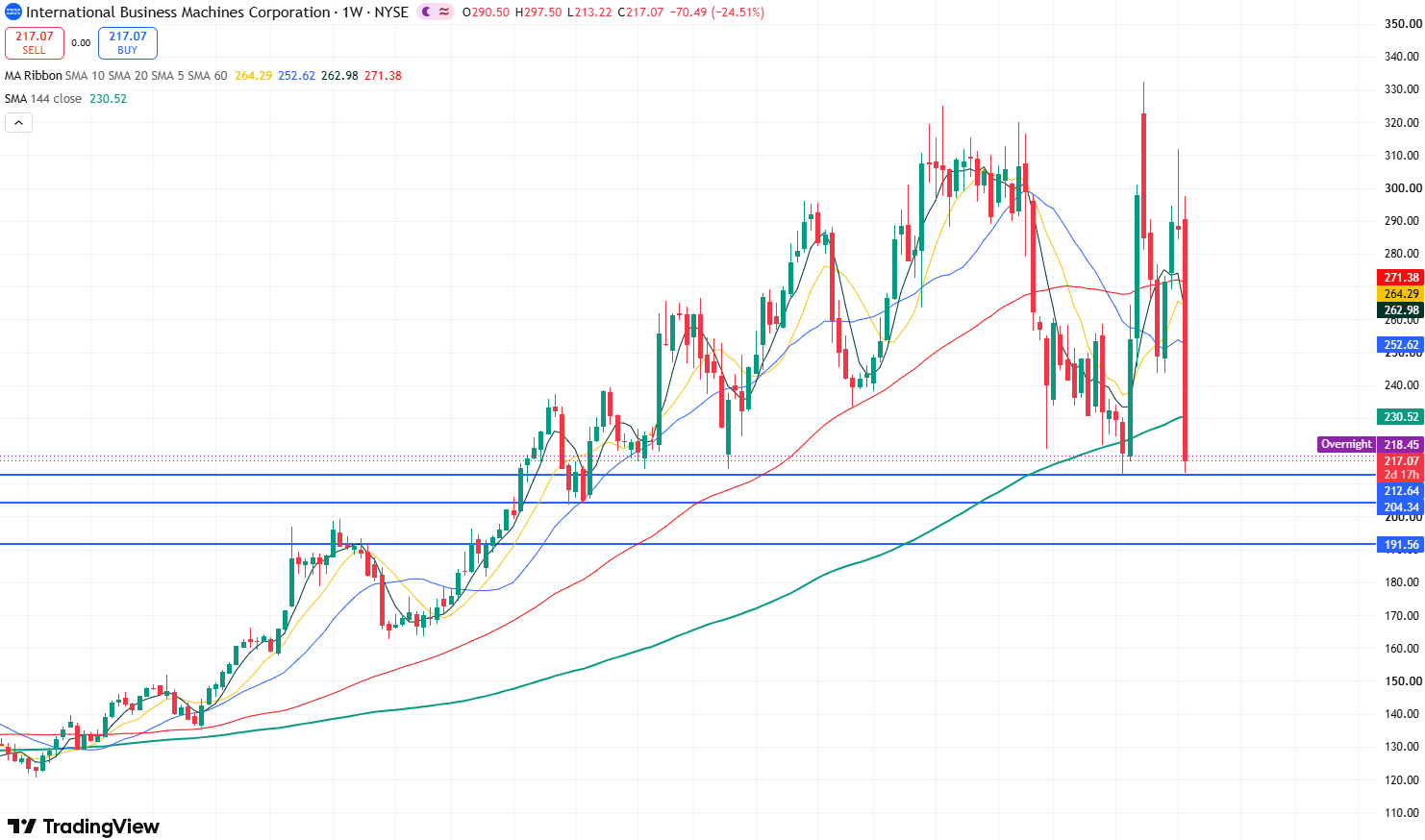
IBM stock price weekly chart, Source: TradingView
Looking at the recent trend of IBM's stock price, the stock gapped down sharply yesterday, with losses exceeding 25% at one point, indicating concentrated selling pressure in the market. Meanwhile, the stock price broke below the low of $243.68 set on June 18, meaning the short-term uptrend has been broken and the short-term technical pattern has weakened significantly.
Currently, the stock price has fallen to near the May low of $212.34, a level that offers some support. If the stock fails to hold this level, it may decline further toward the $204 support level. If the downward trend continues, it could pull back to around $190. Conversely, if the stock can stabilize above $212, the short-term price may see a technical rebound, with the primary upside target testing the $243 resistance level. Beyond that, it could fill yesterday's gap and test upward toward $290.
Recommended Articles


