




SK Hynix (SKHY) Stock Forecast: Gap-Fill Is Happening Now; What’s the Floor at $150?
TradingKey - On Tuesday, July 14, 2026, SK Hynix (NASDAQ: SKHY) is trading at $152.35, down sharply from Monday’s closing price of $168.01. This price action confirms the ADR gap-fill pattern I outlined in this note’s chart review last Friday. The ADR was priced at $149 on July 9, opened at $170 on July 10, and closed the debut session at $168.01, a 13% gain from IPO price. Then, on July 13, SK Hynix’s Seoul shares (000660.KS) collapsed by 15.4%, its biggest single-day plunge ever, and triggered a market-wide trading halt.
The NASDAQ listing is permanent now that SKHY has replaced SKHYV as the new ADR ticker. SK Hynix has tumbled with its Seoul listing and is now down to just $152.35, or $3.35 above its $149 IPO price. SK Hynix has now fallen below the $160.69 level from the support zone mentioned in this note. Today’s question is: will SK Hynix hold at $149?
Why Seoul Fell 15.4%; Profit-Taking, ADR Premium, and Earnings Caution
The Seoul selloff does not appear to reflect any new operational warning from SK Hynix. No guidance cut, profit warning, or customer cancellation has been disclosed. The most direct explanation is valuation: SK Hynix’s Seoul shares had risen more than 600% over the prior year before the Nasdaq listing.
Over the past year leading up to its Nasdaq debut, SK Hynix’s shares in Seoul were up more than 600%. Nasdaq allowed SK Hynix debut price of $170 which provided an opportunity for shareholders in Seoul to sell shares that were bought at much lower prices and turn a profit at the IPO price while selling new shares to US investors. This essentially means that Nasdaq enabled and facilitated a very orderly process of distribution.
The ADR premium creates the other selling pressure on SK Hynix. Each ADR equals 1/10th of a SK Hynix ordinary Korean share. When SKHY was trading at $168 and the Seoul share was at the equivalent of $134, the ADR carried a premium of approximately 25.6% over the underlying Korean security. This is to be expected since investors in the US will be willing to pay extra for the liquidity and the simplicity of settlement in dollars and direct listing in the US.
For a large cap company, however, a 25% premium in price is too large and will create arbitrage opportunities to short the ADR while buying the shares in Seoul. If arbitrageurs begin doing so, the Seoul price should decline and the ADR price should move lower, rather than the ADR price remaining higher than the Seoul price. The ADR and the Seoul listing will converge and if the Seoul shares stop falling, there is no reason why SKHY should not trade around $152.
The Business Case: 58% HBM Market Share, CEO Says Shortage Continues Past 2027
The business case and the market share of SK Hynix remain unchanged. SK Hynix has a 58% share of memory business that is driven by HBM and generates a large portion of its revenue from HBM supply. HBM stands for high bandwidth memory. SK Hynix is supplying Nvidia, AMD and other makers of AI chips with HBM3E, which should see a ramp-up in 2026. This will be followed by commercial HBM4 shipments beginning in Q2 2026. SK Hynix Chairman Chey Tae-won, speaking to CNBC on the Nasdaq debut, says there is an enormous, exponential demand from AI for HBM. He was echoing what I reported in last week’s news note. CEO Kwak Noh-jung stated publicly this year that the memory industry could be facing severe supply shortages in 2027.
SK Hynix will report Q2 2026 results with revenue above KRW 80 trillion and operating profit above KRW 60 trillion, with operating margins potentially in the mid-to-high 70% range. If the company confirms those estimates and results, it will be among the best profit quarters for any memory company. The risk that is driving down the Seoul listing and the ADR is in the area of expectations. Analysts from Korea Investment reportedly believe that a significant ramp up in HBM4 production, sales and shipments could take place in Q3 rather than Q2. In that case, SK Hynix is likely to report Q2 2026 earnings that fall below expectations.
A memory company that produces Q2 operating margins of 70% could face a stock selloff if it reports 65%. In any event, the risk that is currently priced into the company relates to the IPO. $149 will be an important support level because this was the price at which seven-times-oversubscribed institutional demand cleared last week. Institutional investors who applied for $149 shares last week should not sell voluntarily at or below that price so this price will create a floor that provides support.
SKHY Technical Analysis: Gap Filling Now, $149 IPO Floor, Target $167.40 on Stabilization
The $152-$162 gap that formed on the July 10 offering is filling today. The key area of demand is the IPO-pricing zone of $149-$152. Staying above $149 maintains the structure, with $160.69, $164.36, and the prior close of $168.01 as targets. Below $149, IPO demand appears to have been exhausted, the ADR premium has further to compress, and there is no immediate technical support until the $140 area.
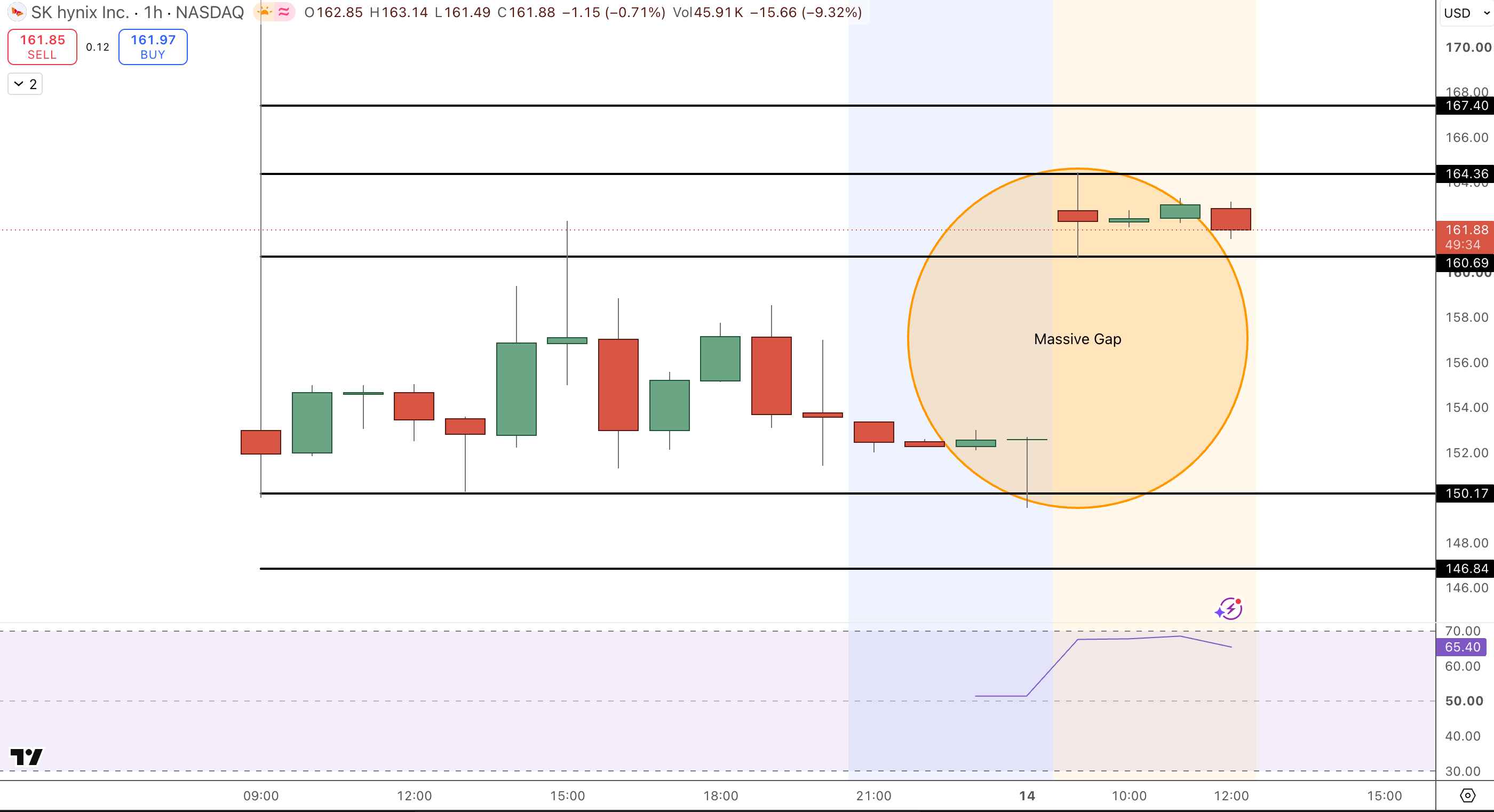
SK Hynix (SKHY) Stock Forecast- Source: Tradingview
- Floor: $149.00 is the IPO price and level of 7x institutional demand.
- Recovery target 1: $160.69 is the lower bound of the original gap.
- Recovery target 2: $167.40 is the source of the previous chart note resistance.
- Bear scenario: A daily close under $149 means premium compression continues, support near $140.
- ADR structure: Each SKHY = 1/10 of a single Seoul ordinary. ADR premium as high as ~25%.
- Earnings watch: Q2 2026 earnings upcoming. Consensus expects >KRW 80T top line; >KRW 60T operating profit.
Bottom Line
The SK Hynix ADR gap is filling. SKHY sits at $152.35, down from $168.01, following a 15.4% decline Monday (the worst day on record) as the premium on the ADR over the underlying Korea stock shrank from around 25%. It’s just a valuation and arbitrage move, not a business problem.
SK Hynix owns 58% of all HBM revenue, sells Nvidia the chips that power its AI chips and should report >65% Q2 operating margins. Institutional demand at the $149 IPO price was 7x oversubscribed and so $149 is the floor. Above $149, we’re looking at $160.69 and $167.40. Below $149, we have $140.
Recommended Articles


