




Vanguard Is Bullish on Value Stocks and Fixed Income. Are These 2 ETFs a Good Buy?
Key Points
Vanguard research projects that value stocks and bonds could be good buys for the next few years.
The Vanguard U.S. Value Factor ETF has outperformed the S&P 500 index over the past year and looks cheap by its P/E ratio.
Despite a few tough years for bond investors, the Vanguard Total Bond Market ETF has delivered a return near 4% over the past year.
- These 10 stocks could mint the next wave of millionaires ›
Recent Vanguard research is bullish on the U.S. economy. The company's recent market commentary, published in June, projects 3% U.S. GDP growth in 2027, which would likely be good news for U.S. stocks, along with lower core inflation of 2.7% in 2027, which could be good news for bond prices.
The company's research says that value stocks in the U.S. could be a good buy. These companies are poised to benefit from artificial intelligence (AI) productivity gains without bearing the up-front costs of AI data centers and capital expenditures (capex).
Missed Nvidia in 2009? This Rare Signal Is Flashing Again. In 2009, a "Double Down" signal flashed for a little-known chipmaker called Nvidia. For the first time in years, that same "Total Conviction" signal is flashing for a company 1/100th the size of Nvidia. Continue »
If you agree with the general direction of Vanguard's forecasts for 2027, how should you invest today? The research didn't recommend any specific stocks or exchange-traded funds (ETFs). But two popular Vanguard ETFs -- the Vanguard U.S. Value Factor ETF (NYSEMKT: VFVA) and the Vanguard Total Bond Market ETF (NASDAQ: BND) -- could be good choices if you want to invest in value stocks and bonds.
Let's look at these two Vanguard ETFs and see if they could be a good fit for your portfolio.

Image source: Getty Images.
Vanguard U.S. Value Factor ETF (VFVA): 649 stocks, eight years of 10.6% annualized returns
The Vanguard U.S. Value Factor ETF is an actively managed fund that invests in U.S. stocks that have lower market valuations relative to their fundamentals. Its portfolio of 649 stocks includes large-cap, mid-cap, and small-cap value stocks. This ETF gained 12.9% in the first half of the year and 28.1% over the past year, outperforming the S&P 500 index.
This fund is well-diversified by sector. If you're concerned that typical S&P 500 ETFs have gotten too top-heavy with major tech stocks, the Vanguard U.S. Value Factor ETF can put your money to work in other parts of the economy. The fund's top five sector holdings are financials (23.5% of the fund), consumer discretionary (18.5%), healthcare (14.7%), technology (12.6%), and industrials (10.7%).
The ETF is also well-diversified across its holdings of value stocks, without being top-heavy with just a few names. The portfolio's top five stock holdings are:
- CVS Health (NYSE: CVS): 0.97% of the fund
- EOG Resources (NYSE: EOG): 0.87%
- Cigna Group (NYSE: CI): 0.83%
- Bristol Myers Squibb (NYSE: BMY): 0.81%
- Verizon Communications (NYSE: VZ): 0.80%
The fund charges an expense ratio of 0.13%, which is higher than many low-cost Vanguard ETFs, but still quite low for an actively managed fund. And it pays decent dividends, with a trailing 12-month yield of 1.93%.
Value stocks don't always beat the market. For the past eight years, since this fund was established in February 2018, it has delivered average annual returns of 10.6%, significantly underperforming the S&P 500:
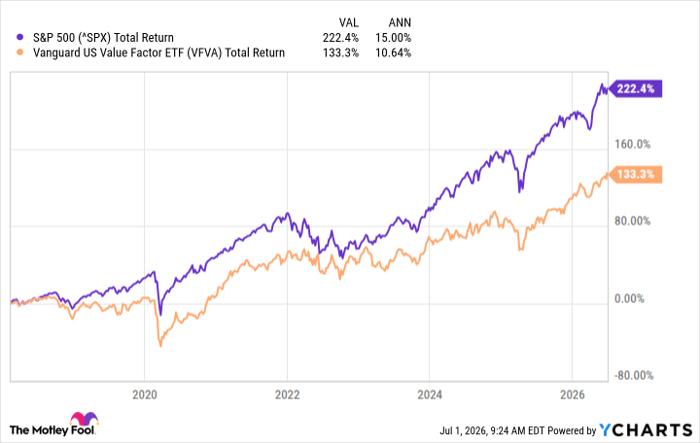
^SPX data by YCharts
But this value stock ETF's future could be bright. Its price-to-earnings (P/E) ratio at recent prices is 11, which is a significant discount to the S&P 500 index's P/E multiple around 25.
Vanguard Total Bond Market ETF (BND): More than 11,000 bonds, 3.1% annualized returns for 19 years
Some investors might have raised their eyebrows when reading Vanguard's research projections about bonds being a good buy. The past few years have been tough for bond investors. The Vanguard Total Bond Market ETF has delivered only an 0.1% average annual return for the past five years.
But over the long term, this bond ETF's performance has been a lot stronger. From the fund's inception in April 2007 through June 30, this bond ETF has delivered average annual returns of 3.1% and a 3.7% return in the past year.
This is an ultra-low-cost bond ETF with an expense ratio of 0.03%, and it holds a well-diversified portfolio of 11,455 bonds, with a broad mix of U.S. government bonds and corporate bonds. If Vanguard's research projections are correct and inflation (and interest rates) decline over the next few years, that could be good news for investors who buy bonds today.
No one knows for sure which sectors, stocks, assets, or ETFs will outperform in the future. But if you believe that the productivity (and profit) gains from the AI boom will spread throughout the economy, and that interest rates could come down from today's levels, this value stock ETF and low-cost bond ETF could be good picks for a long-term investor's diversified portfolio.
Where to invest $1,000 right now
When our analyst team has a stock tip, it can pay to listen. After all, Stock Advisor’s total average return is 918%* — a market-crushing outperformance compared to 208% for the S&P 500.
They just revealed what they believe are the 10 best stocks for investors to buy right now, available when you join Stock Advisor.
See the stocks »
*Stock Advisor returns as of July 5, 2026.
Ben Gran has positions in Vanguard Total Bond Market ETF. The Motley Fool has positions in and recommends Bristol Myers Squibb and Vanguard Total Bond Market ETF. The Motley Fool recommends CVS Health, EOG Resources, and Verizon Communications. The Motley Fool has a disclosure policy.
Recommended Articles


