




Apple Enters a Critical Week After Rebounding From Its Memory-Cost Selloff
TradingKey - Apple (NASDAQ: AAPL) ended its June 29 session with a +3.14% gain at $283.78, climbing back above the 0.618 Fibonacci retracement level of $272.99 and its rising trendline following the June 25 selloff that followed the announcement of higher Mac and iPad pricing driven by the shortage of computer memory. The stock has bounced back by about $8.63 in three sessions, with green candles trading on increased volume showing participation from institutional buyers at the area where the trendline and Fibonacci meet.
The RSI is at 46.39, showing no overbought signal or bearish divergence and with room to move higher. The bigger backdrop, which lifted the stock from the $245 low to the $317 high, was Apple's record-setting Q2 FY2026 quarter, an all-time high for Services, and "extraordinary demand" for the iPhone 17, has not changed. What has changed is the cost input for memory driven by the tightness in the market, and the market has taken three days to sort out its concerns with that input.
What the $317 to $272 Compression Was Actually Pricing In
The selloff from $317.35 to $272.99, a roughly 14% pullback over about two weeks, compressed four concerns into one. There was the memory price increase (DRAM prices rising by 58-63% sequentially, NAND prices jumping by 70-75% sequentially, gross margin guided lower to 47.5-48.5% from 49.3%); the unconfirmed Apple-Intel deal touted by Trump in his social media that won't have business impact for two-to-three years; the class-action lawsuit in the UK about iCloud pricing that will take years to resolve; and the insider selling of over $111 million in a three-month period. The market sold all four at once. The +3.14% gain on June 29 is the market starting to sort out which are concerns and which are noise.
Of the four concerns priced in during the 14% selloff, only the memory cost increase will have impact to Apple's business this quarter. Apple raised MacBook Air pricing by $200 sequentially from $1,099 to $1,299, MacBook Pro 14-inch by $300 sequentially from $1,699 to $1,999, and iPad Air by $150 from $599 to $749. That deliberate pass-through on the Mac and iPad, leaving iPhone pricing untouched, is Apple correctly assessing where demand elasticity is and protecting it for the iPhone 18 pricing cycle.
JPMorgan sees the price increases for iPhone 18 of about $50 sequentially from the iPhone 17, suggesting Apple will keep the iPhone more affordable in the face of rising memory costs. Deutsche Bank estimates the supply-demand tightness for memory could persist into 2028, implying Apple will be adjusting to it for multiple quarters.
Q2 FY2026 Was a Record Quarter — and Services Makes It Recession-Resilient
Apple’s fiscal Q2 2026 earnings, released on April 30, posted strong numbers on the business pillars that matter over the long run. Sales of $111.2 billion, a 17% year-over-year increase, with iPhone revenue near $57 billion, or up 22%, was one of the widest beats by geography in a number of years, with Greater China back in the picture, India speeding up, executives pointing to “extraordinary demand” for the iPhone 17 lineup. GAAP EPS grew 22% to $2.01. Services sales of $31 billion were a record, up 16% in the year-over-year comparison, with operating margins at almost 49%. This is the piece that sets Apple financially apart from any other consumer electronics company: some $31 billion in high-margin, recurring, subscription-based, and non–units-related quarterly revenue that doesn’t rely on memory as a cost driver.
The floor for Services earnings is that the memory cost problem, although real, doesn’t affect Apple’s ability to sustain earnings growth. Whether they’re purchased one month ago or three years ago, App Store, Apple Music, iCloud, Apple TV+ and Apple Pay revenue remains steady from 2.2 billion devices. The installed base continues to grow, as each iPhone 17 and soon iPhone 18 sold brings in one more customer for the Services ecosystem, and the company has repeatedly shown itself to raise average revenue per user as time passes. The 16% growth rate for a Services number that’s hit $31 billion already this quarter, and constitutes a fairly big slice of overall company revenue, is the flywheel that warrants an elevated valuation relative to other hardware makers.
AAPL Technical Setup — 0.618 Fib Hold at $272.99, RSI 46.39, Target $300.40
On the daily timeframe, AAPL is trading at $283.78 after the +3.14% bounce yesterday, keeping a handle on the 0.618 Fibonacci level at $272.99 and the rising black trendline above the EMA200 moving average at $267.79. RSI reading 46.39 is mid-range and able to move further up towards overbought territory without any bearish divergence, as this is more about controlled recovery versus a short squeeze. A rise in trading volume backs up the presence of institutional buyers.
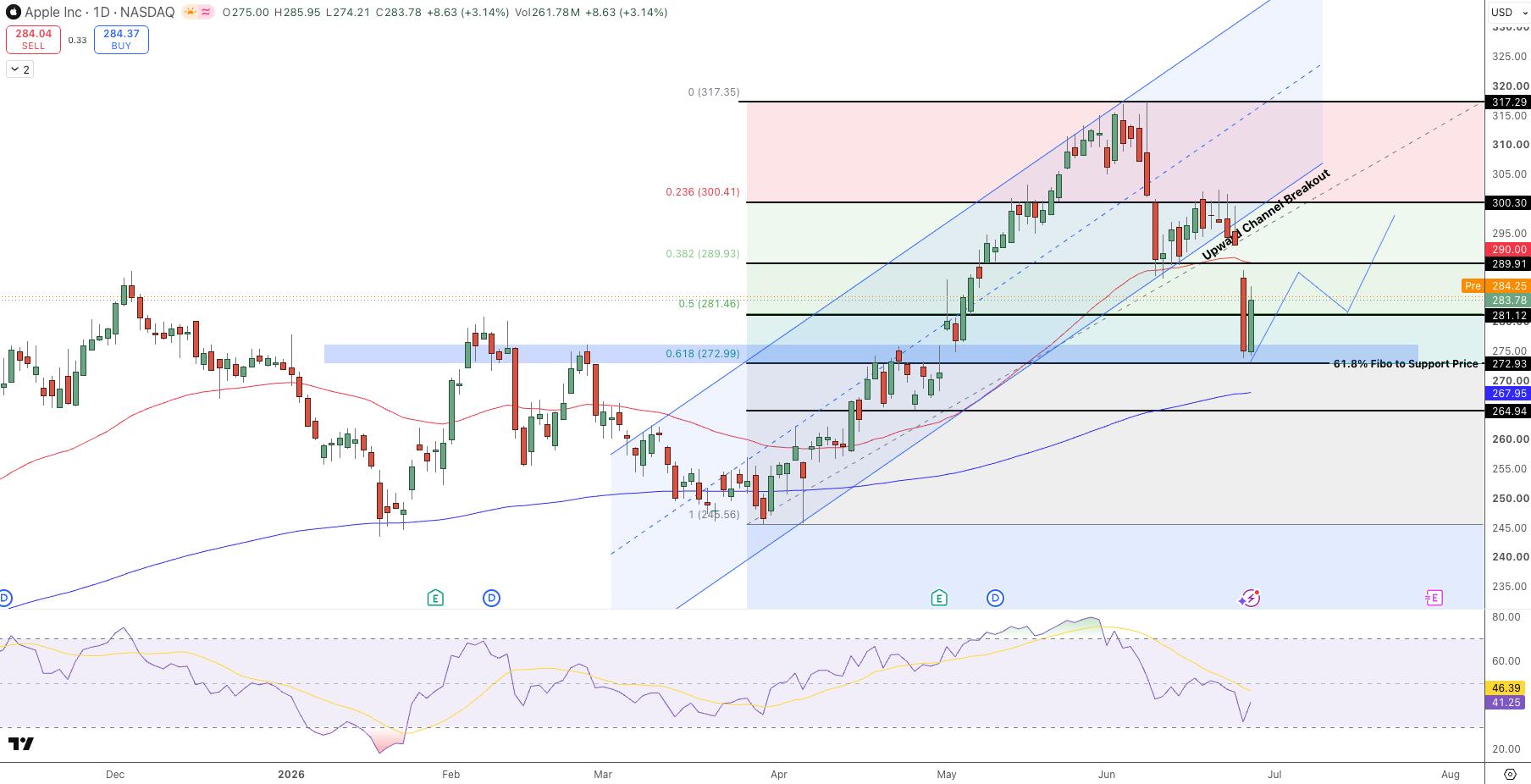
Apple Price Chart - Source: Tradingview
The Fibonacci path from the $245.56 bottom sets short-term resistance at the 0.50 level at $281.46, recently breached, and the 0.382 level at $289.93, while significant upside targets come in at the 0.236 level at $300.41 and the 0.00 level at $317.35, the prior high. A daily close above $289.90 brings $300.40 into focus. The stop should rest beneath $272.90 as the 0.618 Fibonacci level and the trendline support would be gone.
- Entry: Long above $289.90 — 0.382 Fib cleared
- Target 1: $300.40 — 0.236 Fib level
- Target 2: $317.35 — prior high, 0 Fib level
- Stop Loss: Close below $272.90 — 0.618 Fib and trendline fail
- Services revenue: $31B Q2 FY2026, ATH, +16% YoY, ~49% margins
- iPhone 18 catalyst: September 2026 launch — primary upcoming fundamental event
Why Did Apple Sell Off and Why Is It Recovering?
Apple price drop from $317 to $272 in roughly 2 weeks after the June 25 announcement of price increases for Mac and iPads which will be passed on to the consumers as costs of global memory chips increased sharply (DRAM +58-63% QoQ, NAND +70-75% QoQ) which was accompanied by the guidance for gross margin that was reduced from 49.3% to 47.5-48.5%. 3 other negative elements were selling off at the same time: Apple-Intel manufacturing agreement rumor, UK’s iCloud class action and $111M insider sells. The June 29 bounce is just the market starting to differentiate the memory cost issue that is a real, multi-year issue (per Deutsche Bank) versus the other 3 which are short-term concerns, and have no direct impact on business in the near-term.
What Makes Apple’s Services Business a Structural Buffer Against Hardware Headwinds?
Apple’s Services business produced $31B in Q2 FY2026 revenue, +16% y/y, with ~49% operating margin, from the App Store, Apple Music, iCloud, Apple TV+, and Apple Pay, on 2.2B active devices. Unlike hardware revenue that has memory as a cost component and is subject to consumer demand cycles, Services revenue is subscription based, recurring, independent of device sales, and grows with the installed base. With +16% y/y on a $31B quarterly Services base, Services is contributing $5B of annualised revenue per quarter at high margin independent of iPhone unit sales.
What Is the iPhone 18 Catalyst and What Should Investors Watch?
The iPhone 18, at Apple’s September 2026 launch event, is the next big fundamental catalyst between now and the next report. We at JPM expect that Apple will pass on some pricing of $50 or so on each new model, and will try to maintain the price elasticity of the iPhone as long as memory costs are high. The critical factors to monitor are: iPhone 18 Apple Intelligence is a stronger demand story than expected (the bull case), memory pass-through on iPhone side margin will compress margin more than expected (the bear case), and whether the India ramp has lowered the China dependence to the point where investors feel that Apple’s supply chain is diversified enough. The Q2 FY2026 “extraordinary demand” for the iPhone 17 will be a comparison point for the iPhone 18 launch.
Bottom Line
Apple bounce back +3.14% to $283.78 on June 29 confirms the $272.99 0.618 Fib level as support after a 4 negative elements sell from $317. Of the 4, only memory cost increase will have immediate impact this quarter on Apple P&L. Apple-Intel deal, UK class action and insider selling are not business issues in the short term. The $111.2B Q2 FY2026 revenue record, the $31B Services ATH, the iPhone +22%, are not affected, plus we still have 2.2B devices installed base. A trade higher than $289.90 will be looking to test $300.40 and then $317.35. 46.39 RSI is neutral and can climb. September iPhone 18 launch is the next fundamental catalyst and will prove if $317 is a ceiling or just a step to higher.
Recommended Articles


