




Sandisk (SNDK) Weekend Outlook: Can the S&P 500's Best Stock Extend Its 857% Rally?
TradingKey -Sandisk Corporation (NASDAQ: SNDK) is the best-performing stock in the S&P 500 in 2026, with gains year-to-date of roughly 857% as of late June. At $2,196.04, it is consolidating following a fresh high this week, backed by real fundamental strength and a NAND shortage that Micron’s blowout fiscal Q3 ’26 results, revenue of $41.46 billion, which is up 346% on a year-over-year basis, with an 84.6% gross margin and a Q4 guide of $50 billion, proved was structural and not cyclical. Sandisk’s most recent quarter was no slouch either, delivering $5.95 billion in revenue, with the data centre segment growing revenue by 233% quarter-over-quarter.
The company has now guided fiscal Q4 2026 revenue in the range of $7.75 billion to $8.25 billion on non-GAAP EPS of $30 to $33. So the question going into the week of June 30 is not, does the business do well? It clearly does. But, it is, can the valuation at ~17 times revenue this year stay high as supply eventually responds to such high prices?
The Fundamental Case — Why NAND Tightness Is Structural, Not Temporary
The one number that matters the most to the Sandisk bull case is not really anything quarterly but the direction of NAND average selling prices. Micron’s Q3 results provided the most external validation as possible that they are not normalizing. On its June 24 earnings call, Micron management said that supply and demand is still very tight and that it sees no light at the end of the tunnel when it will balance. Semiconductor suppliers are diverting their capacity to HBM and AI accelerators, and as a result NAND prices are expected to move up 70% to 75% sequentially for calendar Q2 2026.
Apple confirmed this trend when it raised its Mac and iPad prices on June 25 because it could not absorb the memory COGS increase. When the world’s best-selling consumer electronics company cannot absorb the memory cost increase, it was not that there was a cyclical NAND shortage. It was that there was a structural capacity issue.
The data centre segment powered the Sandisk Q3 quarter: data centre revenue grew 233% quarter-over-quarter after growing 64% the previous quarter. This is not a rounding error; it is hyperscalers pulling in storage investment faster than Sandisk could actually supply, even as it ramped production. TLC-based enterprise solid-state drives are driving this growth, while Sandisk’s QLC “Stargate” drives have begun shipments into AI training cluster applications.
The new business model (NBM) multi-year customer agreements management brought in with the Q3 earnings is the structural thing put in place to avoid the margin collapse in the 2018 and 2021 NAND supercycles. By having pricing and volume commitments on multiple years, Sandisk is protecting itself against a spot price collapse that typically comes with a supply catch-up period. The big question long term on the bull case is whether these agreements are durable.
The Bear Case and the Bull Counter — 17x Revenue Requires Sustained Cycle Timing
A reasonable argument to be nervous about the current price of 2,196 is the forward price to sales ratio of 17x. NAND gross margin was 78% in Q3 and is expected to be 79 to 81% in Q4, both very high for a commoditized memory business. In the past when supply caught up, gross margins were sharply compressed. The bear argument is that this cycle is similar to the other two: supply catches up, NAND prices compress, and those that traded at 15 to 20 times revenue give back a good portion of the gains.
Deutsche Bank points out that NAND supply might stay tight through to 2028 given the pace of AI infrastructure build-out versus capacity, but may stay tight does not mean will stay tight. The bull argument is that this cycle is different, as both the demand and price floors are different. Demand for AI training clusters is much faster than any previous super cycle.
Additionally, the NBM multi-year customer agreements will establish a contract price that was not present in 2018 or 2021, so if this is done correctly, it will slow and soften the pace of transition into the next cycle. There are arguments on either side of the coin here, but we won't know until supply responds and the pricing data shows up in 2027. Today we just know that the bull case is Q4 guidance of $7.75 to 8.25B.
What to Watch in the Week of June 30 to July 3
The most relevant macro number for SNDK is Core PCE (May). A softer number takes out one of the pressure points of higher-for-longer rates, providing fuel to re-rate an extreme multiple. Anything hotter just reinforces the Warsh Fed stance, and it stays with the multiple headwind. The next data point will be PMI June manufacturing, which could act as a secondary measure to see if AI demand is moving broader than just to the hyperscalers.
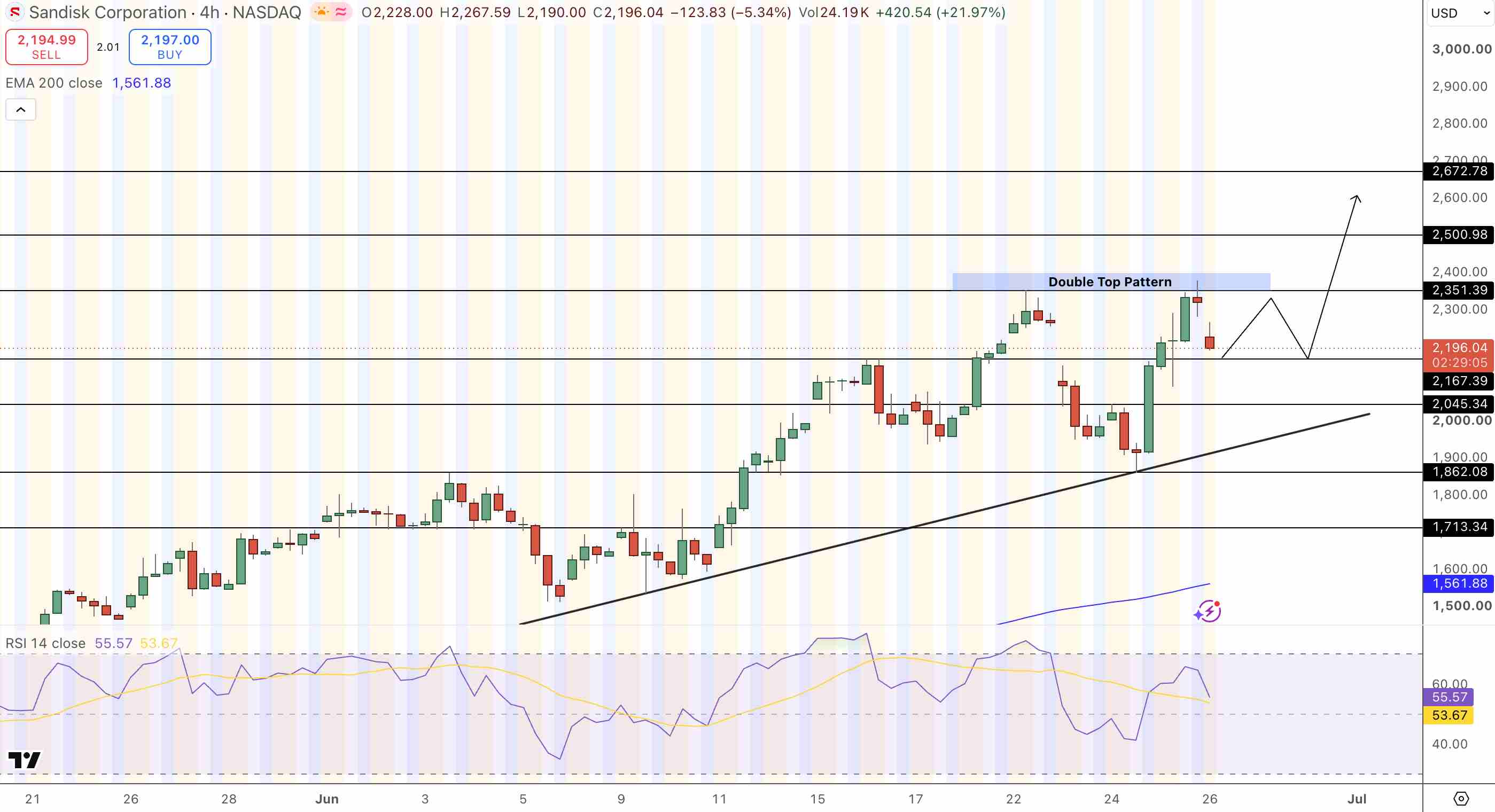
Sandisk (SNDK) Price Chart - Source: Tradingview
Of course, any commentary on NAND pricing in the market (channel checks or from analyst calls) is the most important number for Sandisk to keep in mind: if it points to further ASP increases in Q3, that validates the Q4 guidance, but anything early that is a sign of softness would be the number to watch closely.
- Revenue (Q3 FY2026): $5.95B — up 97% sequentially, data centre +233% QoQ
- Q4 FY2026 guidance: $7.75–8.25B revenue, EPS $30–33 non-GAAP
- YTD performance: ~857% — #1 S&P 500 stock in 2026 as of June 22
- NBM agreements: Multi-year fixed-price contracts — key structural difference from prior cycles
- Key macro next week: Core PCE (May), manufacturing PMI — week of June 30
- Technical note: Double top at $2,351–2,672 forming; RSI 55.57 neutral; support $2,045
What Has Driven Sandisk’s 857% Year-to-Date Return?
Sandisk’s massive 2026 return has three key drivers:
- a structural NAND shortage, where demand from AI infrastructure construction draws away production capacity destined for HBM;
- TLC and QLC SSD demand in the data centre market is increasing more quickly than the supply of NAND flash available for it (data centre revenue increased 233% QoQ Q3 FY2026); and
- multi-year customer agreements with hyperscalers in the New Business Model (NBM) have fixed prices above the spot rate for multiple years. Micron posted Q3 FY2026 record results ($41.46 billion revenue +346%, 84.6% gross margin), which indicated the supply squeeze was structural and Micron saw no light at the end of the tunnel in seeing NAND supply and demand balance out.
How Do Micron’s Q3 Results Affect Sandisk’s Investment Case?
Micron’s Q3 FY2026 results were most relevant for us for external verification of Sandisk’s thesis. Micron Management stated “NAND supply and demand remain very tight, with no line of sight to balance. In the near-term, we expect NAND prices to grow 70-75% QoQ, as manufacturers continue to reallocate capacity to AI accelerators,” which reinforces Sandisk’s Q4 $7.75 to $8.25 billion guidance and supports that the current ASP environment was not a transitory spike. Furthermore, Apple had to increase Mac and iPad prices because of NAND memory costs, another practical example of NAND supply shortages forcing increased pricing on end-user computing products.
What Is the Primary Risk for Sandisk at $2,196?
The biggest risk is the cycle mean reversion to the average:
- NAND gross margins between 78% and 81% are near all-time highs and the stock at ~17X current-year revenue implies sustained elevated profitability.
- The bull case is the NBM multi-year agreements combined with the high-growth rate of AI demand, which means the cycle mean reversion time line this cycle is significantly different than 2018 or 2021. The only way to resolve the debate in terms of cycle timing is by 2027 pricing data. The technical chart has a double top forming at the $2,351 to $2,672 resistance level we watch and monitor for a confirmation breakout/breakdown; a confirmed breakdown below $2,167 confirms the near-term pullback to $2,045 is confirmed.
Bottom Line
Sandisk’s 857% year-to-date return is a product of genuine NAND memory supply and demand imbalances validated by Micron’s record-breaking $41.46 billion quarter and by Apple being forced to raise prices for its Mac and iPad product lines. Sandisk’s Q4 $7.75 to $8.25 billion guidance and EPS of $30 to $33 will be Sandisk’s next fundamental earnings and profitability test. We believe NBM multi-year customer agreements are Sandisk’s argument this cycle will be different from 2018 or 2021.
The bear case is a legitimate one: 17x current-year revenue prices with permanently elevated NAND margins. History indicates this is unsustainable. The debate will likely only be resolved with 2027 NAND pricing data. Next week’s Core PCE is Sandisk’s primary macro catalyst. The 4H chart has a double top developing at $2,351 to $2,672 resistance level with the RSI 55 at neutral and measured downside risk in a confirmed downside breakout below $2,167 to $2,045.
Recommended Articles


