




The Japanese Yen got its hike; Tokyo still has to do the rest
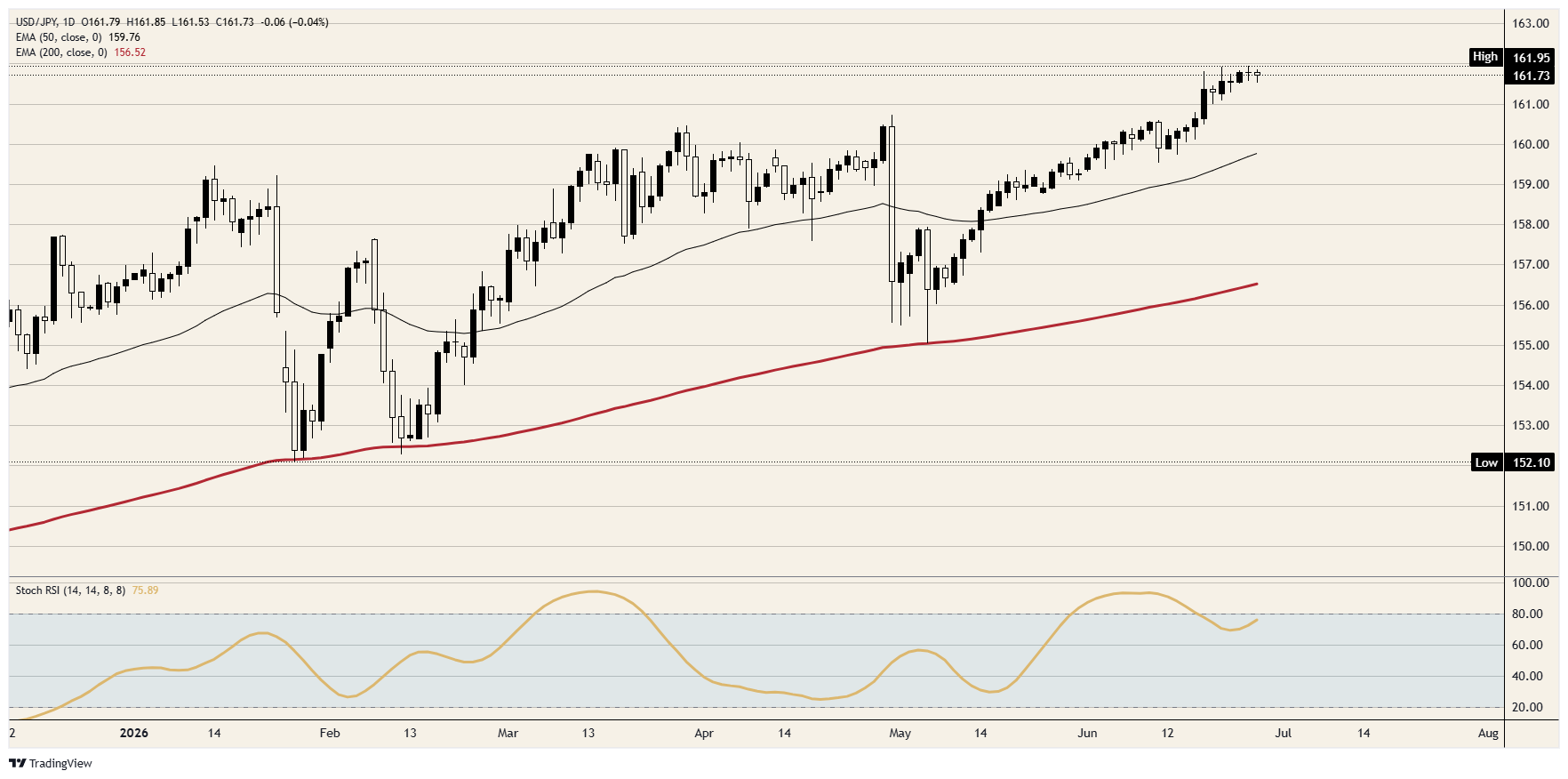
- USD/JPY is parked near generational highs, back in the territory that has historically triggered Japanese intervention.
- June's BoJ hike narrowed the rate gap on paper but failed to lift the Yen.
- Next week's Tankan and US payrolls set up the next test of Tokyo's resolve.
USD/JPY ended the week pressing the 162.00 handle, a whisker beneath its multi-decade high, and the more revealing detail is what it took to drag the Yen up there: a Bank of Japan (BoJ) rate hike that was billed as the turning point. The June move to 1.00% was the policy Yen bulls had demanded for two years, and the currency enjoyed it for barely a session before sliding back toward the zone that keeps Japan's Ministry of Finance (MoF) on intervention watch.
The hike the carry trade swallowed whole
The arithmetic is what makes the move so deflating for the Yen. Even after the hike, the BoJ sits at 1.00% against a Federal Reserve (Fed) policy rate of 3.75%, and the June Federal Open Market Committee (FOMC) meeting did Tokyo no favours: the easing bias was scrapped and the updated projections pencilled a 2026 median near 3.80%, hawkish enough to keep the carry trade comfortably in profit.
A 275 basis point gap still pays handsomely to be short the Yen, and one 25 basis point move does not close it. The genuinely awkward part for the BoJ is the timing: it tightened on June 16, one day before a Fed that hardened its own guidance, leaving the differential that actually drives the pair barely changed. The long-awaited hike arrived and was overwhelmed inside two sessions.
Running out of windows, not reserves
With the rate gap refusing to close on its own, the Ministry of Finance is left holding the only circuit breaker that works, and even that is rationed. International Monetary Fund (IMF) convention treats a free-floating currency as one intervened in no more than three times over six months, each round capped at three business days, and Tokyo burned through most of that allowance defending the pair earlier this spring. That leaves only a window or two before November.
Reserves are not the constraint; Japan holds well over $1 trillion and could, in theory, keep firing for a long while. The classification is the constraint, and it explains Tokyo's conspicuous silence during the climb back above 160.00. The defended line crept from there to 157.00 as each level gave way; the pair now sits above all of them, and officials have husbanded their last rounds rather than spend them into a grind the market keeps buying.
Next week hands Tokyo the trigger
The calendar does the rest of the talking next week, and it is front-loaded with the Yen's own data before the US takes over. Japan's Tankan survey of large manufacturers lands late Tuesday (23:50 GMT), with the headline reading seen slipping to 16 from 17, a soft print that would underline how little room the BoJ has to keep tightening and how wide the gap is likely to stay.
From midweek the US dominates, with private payrolls and a factory gauge on Wednesday and a scheduled appearance by the Fed Chair. The marquee release is Nonfarm Payrolls, pulled forward to Thursday (12:30 GMT) ahead of the US Independence Day holiday, with consensus near 114K against 172K previously and the wage figures the rate market watches even more closely. A firm read reinforces the Fed's hawkish hold, lifts the Dollar, and pushes USD/JPY deeper into intervention range, daring Tokyo to spend one of its last windows; a soft read is the only organic relief the Yen has left.
Levels to watch
Upside: Bulls are pressing the 162.00 handle, with the multi-decade peak sitting just beneath it; a clean break opens 162.50 and then 163.00, though every step higher shortens the odds that verbal warnings turn into actual Yen-buying.
Downside: Initial support sits around 160.00, a psychological line reinforced by the 50-day Exponential Moving Average (EMA) sitting close by, with 158.50 beneath it and the 200-day EMA near 156.50 marking the deeper retracement; only an intervention shock or a soft US payrolls print is likely to reach those levels.
Bias: Higher with an asymmetric tail, favouring trend-following longs on dips toward 160.00 while the pair holds above the 50-day EMA, with the Stochastic Relative Strength Index (Stoch RSI) near 76 confirming momentum is firm without yet being stretched. The qualifier is position size rather than direction, because a single intervention round can flush 300 to 500 pips out of the pair in minutes from up here, so conviction above 162.00 belongs in smaller size, not a change of view.
USD/JPY daily chart
Japanese Yen FAQs
The Japanese Yen (JPY) is one of the world’s most traded currencies. Its value is broadly determined by the performance of the Japanese economy, but more specifically by the Bank of Japan’s policy, the differential between Japanese and US bond yields, or risk sentiment among traders, among other factors.
One of the Bank of Japan’s mandates is currency control, so its moves are key for the Yen. The BoJ has directly intervened in currency markets sometimes, generally to lower the value of the Yen, although it refrains from doing it often due to political concerns of its main trading partners. The BoJ ultra-loose monetary policy between 2013 and 2024 caused the Yen to depreciate against its main currency peers due to an increasing policy divergence between the Bank of Japan and other main central banks. More recently, the gradually unwinding of this ultra-loose policy has given some support to the Yen.
Over the last decade, the BoJ’s stance of sticking to ultra-loose monetary policy has led to a widening policy divergence with other central banks, particularly with the US Federal Reserve. This supported a widening of the differential between the 10-year US and Japanese bonds, which favored the US Dollar against the Japanese Yen. The BoJ decision in 2024 to gradually abandon the ultra-loose policy, coupled with interest-rate cuts in other major central banks, is narrowing this differential.
The Japanese Yen is often seen as a safe-haven investment. This means that in times of market stress, investors are more likely to put their money in the Japanese currency due to its supposed reliability and stability. Turbulent times are likely to strengthen the Yen’s value against other currencies seen as more risky to invest in.
Recommended Articles


