




Down 38% From Its All-Time High, Is MercadoLibre a Buy?
Key Points
MercadoLibre has steadily fallen over the last year due to concerns about falling profits.
Management says it's investing for the long term, rather than optimizing short-term margins.
It's still growing its top-line by nearly 50%.
- 10 stocks we like better than MercadoLibre ›
MercadoLibre (NASDAQ: MELI) might not be a household name in the U.S., but Foolish investors know the Latin American e-commerce company as a standout on the stock market.
Since its 2007 IPO, MercadoLibre is up more than 5,000%, and it's built an Amazon-like network of businesses as it expands across Latin America, including in logistics, fintech, credit, and asset management. It's also added its Prime-like MELI+ membership program to help lock customers into its ecosystem.
Missed Nvidia in 2009? This Rare Signal Is Flashing Again. In 2009, a "Double Down" signal flashed for a little-known chipmaker called Nvidia. For the first time in years, that same "Total Conviction" signal is flashing for a company 1/100th the size of Nvidia. Continue »
While MercadoLibre has continued to put up strong growth numbers, the stock has struggled over the last year, falling 36% in a steady decline.
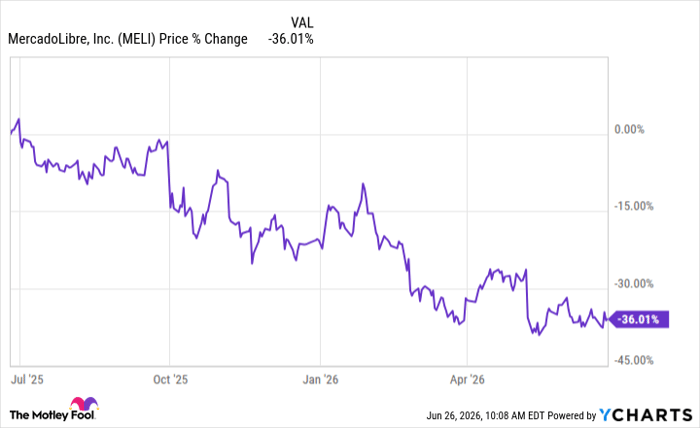
MELI data by YCharts
That sell-off isn't unwarranted, as there are several reasons why investors have sold off MercadoLibre stock. Let's take a look at those challenges before discussing whether MercadoLibre is a buy.

Image source: MercadoLibre.
What's ailing MercadoLibre?
The biggest reason for MercadoLibre's slide is that its profits are falling. In the first quarter, despite a 49% jump in revenue, operating income slipped from $763 million to $611 million.
The decline in profits has come primarily as the company has faced increased competition in Brazil from Sea Limited's Shopee, PDD Holdings' Temu, Amazon, and others. Brazil is MercadoLibre's biggest market, representing about half of its revenue.
To push back against competition, MercadoLibre lowered its free shipping threshold in Brazil, or the minimum order value to get free shipping, which helped accelerate GMV growth to a currency-neutral 38%.
Management first introduced free shipping in 2016, which had a similar headwind on profit margins, but paid off over the longer run, and it expects the lower free shipping threshold to do the same.
The company is also investing in cross-border trade for merchants in China and the U.S., giving them the option to work with the regional leader rather than Amazon or Temu. It's given sellers easier access to free shipping and other incentives, and it opened its first fulfillment center in China to improve relationships with merchants there.
MercadoLibre's margins are also compressing due to the growth of lower-margin businesses, including its first-party e-commerce business and its credit business, which saw a modest rise in delinquency rates in the first quarter.
The credit business introduces a new risk for MercadoLibre, but management sees it as a key driver for the company's two principal businesses, e-commerce and fintech. Its credit portfolio increased 87% to $14.6 billion in the first quarter, and it issued 2.7 million MercadoPago credit cards.
Is MercadoLibre a buy?
It's understandable why falling profits would send MercadoLibre stock lower. After all, this is a stock that has historically traded at a premium valuation priced for growth.
However, the overall picture of the company is that the margin compression is primarily the result of its own decision-making to prioritize long-term growth over short-term profits in a shifting competitive landscape. That's a smart move, and it's similar to the strategy that worked so well for Amazon.
While competition may be impacting MercadoLibre's performance, market share wars don't last forever, as the experience of industries like ridesharing and food delivery has shown. Additionally, MercadoLibre actually gained market share in the first quarter, and its structural advantages, like its MercadoEnvios logistics network, should ensure that it maintains its leadership in Brazil and elsewhere. Management also believes that there's a long runway for growth in Latin American e-commerce as the average Latin American makes just seven online purchases a year, compared to 41 for the average American, so there can be more than one winner here.
The margin pullback is likely temporary, and these investments should pay off. In the meantime, MercadoLibre continues to deliver strong revenue growth, up 49% in the first quarter, a sign of a healthy business despite the bottom-line woes.
With the e-commerce stock down nearly 40% from its peak, MercadoLibre is worth buying here. The long-term growth outlook still looks strong.
Should you buy stock in MercadoLibre right now?
Before you buy stock in MercadoLibre, consider this:
The Motley Fool Stock Advisor analyst team just identified what they believe are the 10 best stocks for investors to buy now… and MercadoLibre wasn’t one of them. The 10 stocks that made the cut could produce monster returns in the coming years.
Consider when Netflix made this list on December 17, 2004... if you invested $1,000 at the time of our recommendation, you’d have $382,359!* Or when Nvidia made this list on April 15, 2005... if you invested $1,000 at the time of our recommendation, you’d have $1,201,390!*
Now, it’s worth noting Stock Advisor’s total average return is 883% — a market-crushing outperformance compared to 205% for the S&P 500. Don't miss the latest top 10 list, available with Stock Advisor, and join an investing community built by individual investors for individual investors.
See the 10 stocks »
*Stock Advisor returns as of June 26, 2026.
Jeremy Bowman has positions in Amazon and MercadoLibre. The Motley Fool has positions in and recommends Amazon, MercadoLibre, and Sea Limited. The Motley Fool has a disclosure policy.
Recommended Articles


