




SpaceX Reportedly Plans to Launch Starlink Retail Mobile Service, Directly Challenging Verizon, AT&T and T-Mobile
T radingKey - On June 25, Eastern Time, S paceX ( S PCX) dropped another bombshell on the market just days after completing the largest I PO in history. According to the Financial Times, citing four people familiar with the matter, S paceX President and C hief Operating Officer Gwynne S hotwell stated during the I PO roadshow that the company is considering launching S tarlink retail mobile services for US consumers and may build its own terrestrial mobile network covering the US.
I f implemented, this would mean S paceX is no longer satisfied with being a supplementary provider of satellite coverage for telecom operators. I nstead, it will directly sell mobile communication contracts to individual users, competing head-on with Verizon Communications ( V Z ), A T&T ( T) and T -Mobile, the three major giants. P reviously, its primary model was to allow telecom carriers like A T&T and T -Mobile to connect to its satellites to supplement rural network coverage and take a cut of the customer revenue.
S paceX has long laid the groundwork for this. L ast S eptember, S paceX announced the purchase of A WS-4 and H -block wireless spectrum licenses from E choS tar for approximately $17 billion. T he two parties revised the agreement in November, with S paceX adding about $2.6 billion to purchase A WS-3 spectrum, bringing the total transaction value to approximately $19.6 billion. T his massive deal was officially approved by the F ederal C ommunications C omission (F CC) in May of this year.
T he wording in the bond offering prospectus also hints at a broader vision: while S tarlink's mobile service currently appeals most to "the unconnected in remote areas," the company's ambition clearly goes beyond this. U ltimately, it aims to become "the preferred provider of connectivity experiences," regardless of whether users live in cities, suburbs, or rural areas.
S tarlink currently operates in more than 150 countries worldwide, with subscription users surpassing 10.3 million as of March this year. F or the full year of 2025, revenue was $18.67 billion, and in the first quarter of 2026, revenue reached $4.69 billion with an E BI T DA margin of 63%. A lthough the S tarlink business is highly lucrative and serves as S paceX's sole "cash cow," S paceX as a whole still posted a net loss of approximately $4.9 billion in 2025 and a net loss of $4.28 billion in the first quarter of 2026.
T his may also explain why S paceX is eager to find new revenue pillars. T he retail mobile service market is far larger than satellite broadband. O nce established, it will not only bring significant recurring revenue to the company but also create leverage against existing partners at the negotiating table.
A s D avid B arden, a partner at NewS treet R esearch, pointed out, S paceX holds only 65 M Hz of spectrum resources, whereas the three major US carriers collectively hold about 1,020 M Hz, making it "extremely difficult" to build its own wireless network in a globally saturated telecom market. H owever, looking at it from another angle, playing the card of "building its own retail network" as a bargaining chip with mobile operators is an exceptionally powerful opening move.
S paceX debuted on the Nasdaq on June 12 at an I PO price of $135, raising $75 billion. T he stock opened at $150 on its first trading day. A s of the close on June 26, the share price fell to $153, down approximately 32% from the high of $225 touched last week.
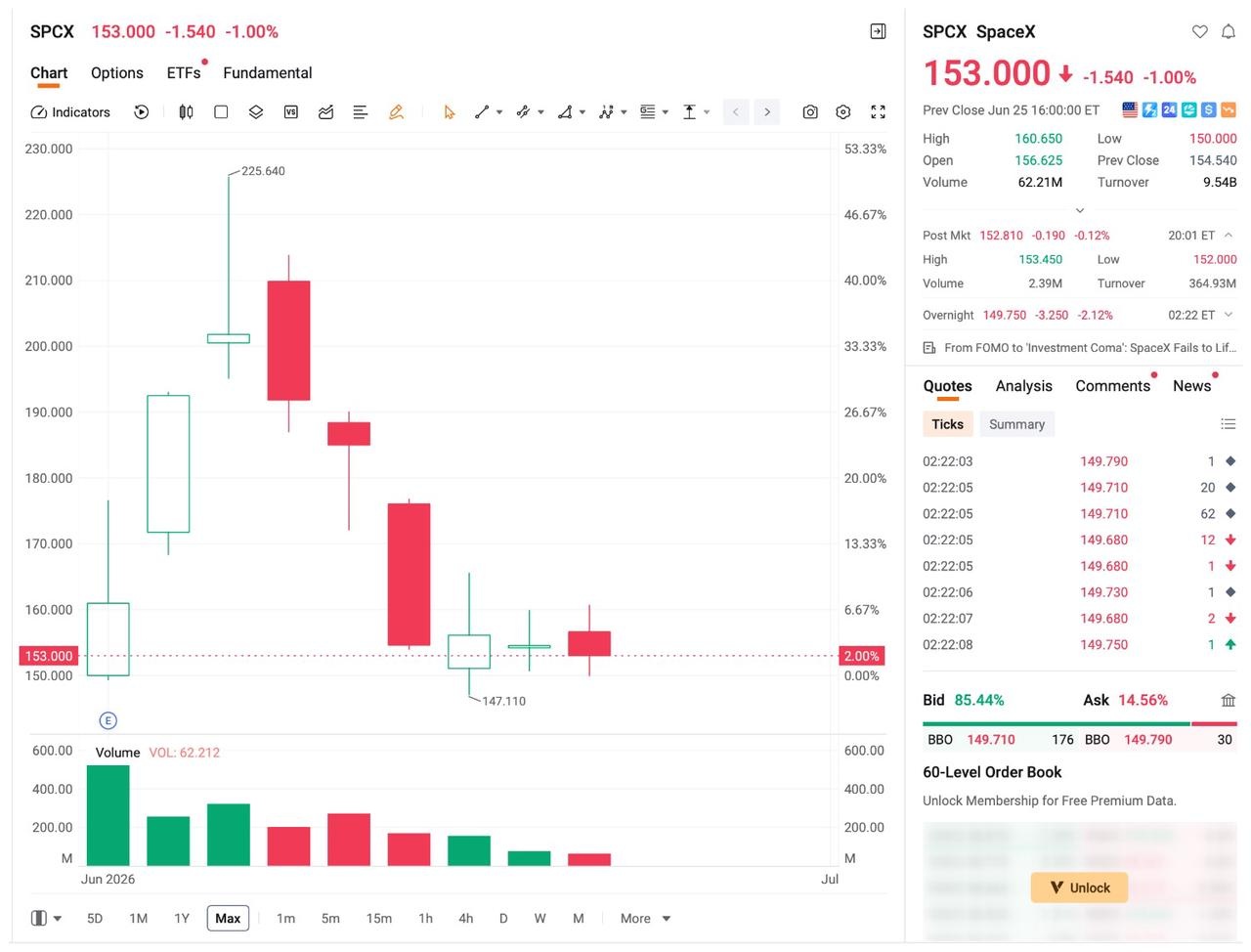
[S ource: F utu]
Recommended Articles


