




Extending Moore’s Law: IBM Launches World’s First Sub-1nm Chip Technology, Dual Leap in Computing Power and Energy Efficiency Ignites Market Enthusiasm
TradingKey - In US pre-market trading on Thursday, IBM ( IBM) shares jumped over 6% at one point after the company announced a milestone breakthrough in semiconductor technology, officially unveiling the world's first manufacturable sub-1nm chip technology.
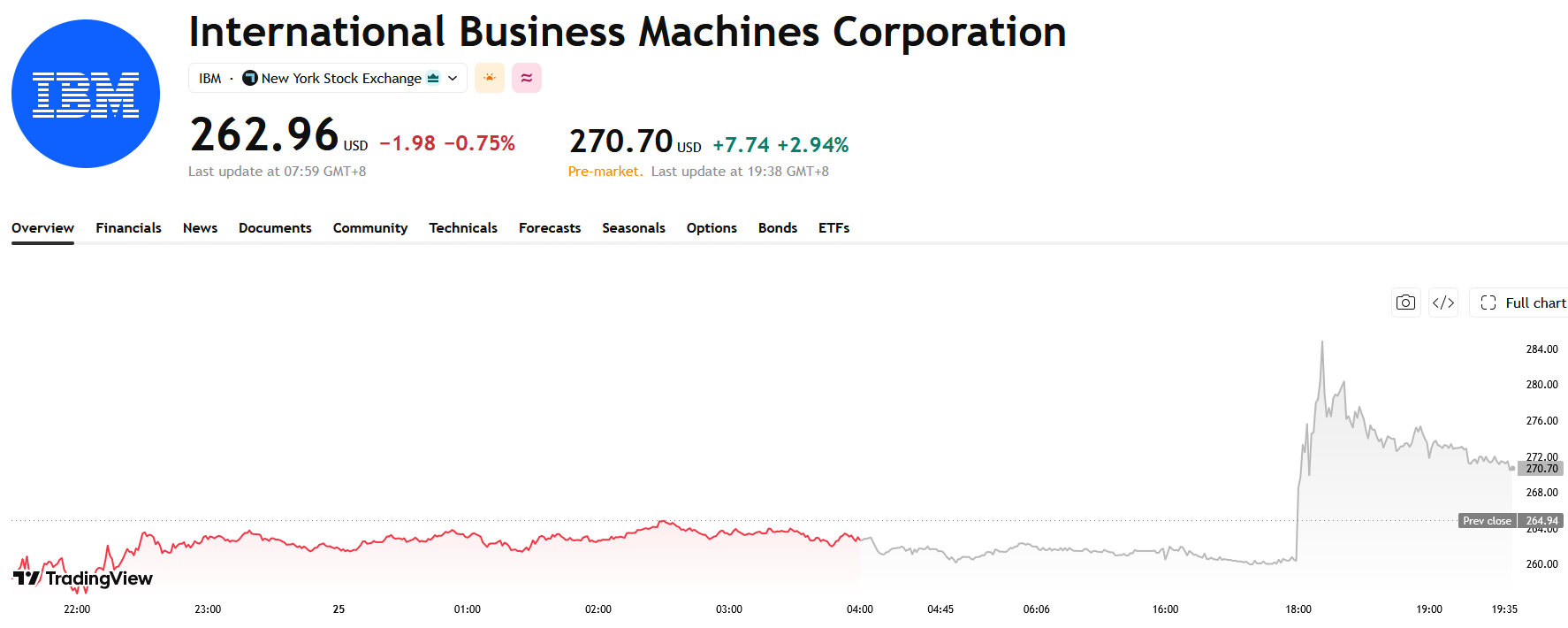
Source: TradingView
The chip utilizes a revolutionary three-dimensional "nanostack" architecture, advancing the transistor node to the 0.7-nanometer (7-angstrom) scale. This achievement not only breaks through the physical limits of chip manufacturing processes but also provides a new path for the continuation of Moore's Law, promising to bring disruptive changes to fields such as AI computing power and cloud computing.
3D stacking breaks through physical limits
Unlike traditional planar transistor layouts, IBM's newly introduced "NanoStack" architecture utilizes a vertically stacked design, arranging transistors in offset layers to pack nearly 100 billion transistors into the same surface area—doubling the density of the 2-nanometer chip released in 2021. This three-dimensional integration technology not only increases chip density but also allows different layers to use distinct materials, enabling the independent optimization of performance and energy efficiency.
Jay Gambetta, director of IBM Research, stated: "We are not just shrinking transistors; we are fundamentally redefining how chips are built."
Laboratory tests show that compared to 2-nanometer node products, this sub-1-nanometer chip offers up to a 50% boost in performance and up to a 70% improvement in energy efficiency. At the same time, the NanoStack architecture shrinks SRAM memory cells by 40%, providing higher bandwidth support for AI workloads.
Furthermore, alongside the release of its sub-1-nanometer technology, IBM announced plans to establish "Anderon," the world's first quantum foundry. This independent subsidiary will integrate IBM's accumulated expertise in quantum computing and semiconductors, helping the U.S. seize a leading position in quantum wafer manufacturing.
To be implemented within five years, with the roadmap extending ten years
Although IBM long ago exited the chip manufacturing business, its laboratory in Albany, New York, continues to lead semiconductor research and development. This breakthrough is the result of close collaboration with equipment manufacturers including ASML and Lam Research, with the upcoming introduction of high-numerical-aperture extreme ultraviolet (High NA EUV) lithography systems providing critical support for sub-1-nanometer processes. IBM expects its NanoStack technology to enter mass production in as early as five years, supporting a continuous scaling roadmap for at least a decade.
TechInsights analyst Dan Hutcheson noted: "This technology extends the chip roadmap by 10 to 15 years, resolving the conflict between the surging demand for computing power in the AI era and energy cost constraints." Currently, TSMC is already mass-producing 2-nanometer chips, while Intel's 18A process (approximately 1.8nm) has entered the risk production phase. IBM's sub-1-nanometer technology will undoubtedly propel industry competition into a new phase.
Recommended Articles


