




Missed Out On Dell Technologies' Red-Hot Rally? Here's Another Artificial Intelligence (AI) Infrastructure Stock to Buy Hand Over Fist Before It Becomes a Multibagger
Key Points
Jabil serves key AI-focused industries, such as data centers and semiconductors, which is why it has been consistently upgrading its guidance.
The stock's growth potential and cheap valuation make it a no-brainer buy right now.
- 10 stocks we like better than Jabil ›
Dell Technologies (NYSE: DELL) stock has shot up by a phenomenal 235% in 2026, as investors have been buying the stock hand over fist to capitalize on the booming demand for artificial intelligence (AI) servers.
Dell released its fiscal 2027 first-quarter results (for the three months ended May 1) on May 28, and it became evident that it is poised to witness significant acceleration in growth. Dell's revenue shot up 88% year over year to $43.8 billion, primarily driven by a 181% spike in its infrastructure solutions group (ISG) segment. This business benefited from the strong demand for Dell's AI-optimized servers, and it is likely to drive even stronger growth for the company in the long run.
Where to invest $1,000 right now? Our analyst team just revealed what they believe are the 10 best stocks to buy right now, when you join Stock Advisor. See the stocks »
The good part is that it isn't too late to buy this AI stock. Dell trades at just 2 times sales, suggesting that it can become a multibagger if the market rewards it with a premium valuation due to its accelerating revenue growth. However, there's another underrated company -- Jabil (NYSE: JBL) -- that's benefiting from the massive investments in AI data centers and is as cheap as Dell.
What's more, it is yet to take off like its bigger peer. Let's look at the reasons why Jabil could go on a parabolic run like Dell.

Image source: Getty Images.
AI is going to move the needle in a bigger way for Jabil
Jabil is a contract electronics manufacturer that serves multiple industries, such as automotive, semiconductor equipment, healthcare, networking and communications, cloud and data center infrastructure, and others. Not surprisingly, the company's semiconductor capital equipment, cloud and data center, and networking businesses are in solid form due to AI.
Jabil manufactures data center infrastructure, such as server racks, power management solutions, and liquid-cooling systems. It also offers advanced semiconductor test equipment and wafer fabrication equipment. It also assists customers in manufacturing wired and optical networking equipment. So, the company serves key industries experiencing secular growth driven by AI.
As a result, it anticipates $13.6 billion in AI-related revenue in fiscal 2026, up by 51% from the previous year. Notably, Jabil has consistently raised its AI revenue expectations throughout the year. The company was originally anticipating a 25% increase in AI-related revenue in fiscal 2026 to $11.2 billion. However, as demand for its AI data center, networking, and semiconductor offerings increased, it began to see stronger growth.
The uptick in AI revenue is positively impacting Jabil's overall growth. The company released its fiscal 2026 third-quarter results (for the three months ending May 31) on June 17. Its revenue increased by 12% year over year to $8.8 billion, while non-GAAP earnings per share increased by 24% to $3.16. Jabil also raised its full-year forecast.
The company now anticipates fiscal 2026 revenue of $35 billion, which would be an improvement of 17.4% from the prior year. Also, its non-GAAP earnings per share guidance of $12.70 represents a 30% increase over fiscal 2025 levels. For comparison, Jabil's earnings increased by 15% in the previous fiscal year.
Clearly, the acceleration in AI revenue is giving Jabil a solid boost. Specifically, AI will account for 39% of Jabil's top line in fiscal 2026, a nice improvement over 30% in fiscal 2025. It won't be surprising to see Jabil's growth accelerating in the future as AI has the potential to become a bigger growth driver for the company.
I say this because Jabil has been winning new customers for its AI-related solutions, adding a third hyperscaler customer to its ranks in the previous quarter. Importantly, Jabil won additional business after signing initial deals with its hyperscaler customers, which may explain its accelerating growth.
Moreover, there is a good chance the company will add more AI-focused customers to its portfolio due to the strong growth prospects in the server, semiconductor, and networking end-markets. The global AI server market is poised to expand at an annual rate of 34% through 2030, while the semiconductor manufacturing equipment space is poised to clock 11% growth through 2034, as per third-party research estimates.
Optical networking, meanwhile, is emerging as the next major bottleneck in the AI infrastructure market, suggesting that it could present another tremendous growth opportunity for Jabil. As such, there is a good chance of Jabil's growth rate picking up over the long run, and that could translate into healthy stock price upside.
The stock has multibagger potential
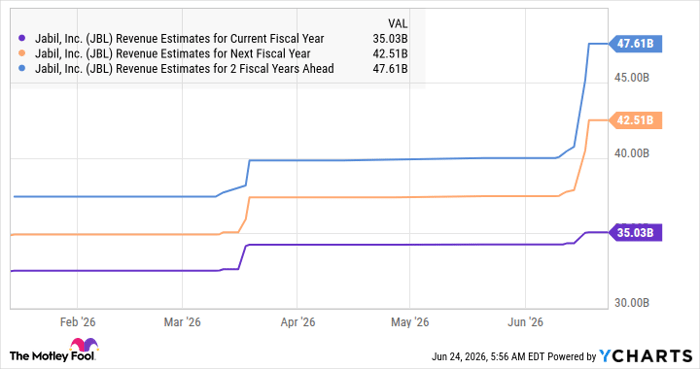
Analysts have become bullish about Jabil's growth prospects following its latest quarterly report, significantly raising their revenue expectations.
Data by YCharts
The chart above indicates that Jabil's top line is on track to grow by strong double digits over the next couple of years as well. Of course, it could do better than that given the fast-growing nature of the AI server, optical networking, and semiconductor markets. But even if Jabil grows in line with Wall Street's expectations, it deserves to trade at a significant premium.
Jabil has a price-to-sales ratio of 1.2. That's well below the tech-focused Nasdaq Composite index's sales multiple of 5.3. Assuming Jabil trades at a conservative 3x sales in fiscal 2028, its market cap could reach $143 billion (based on the revenue estimate shown in the chart above). That's 3.5x Jabil's current market cap.
So, investors have an opportunity to buy this growth stock benefiting from AI adoption at an extremely attractive valuation right now, and doing so could prove the right move, given the potential upside on offer.
Should you buy stock in Jabil right now?
Before you buy stock in Jabil, consider this:
The Motley Fool Stock Advisor analyst team just identified what they believe are the 10 best stocks for investors to buy now… and Jabil wasn’t one of them. The 10 stocks that made the cut could produce monster returns in the coming years.
Consider when Netflix made this list on December 17, 2004... if you invested $1,000 at the time of our recommendation, you’d have $392,713!* Or when Nvidia made this list on April 15, 2005... if you invested $1,000 at the time of our recommendation, you’d have $1,227,782!*
Now, it’s worth noting Stock Advisor’s total average return is 897% — a market-crushing outperformance compared to 208% for the S&P 500. Don't miss the latest top 10 list, available with Stock Advisor, and join an investing community built by individual investors for individual investors.
See the 10 stocks »
*Stock Advisor returns as of June 24, 2026.
Harsh Chauhan has no position in any of the stocks mentioned. The Motley Fool has no position in any of the stocks mentioned. The Motley Fool has a disclosure policy.
Recommended Articles


