




The Strait of Hormuz Is Open: Time to Buy Airline Stocks?
Key Points
Transit through the Strait of Hormuz is precarious, as full peace talks are ongoing and normalization will take time.
Airline stocks have already erased losses from conflict-related events.
Delta's oil refinery helps it offset some increases in jet fuel costs, while American Airlines is re-shaping its operations.
- 10 stocks we like better than Delta Air Lines ›
Last week, the U.S. and Iran signed a memorandum of understanding (MOU), and tankers began to travel through the vital Strait of Hormuz once more. However, the situation remains fluid: By the end of the week, there were mixed reports about restrictions on transit through the vital waterway. The MOU is the beginning of a 60-day negotiation period, rather than a full peace deal.
WTI crude prices have fallen by more than 20% over the past month to around $75 (as of June 22). That's up from $57 at the start of the year, but significantly down from almost $113 in April. The challenge for investors is that reopening the Strait is not a linear process from geopolitical and logistical perspectives. It will take time, and there may be further moves to restrict tanker movements if violence restarts.
Missed Nvidia in 2009? This Rare Signal Is Flashing Again. In 2009, a "Double Down" signal flashed for a little-known chipmaker called Nvidia. For the first time in years, that same "Total Conviction" signal is flashing for a company 1/100th the size of Nvidia. Continue »
When major geopolitical shifts occur, it is natural to consider which sectors might become more or less attractive. High jet fuel prices certainly pressured airline stocks at the start of the conflict, but markets have already started to price in an end to the war. Indeed, the U.S. Global Jets ETF (NYSEMKT: JETS), which tracks the global airline industry, is trading higher than when the war started. Not only has air travel demand proven remarkably resilient, but traders are already looking beyond the conflict.

Image source: Getty Images.
Is it time to buy airline stocks?
The Strait of Hormuz is important, but the bigger question is what place individual airlines might have in your portfolio for the coming five years or more. It is a challenging and cyclical sector, with fierce competition and high fixed costs, including fuel, planes, and staff, that can be particularly susceptible to economic and geopolitical shocks. This year's events are a reminder of the impact that global conflict can have on fuel prices, travel demand, and flight paths.
Here's what you need to know about Delta Air Lines (NYSE: DAL) and American Airlines (NASDAQ: AAL) -- two top airline stocks with very different investment profiles.
Delta Air Lines
Delta Air Lines has proven the most resilient of U.S. airlines this year. Its stock sank at the start of the conflict, but recovered quickly: It is up over 21% year-to-date and rose to an all-time high last week after announcing a 15% quarterly dividend increase. CEO Ed Bastian is credited with championing the company's commitment to excellence and premium brand, and that strong leadership is an important factor for investors.
Two features have helped Delta during what's been a tough period for airlines. First, it owns an oil refinery in Pennsylvania, which it used to offset the worst of the higher jet fuel costs. Second, premium customers -- who have continued to travel even as prices have risen -- make up an increasing part of its revenue. Delta generated more than 60% of its Q1 revenue from premium and corporate customers, and its loyalty program.
Delta's Q1 2026 revenue was $14.2 billion, up almost 10% year over year, although it had a net loss of $289 million for the quarter. Demand remained high even as the firm increased fares and baggage fees and reduced capacity to mitigate the impact of high fuel costs. Delta stock may appeal to investors looking for an airline with solid long-term potential and some insulation from oil price fluctuations.
American Airlines
Some see American Airlines as a turnaround story. The firm has lagged both United Airlines and Delta, but is focused on increasing its corporate and premium share and improving flight reliability. It also expanded its partnership with Citi by launching an exclusive co-branded credit card this year, which is already generating earnings and could further build customer loyalty.
Similar to Delta, its Q1 2026 revenue increased almost 11% year over year to $13.9 billion, though its net loss was higher at $382 million. American Airlines' heavy debt continues to drag on its bottom line. At the end of Q1 2026, its total debt was $34.7 billion -- the first time it's been under $35 billion since 2015. For context, Delta's total debt stands at $13.5 billion. Putting aside the interest costs, that debt means American has less room to maneuver when things get tough.
American Airlines has underperformed both Delta and its industry peers so far this year. That could present an opportunity, particularly in light of its strategic changes, but there are still headwinds ahead.
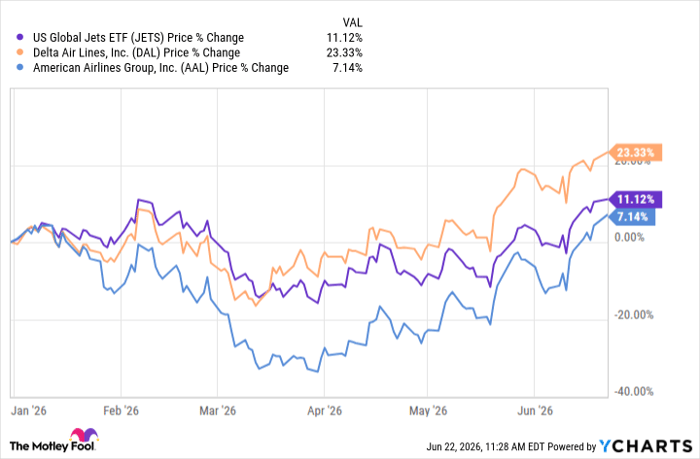
JETS data by YCharts
Expect further turbulence
Don't invest in airline stocks because of what's happening with the Strait of Hormuz. Not only are negotiations still fragile, but it will also take time for traffic to flow normally again, and damage to key infrastructure could take months or years to repair. Instead, think about how individual airlines might fit into your portfolio, and whether you see more long-term opportunity in American Airlines' potential comeback than Delta's continued premium plan.
Should you buy stock in Delta Air Lines right now?
Before you buy stock in Delta Air Lines, consider this:
The Motley Fool Stock Advisor analyst team just identified what they believe are the 10 best stocks for investors to buy now… and Delta Air Lines wasn’t one of them. The 10 stocks that made the cut could produce monster returns in the coming years.
Consider when Netflix made this list on December 17, 2004... if you invested $1,000 at the time of our recommendation, you’d have $392,713!* Or when Nvidia made this list on April 15, 2005... if you invested $1,000 at the time of our recommendation, you’d have $1,227,782!*
Now, it’s worth noting Stock Advisor’s total average return is 897% — a market-crushing outperformance compared to 208% for the S&P 500. Don't miss the latest top 10 list, available with Stock Advisor, and join an investing community built by individual investors for individual investors.
See the 10 stocks »
*Stock Advisor returns as of June 24, 2026.
Citigroup is an advertising partner of Motley Fool Money. Emma Newbery has no position in any of the stocks mentioned. The Motley Fool recommends Delta Air Lines. The Motley Fool has a disclosure policy.
Recommended Articles


