




Kevin Warsh's Fed "Regime Change" Could Sink the Stock Market, and the Blame Lies With President Trump
Key Points
Warsh says the Fed is making decisions based on outdated models that fail to account for the deflationary impact of artificial intelligence.
Warsh thinks AI-driven productivity gains, coupled with a reduction in the Fed’s balance sheet, leave room for lower interest rates.
Trump's decisions have put Warsh in a tough spot: Rate cuts would raise questions about Fed independence that could sink the stock market.
- 10 stocks we like better than S&P 500 Index ›
The S&P 500 (SNPINDEX: ^GSPC) returned 12.7% annually under former Federal Reserve Chair Jerome Powell, its best performance under any chairman since Paul Volcker took the position in 1979. Yet President Trump repeatedly criticized Powell and other Fed officials for keeping interest rates too high.
The president's attempts to influence monetary policy didn't stop at verbal attacks. Since Trump returned to office, the Justice Department has launched criminal investigations into Powell and Fed Governor Lisa Cook, moves that many economists warn could erode trust in the central bank.
Will AI create the world's first trillionaire? Our team just released a report on the one little-known company, called an "Indispensable Monopoly" providing the critical technology Nvidia and Intel both need. Continue »
Enter Kevin Warsh, a former Fed governor who has argued for lower interest rates since last year. "We can begin reform at the Fed with a rate cut, which is just the first step to regime change," he told CNBC in July 2025. Warsh officially replaced Powell as Fed chair in May after securing Trump's nomination earlier this year.
However, Warsh's plans for a regime change in the conduct of monetary policy have been complicated by Trump's attacks on the Fed and his decision to wage war in Iran.
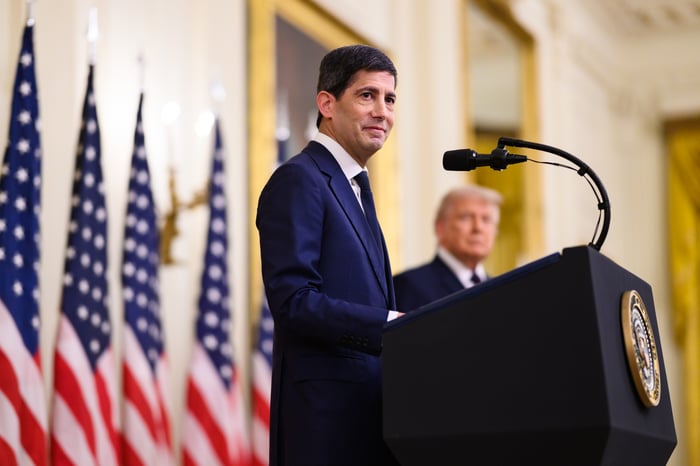
Fed Chair Kevin Warsh and President Donald Trump. Image source: Official White House Photo.
Warsh says the deflationary impact of AI leaves room for interest rate cuts
Warsh believes the Federal Reserve is setting monetary policy based on outdated models that fail to account for the deflationary impact of artificial intelligence. "We are probably in the early innings of a structural decline in prices," he told CNC last year. "AI is going to make almost everything cost less."
Warsh argues AI-driven productivity gains would support lower interest rates. But I doubt that argument will fly in the current climate. Investors actually expect the Fed to raise interest rates early next year to curb inflation tied to the Iran war. If Warsh votes to cut rates any time soon, it could damage the Fed's credibility and sink the stock market.
CPI inflation increased to 3.8% in April, its worst reading in three years, as the Iran war pushed energy prices higher. And the situation is still deteriorating. A forecasting tool from the Federal Reserve Bank of Cleveland shows CPI inflation accelerating above 4% in May and June.
Against that backdrop, rate cuts would be met with extreme skepticism. Investors would wonder if President Trump had compromised the Fed's independence. Even the perception of political interference would make the central bank less credible, and that could have a devastating impact on financial markets.
The stock market could plunge if investors question the Federal Reserve's independence
A politically motivated Fed could not be trusted to make monetary policy decisions in the best interest of the economy over the long term. Instead, policymakers could cut rates to boost the economy for political reasons, such as winning favor with voters ahead of an election. But unnecessary rate cuts would ultimately lead to higher inflation.
Bond investors would anticipate that risk and demand higher yields as compensation. That means they would sell existing bonds (driving prices lower and yields higher) until payouts were sufficiently attractive. New bonds would have to match those rates to stay competitive. That domino effect could hurt the stock market in two ways.
First, higher yields would make bonds more attractive to investors, which could pull money away from stocks. Second, stocks are frequently valued using the discounted cash flow model, and higher yields would compress valuations by reducing the present value of future cash flows.
Kevin Warsh wants to shrink the Federal Reserve's balance sheet
Warsh believes the inflationary impact of rate cuts could be offset by shrinking the Fed's balance sheet, a process known as quantitative tightening (QT). The Fed currently holds $6.7 trillion in assets (two-thirds of which are Treasury bonds), representing a substantial increase from $900 billion in 2007.
The Fed began purchasing bonds in earnest to stabilize markets during the financial crisis in 2008. Interest rates were already near zero, which forced policymakers to get creative. But Warsh thinks the Fed has leaned too heavily on that strategy. He views interest rates as a more even-handed monetary policy tool.
"The Fed has an interest rate tool and a balance sheet tool. My view is the interest rate tool gets in the cracks. It's fairer," Warsh told the Senate Banking Committee during his confirmation hearing. "The balance sheet tool disproportionately helps those with financial assets. The interest rate tool hits the entire economy."
Warsh may be correct, but it doesn't address concerns about Fed independence. If Warsh tries to justify rate cuts by shrinking the Fed's balance sheet, investors may see it as a surreptitious attempt to placate President Trump.
Here's the big picture: Trump's attacks on the Federal Reserve and his decision to take military action in Iran have put Warsh in a tough position. While Warsh's views on AI and the Fed's balance sheet may be spot on, rate cuts in the current climate would raise questions about the Fed's independence, which could cause the stock market to plunge.
Should you buy stock in S&P 500 Index right now?
Before you buy stock in S&P 500 Index, consider this:
The Motley Fool Stock Advisor analyst team just identified what they believe are the 10 best stocks for investors to buy now… and S&P 500 Index wasn’t one of them. The 10 stocks that made the cut could produce monster returns in the coming years.
Consider when Netflix made this list on December 17, 2004... if you invested $1,000 at the time of our recommendation, you’d have $445,672!* Or when Nvidia made this list on April 15, 2005... if you invested $1,000 at the time of our recommendation, you’d have $1,280,566!*
Now, it’s worth noting Stock Advisor’s total average return is 948% — a market-crushing outperformance compared to 206% for the S&P 500. Don't miss the latest top 10 list, available with Stock Advisor, and join an investing community built by individual investors for individual investors.
See the 10 stocks »
*Stock Advisor returns as of June 10, 2026.
Trevor Jennewine has no position in any of the stocks mentioned. The Motley Fool has no position in any of the stocks mentioned. The Motley Fool has a disclosure policy.
Recommended Articles


