




The SpaceX IPO Is Weeks Away: Here's What History Says Happens After It Starts Trading
Key Points
SpaceX aims to raise $75 billion at a valuation of at least $1.75 trillion, according to reports.
There's conflicting data about recent IPOs and large venture-backed IPOs.
The biggest IPOs of the last 20 years may be the best indication of how SpaceX will trade after its debut.
- These 10 stocks could mint the next wave of millionaires ›
SpaceX is set to make history in just a couple of weeks when it makes its public market debut. The company is looking to raise $75 billion, putting the company's valuation at $1.75 billion, according to reports. That would make it the largest public offering in history.
With all the excitement around the company, it wouldn't be a surprise to see the space stock rocket higher even before it opens for trading. A first-day IPO pop isn't uncommon, as underwriters aim to support their valuation and ensure a successful debut. While SpaceX founder Elon Musk plans to set aside a large chunk of shares for retail investors at the IPO price, many more will likely be looking to get into the stock once it starts trading. And history suggests it's often much riskier to buy shares on the first day of trading.
Will AI create the world's first trillionaire? Our team just released a report on the one little-known company, called an "Indispensable Monopoly" providing the critical technology Nvidia and Intel both need. Continue »
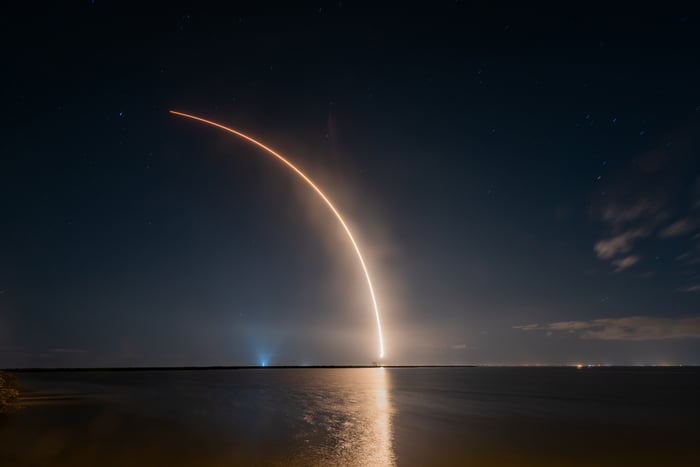
Image source: Getty Images.
What do decades of IPO data say will happen after SpaceX starts trading?
Professor Jay Ritter maintains a massive database of IPO statistics dating back to 1980. His data show an interesting development that's especially pertinent to anyone interested in the SpaceX IPO. Between 2011 and 2024, the average IPO popped 23% on its first day of trading. However, over the following one-year period, the average return for new issues from their first-day closing price is negative 1.7%.
The trend has gotten significantly worse since 2020. There were 311 IPOs in 2021, but they posted a one-year average return of negative 49.1% after the first day of trading. Granted, those issues got caught up in the 2022 bear market. IPO frequency slowed significantly since, but the 164 IPOs in 2022, 2023, and 2024 produced an average one-year return of negative 17.9% despite the strong bull market.
IPOs have historically continued to climb after their debuts, though they have typically trailed overall market returns, according to Ritter's data. The only other period in which IPOs had negative one-year returns after they started trading was 1999 to 2000, when many small, unprofitable dot-com companies took advantage of extremely high valuations ahead of the bubble popping.
The simplest explanation for the recent downturn in overall IPO results is that companies are waiting longer to go public, as they can raise billions of dollars in private capital. When a company is already a mature business by the time it goes public, there's less room for capital appreciation, so the theory goes.
But larger companies can still produce solid returns for investors. From 1980 through 2024, venture capital-backed companies with more than $100 million in annual sales (adjusted for inflation) produced average three-year returns that beat the market by 11%.
So, the data is mixed for SpaceX: Newer IPOs have struggled, but large venture-backed companies have outperformed.
How do the biggest IPOs perform?
To be sure, an IPO the size of SpaceX is unprecedented, but it may be worth examining only the largest IPOs in recent history to get an idea of how it might perform.
Logically, larger, more mature companies offer less upside than smaller, rapidly growing companies. Not only can they produce very strong growth as a percentage of existing revenue and earnings, but it doesn't take a huge amount of capital flowing into the stock to move the price significantly higher.
With that in mind, here are some of the largest U.S. IPOs in the last 20 years and their one-year performances following their debuts.
| Stock | Offer Date |
Amount Raised |
One-Year Performance |
S&P 500 Return |
Relative Performance |
|---|---|---|---|---|---|
| Alibaba | Sept. 18, 2014 | $21.8 billion | (28.9%) | (1.4%) | (27.5 pp) |
| Visa | March 18, 2008 | $17.8 billion | (18.1%) | (41%) | 22.9 pp |
| Facebook (now Meta Platforms) | May 17, 2012 | $16 billion | (24.3%) | 26.6% | (50.9 pp) |
| General Motors | Nov. 17, 2010 | $15.8 billion | (33.9%) | 3.1% | (37 pp) |
| Rivian Automotive | Nov. 9, 2021 | $11.9 billion | (73.2%) | (14.9%) | (58.3 pp) |
| Uber Technologies | May 9, 2019 | $8.1 billion | (12.7%) | 2.1% | (14.8 pp) |
| Coinbase Global* | April 14, 2021 | N/A | (52.9%) | 7.8% | (60.7 pp) |
*Coinbase went public via a direct listing. Data source: YCharts, Renaissance Capital.
As you can see, the track record of the biggest of the big IPOs has been pretty dismal over the last 20 years. That suggests that the sweet spot for IPOs may be companies with significant revenue bases and the confidence of venture capitalists, but not so big that continued growth will be difficult.
SpaceX's valuation is highly speculative, based on massive growth expectations for endeavors with decades-long timelines. That makes the stock not too dissimilar to Musk's Tesla, which is valued based on its potential robotaxi and robotics businesses. It could offer good value to investors willing to take on the business's risks at its IPO price.
However, if you can't buy directly into the IPO, it's probably worth waiting for a pullback in the share price after its first-day pop. History suggests there could be a much better entry point for the highly anticipated IPO within the next year.
Where to invest $1,000 right now
When our analyst team has a stock tip, it can pay to listen. After all, Stock Advisor’s total average return is 978%* — a market-crushing outperformance compared to 211% for the S&P 500.
They just revealed what they believe are the 10 best stocks for investors to buy right now, available when you join Stock Advisor.
See the stocks »
*Stock Advisor returns as of May 31, 2026.
Adam Levy has positions in Meta Platforms, Uber Technologies, and Visa. The Motley Fool has positions in and recommends Meta Platforms, Tesla, Uber Technologies, and Visa. The Motley Fool recommends Alibaba Group, Coinbase Global, and General Motors. The Motley Fool has a disclosure policy.
Recommended Articles


