




Prediction: The Trump Bull Market Will Come to an Abrupt End Because of 2 Decisions Made by the President
Key Points
The Dow Jones Industrial Average, S&P 500, and Nasdaq Composite have all soared with Donald Trump in the White House.
However, President Trump's military campaign against Iran is having far-reaching effects on U.S. inflation.
Additionally, Trump's pick to succeed Fed Chair Jerome Powell, Kevin Warsh, has a track record of being hawkish, which is terrible news for a historically pricey stock market amid an inflationary environment.
- 10 stocks we like better than S&P 500 Index ›
Based solely on return data, Wall Street has absolutely loved having Donald Trump in the White House. Although volatility has been breathtaking at times under Trump, the iconic Dow Jones Industrial Average (DJINDICES: ^DJI), benchmark S&P 500 (SNPINDEX: ^GSPC), and growth-driven Nasdaq Composite (NASDAQINDEX: ^IXIC) soared 57%, 70%, and 142%, respectively, during his first, non-consecutive term.
Despite the S&P 500 or Dow advancing in 26 of the last 33 presidential terms, dating back to 1896, annualized returns under Trump are notably higher than under most other presidents.
Will AI create the world's first trillionaire? Our team just released a report on the one little-known company, called an "Indispensable Monopoly" providing the critical technology Nvidia and Intel both need. Continue »
To be fair, some of the catalysts driving the Trump bull market have virtually nothing to do with the president. The evolution of artificial intelligence and the advent of quantum computing were well underway before Donald Trump began his second term.
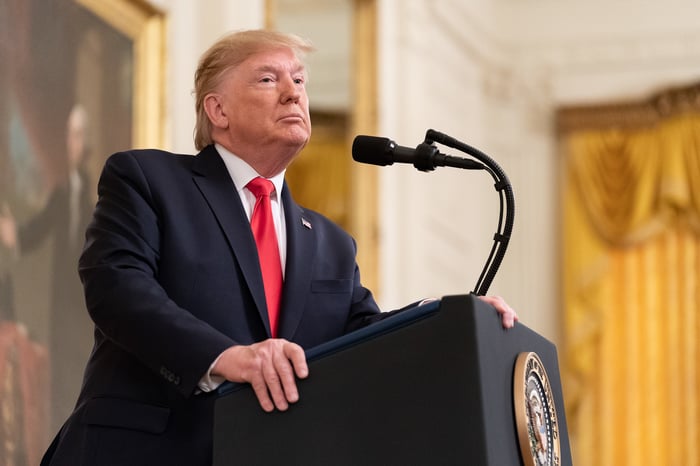
President Trump delivering remarks. Image source: Official White House Photo by Shealah Craighead, courtesy of the National Archives.
But there are aspects of this rally that decisively have the president's fingerprints on them. For example, S&P 500 share buybacks hit an all-time high in 2025. Trump's flagship tax and spending law, the Tax Cuts and Jobs Act, permanently lowered the peak marginal corporate income tax rate, allowing businesses to retain more of their earnings and meaningfully boost their buybacks.
While the Trump bull market is currently firing on all cylinders, history teaches that sentiment can turn on a dime. Although nothing can ever be guaranteed on Wall Street, two decisions made by President Trump look to have sealed the Trump bull market's fate.
Iran war inflationary pressures can't be swept under the rug
The first decision that's likely to come back to bite Wall Street is the president giving the green light to attack Iran.
On Feb. 28, U.S. and Israeli military forces commenced attacks on Iran. Shortly after these military operations began, Iran shut down the Strait of Hormuz to virtually all commercial vessels. Iran's actions threw 20 million barrels of petroleum liquids per day into limbo, adversely affecting 20% of the world's crude oil demand.
Even if Trump were to swiftly end the Iran war (it's still ongoing as of this writing on May 10), the damage caused by the largest energy supply disruption in modern history will already be done.
⛽ Average U.S. gas prices per gallon on May 6, per AAA:
-- NBC News (@NBCNews) May 6, 2026
• Regular: $4.54 (⬆️ $1.56 since war in Iran began on Feb. 28)
• Premium: $5.39 (⬆️ $1.85 since war began)
• Diesel: $5.67 (⬆️ $1.81 since war began)
The most direct impact of the Iran war has been seen at the fuel pumps, where gas prices have soared at the fastest pace in over 30 years. Although gas accounts for just 3.1% of the average American household budget, according to research by The Motley Fool, it can be a considerably larger percentage of monthly expenditures for low-income households.
But this is just the tip of the iceberg when it comes to energy supply shocks. The effect of higher energy prices on businesses often lags a few months. When higher transportation and production costs begin to show up in economic data, the U.S. inflation rate can rise further.
In February, before the effects of the Iran war were impacting the U.S. economy, trailing 12-month (TTM) inflation clocked in at 2.4%. In March, TTM inflation jumped 90 basis points to 3.3%. With the Cleveland Fed's Inflation Nowcasting tool projecting TTM inflation of 3.89% in May, it's looking increasingly likely that inflation will become a nuisance to consumers and businesses, forcing the Federal Reserve to act.

Image source: Getty Images.
Trump's pick to lead the Fed comes with unintended consequences for Wall Street
However, green-lighting the Iran war isn't the only decision that threatens to bring the Trump bull market to an abrupt end. Donald Trump's choice of Kevin Warsh to succeed Jerome Powell, whose final day as Fed chair was May 15, may come back to haunt the president.
Warsh was previously on the Board of Governors of the Federal Reserve (Feb. 24, 2006 – March 31, 2011) and was a voting member of the Federal Open Market Committee (FOMC) -- the 12-person body responsible for setting the nation's monetary policy. He was one of the puzzle pieces instrumental in navigating the U.S. economy through the financial crisis.
But it's impossible to overlook Warsh's FOMC voting record or monetary policy ideology, which potentially put him and the FOMC on a collision course with Wall Street and President Trump.
On paper, all members of the FOMC aim to uphold the dual mandate of maximum employment and price stability. Yet throughout the financial crisis, Kevin Warsh's voting record shows he consistently favored price stability and higher interest rates, even as the unemployment rate soared. His desire to suppress inflation earned him the label of "hawk."
"If Trump wants someone easy on inflation, he got the wrong guy in Kevin Warsh."@AnnaEconomist pic.twitter.com/FGMfeSqHpU
-- Daily Chartbook (@dailychartbook) January 31, 2026
Based on the Cleveland Fed's estimate, the Iran war is on track to increase TTM inflation by nearly 150 basis points between February and May. That's not the type of move that can be swept under the rug -- especially when the new head of the Fed has a track record of favoring price stability above all else.
Even though Kevin Warsh represents just one of 12 votes, his influence, coupled with that of three FOMC members (Beth Hammack, Neel Kashkari, and Lorie Logan) opposing the inclusion of an easing bias in the April FOMC meeting statement, points to the growing likelihood of a shift toward a neutral or hiking bias in the not-too-distant future.
One of the foundational pillars of the Trump bull market's resiliency has been the prospect of lower interest rates and/or sustained access to cheap capital. Rapidly rising inflation caused by the Iran war, paired with a hawkish Fed chair and a historically pricey stock market, is a recipe for disaster for the Dow Jones Industrial Average, S&P 500, and Nasdaq Composite.
Should you buy stock in S&P 500 Index right now?
Before you buy stock in S&P 500 Index, consider this:
The Motley Fool Stock Advisor analyst team just identified what they believe are the 10 best stocks for investors to buy now… and S&P 500 Index wasn’t one of them. The 10 stocks that made the cut could produce monster returns in the coming years.
Consider when Netflix made this list on December 17, 2004... if you invested $1,000 at the time of our recommendation, you’d have $469,293!* Or when Nvidia made this list on April 15, 2005... if you invested $1,000 at the time of our recommendation, you’d have $1,381,332!*
Now, it’s worth noting Stock Advisor’s total average return is 993% — a market-crushing outperformance compared to 207% for the S&P 500. Don't miss the latest top 10 list, available with Stock Advisor, and join an investing community built by individual investors for individual investors.
See the 10 stocks »
*Stock Advisor returns as of May 17, 2026.
Sean Williams has no position in any of the stocks mentioned. The Motley Fool has no position in any of the stocks mentioned. The Motley Fool has a disclosure policy.
Recommended Articles


