




Here's Why a Drop in Oil Prices Might Be a Warning Sign for the Economy
Key Points
A pullback in oil prices would initially be good for many companies and consumers.
But a prolonged decline would suggest the global economy is sputtering out.
- 10 stocks we like better than Chevron ›
The price of Brent crude oil has risen more than 90% this year to about $120 per barrel. The main catalyst was the outbreak of the Iran war in late February, which throttled oil shipments through the Strait of Hormuz -- the chokepoint for roughly 25% of the world's maritime oil trade.
Rising oil prices generated tailwinds for big oil companies like Chevron (NYSE: CVX), but generated fierce headwinds for other sectors dependent on low or stable oil prices. Therefore, a pullback in oil prices might seem like a green flag for those struggling companies. However, a steeper-than-expected drop could actually be a grim warning sign for the economy.
Will AI create the world's first trillionaire? Our team just released a report on the one little-known company, called an "Indispensable Monopoly" providing the critical technology Nvidia and Intel both need. Continue »
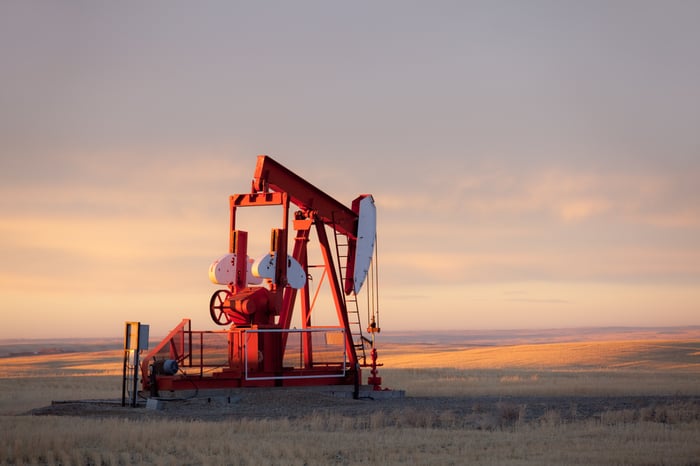
Image source: Getty Images.
Why would declining oil prices be bad for the economy?
If the Iran conflict ends, crude oil prices will inevitably decline. That pullback should initially reduce transportation costs and ease pressure on consumers, enabling companies to stabilize their margins and sell more products and services.
But if oil prices continue to decline, that's an indicator that factories, logistics companies, and airlines are using less oil. That means manufacturing is slowing down, trade volumes are declining, and global travel is cooling as consumers rein in their discretionary spending. That's why oil prices crashed during the Great Recession and the COVID-19 recession, yet no one considered those record-low prices a good sign for the global economy.
As oil prices decline, big oil companies will also reduce their production and cut their spending. For example, Chevron has a breakeven price of about $50 per barrel for Brent crude oil. If it drops below that level, Chevron will likely need to pause its projects, reduce its hiring, or trim its workforce to stabilize its profits. Chevron and its industry peers will also struggle to reduce their debt -- which would cause headaches for big financial institutions.
Since oil prices are forward-looking, a sharp decline would also be a clear indicator of future economic challenges. That red flag could trigger deflation and prompt companies to pause investments, exacerbating the economic slowdown.
Oil prices need to stabilize at a "Goldilocks" level
Oil prices could stay elevated throughout the rest of the year if the Iran conflict drags on. But if it ends and oil prices drop faster than expected, investors should brace for deflation and a messy economic slowdown that could ripple through the energy, financial, industrial, and consumer sectors. The ideal scenario would be for oil prices to settle at a "Goldilocks" level -- well above the breakeven prices for big oil companies but not so high as to hurt other sectors.
Should you buy stock in Chevron right now?
Before you buy stock in Chevron, consider this:
The Motley Fool Stock Advisor analyst team just identified what they believe are the 10 best stocks for investors to buy now… and Chevron wasn’t one of them. The 10 stocks that made the cut could produce monster returns in the coming years.
Consider when Netflix made this list on December 17, 2004... if you invested $1,000 at the time of our recommendation, you’d have $460,826!* Or when Nvidia made this list on April 15, 2005... if you invested $1,000 at the time of our recommendation, you’d have $1,345,285!*
Now, it’s worth noting Stock Advisor’s total average return is 983% — a market-crushing outperformance compared to 207% for the S&P 500. Don't miss the latest top 10 list, available with Stock Advisor, and join an investing community built by individual investors for individual investors.
See the 10 stocks »
*Stock Advisor returns as of May 12, 2026.
Leo Sun has no position in any of the stocks mentioned. The Motley Fool has positions in and recommends Chevron. The Motley Fool has a disclosure policy.
Recommended Articles


