




Up 373%, Is ExxonMobil Proving Why It Was a Mistake for Salesforce to Replace ExxonMobil in the Dow Jones Industrial Average?
Key Points
Investor sentiment has soured on software stocks since Salesforce was added to the Dow in 2020.
Meanwhile, energy stocks have rebounded due to higher oil prices and the sector's resistance to AI disruption.
ExxonMobil is one of the best-run energy companies and pays a highly reliable dividend.
- 10 stocks we like better than ExxonMobil ›
The Dow Jones Industrial Average (DJINDICES: ^DJI) underwent a major shake-up on Aug. 31, 2020, with Salesforce (NYSE: CRM) replacing ExxonMobil (NYSE: XOM), swapping Amgen in for Pfizer, and Honeywell International for Raytheon Technologies (now RTX).
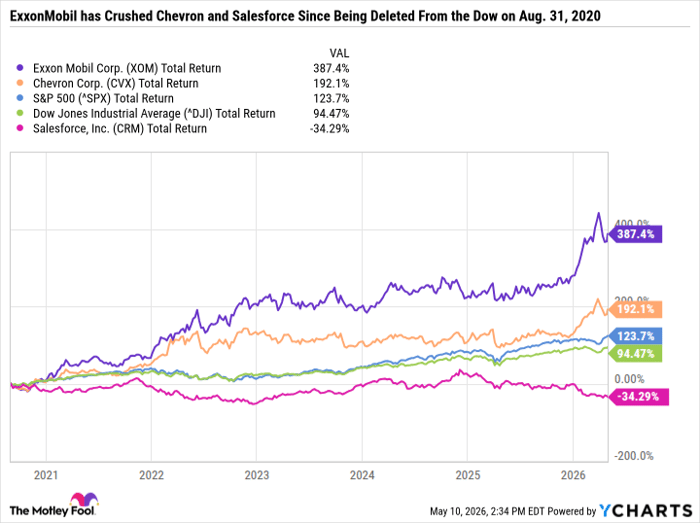
Fast forward to market close on May 11, 2026, and ExxonMobil has produced a staggering 373% total return (gains plus dividends) while investors who bought Salesforce on Aug. 31, 2020, have seen their investment lose over a third of its value.
Will AI create the world's first trillionaire? Our team just released a report on the one little-known company, called an "Indispensable Monopoly" providing the critical technology Nvidia and Intel both need. Continue »
Here's why Salesforce replaced ExxonMobil, why the Dow gets it wrong sometimes, the pitfalls of getting caught up in trends, and why ExxonMobil is an excellent buy now.
Image source: Getty Images.
Salesforce was a natural fit (at the time)
In the summer of 2020, oil prices were just a few months removed from briefly turning negative. Oil and gas stocks were under intense pressure, and ExxonMobil would go on to report its worst year in history, with a net loss of $23.3 billion. Fellow Dow component Chevron (NYSE: CVX) fared better, but still reported a $5.6 billion loss in 2020. Chevron's high margins, capital discipline, strong free cash flow, and superior balance sheet compared to ExxonMobil were probably why Chevron was kept in the Dow over ExxonMobil. But ExxonMobil has been the better buy since.
XOM Total Return Level data by YCharts.
While energy stocks were tumbling, software stocks were soaring, as the boom in remote work and productivity was a major tailwind for enterprise software-as-a-service (SaaS) companies like Salesforce. With software playing an increasingly important role in the tech sector, Salesforce's position as the leader of customer relationship management software made it a top candidate to join the Dow. This was especially true after Salesforce expanded beyond its flagship CRM platform with its acquisition of Tableau in August 2019 and later completed its acquisition of Slack in July 2021.
Salesforce joining Apple, Microsoft, Cisco Systems, and International Business Machines in the Dow provided even more tech exposure, especially through a software lens. Even today, there's a fair argument that the Dow should only have one energy stock, given that energy makes up just 3.5% of the S&P 500 (SNPINDEX: ^GSPC).
ExxonMobil is firing on all cylinders
Dow shakeups often reflect market sentiment at the time, rather than which stocks are the best buys in a sector over the long term. ExxonMobil was ill-prepared for the COVID-19 market dynamics, leaving it highly vulnerable to steep losses in 2020. However, it has made numerous improvements to better position its business to endure downturns. And unlike other energy majors, ExxonMobil didn't overly invest in renewable energy opportunities, preferring to operate within its wheelhouse through sustainability efforts that are associated with oil and gas, such as emissions reductions from its operations, reducing or eliminating flaring, lower methane intensity, carbon capture and storage, hydrogen, biofuels, and more.
In ExxonMobil's corporate plan through 2030, released in December 2025, the company said it now expects to achieve its 2030 greenhouse gas emissions intensity goal in 2026. It also expects a $25 billion increase in earnings growth and a $35 billion jump in cash flow growth, both on the same price and margin basis as 2024. This means those gains are coming solely from efficiency improvements, not capital spending.
At the same time, ExxonMobil is also ramping up its investments in what it calls its advantaged assets -- high-margin opportunities in the Permian Basin, liquefied natural gas, and offshore Guyana. ExxonMobil expects these projects to account for 65% of its 2030 oil-equivalent upstream production.
ExxonMobil is forecasting $145 billion in cumulative surplus cash flow and a return on capital employed of over 17% in 2030, assuming Brent crude oil prices of $65. For context, Brent prices averaged $69.14 per barrel in 2025 but are over $100 at the time of this writing, largely due to lower global supply due to Middle East constraints through the Strait of Hormuz.
ExxonMobil's excess cash flow supports consistent buybacks and dividend raises. ExxonMobil has increased its dividend for 43 consecutive years, noting that fewer than 5% of S&P 500 companies have achieved that distinction.
A top dividend stock to buy in May
ExxonMobil's incredible return since being removed from the Dow reflects excellent strategic execution, higher oil prices, and a shift in investor sentiment.
Energy and heavy industry companies with hard assets are uniquely resistant to artificial intelligence (AI) disruption. And AI energy bottlenecks could lead to a sustained boom in global energy demand, both for fossil fuels and renewable energy -- while Salesforce and the broader software industry are top of mind for investors concerned about new AI tools taking market share from established players and reducing the number of subscriptions an enterprise needs.
With a highly reliable dividend yielding 2.9%, a reasonable valuation, and a clear roadmap through 2030, ExxonMobil stands out as an excellent stock to buy now, especially for income and value investors. And if energy continues to make up a larger share of the S&P 500, ExxonMobil could make the case for being swapped back into the Dow -- ironically, maybe even for Salesforce.
Should you buy stock in ExxonMobil right now?
Before you buy stock in ExxonMobil, consider this:
The Motley Fool Stock Advisor analyst team just identified what they believe are the 10 best stocks for investors to buy now… and ExxonMobil wasn’t one of them. The 10 stocks that made the cut could produce monster returns in the coming years.
Consider when Netflix made this list on December 17, 2004... if you invested $1,000 at the time of our recommendation, you’d have $460,826!* Or when Nvidia made this list on April 15, 2005... if you invested $1,000 at the time of our recommendation, you’d have $1,345,285!*
Now, it’s worth noting Stock Advisor’s total average return is 983% — a market-crushing outperformance compared to 207% for the S&P 500. Don't miss the latest top 10 list, available with Stock Advisor, and join an investing community built by individual investors for individual investors.
See the 10 stocks »
*Stock Advisor returns as of May 12, 2026.
Daniel Foelber has no position in any of the stocks mentioned. The Motley Fool has positions in and recommends Amgen, Apple, Chevron, Cisco Systems, Honeywell International, International Business Machines, Microsoft, Pfizer, RTX, and Salesforce. The Motley Fool has a disclosure policy.
Recommended Articles


