




Here's Why I Still Wouldn't Touch Energy Transfer LP -- Even With That 6.9% Yield
Key Points
A ~7% yield isn’t a bonus -- it signals concerns around execution risk, capital intensity, and long-term consistency compared to lower-yielding peers.
Utilities and other infrastructure names yield 3% to 5% but offer more predictable cash flows and steadier dividends, which may be more attractive for long-term income.
With $5 billion to $5.5 billion in growth capital expenditures plus ~$1.1 billion in maintenance, much of the cash flow is recycled back into the business, limiting true free cash flow to investors.
- 10 stocks we like better than Energy Transfer ›
On paper, Energy Transfer LP (NYSE: ET) looks solid. In 2025, the company generated roughly $8.2 billion in distributable cash flow and a coverage ratio of around 1.77x. That's more than adequate.
Leverage is also manageable, with net debt of around $60 billion and a debt-to-EBITDA (earnings before interest, taxes, depreciation, and amortization) ratio of around 4.6x. Those are reasonable numbers for a midstream operation.
Will AI create the world's first trillionaire? Our team just released a report on the one little-known company, called an "Indispensable Monopoly" providing the critical technology Nvidia and Intel both need. Continue »
But here's the rub: This is still a capital-heavy business, and Energy Transfer is not a steady-state cash machine. It's a capital-intensive infrastructure company that requires continuous investment to maintain and grow its asset base. Here's why that matters for investors and why I don't think it looks attractive.
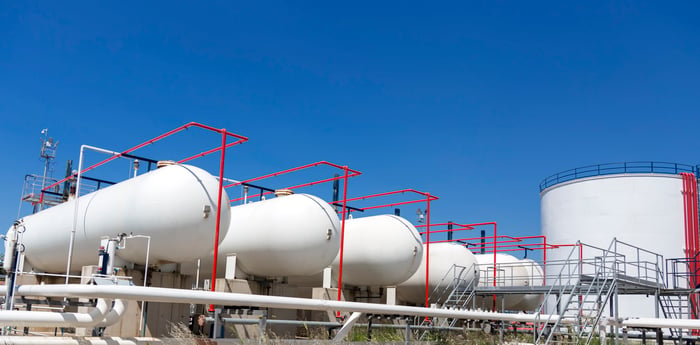
Image source: Getty Images.
A track record matters
Annual capital expenditures actually remain quite elevated, with growth capex coming in at around $5 billion to $5.5 billion per year, which doesn't include maintenance capex, which clocked in at around $1.1 billion in 2025.
This means a significant portion of cash flow is recycled back into the business. So when capital markets tighten or project economics shift, that model becomes more fragile.
Energy Transfer has already shown how quickly things can change.
In 2020, the company cut its distribution by 50%, reducing it from $1.22 to $0.61. This was the result of high leverage, aggressive expansion, and pressure from declining energy demand during the COVID-19 pandemic.
Of course, the distribution was restored, but this was an inconvenient reminder that this is not a "set it and forget it" income investment. It should also be noted that the nearly 7% yield isn't without a catch.
You see, yield is actually a function of price and perceived risk. When a company like Energy Transfer trades at a higher yield than many of its peers, it's because investors are discounting something in the business.
In this case, it could be an execution risk.
Energy Transfer continues to run a large slate of multibillion-dollar growth projects with long timelines. Delays, cost overruns, or weaker-than-expected volumes don't show up immediately in headline numbers, but they can affect returns over time.
There's also capital intensity.
Even with roughly $8 billion-plus in annual distributable cash flow, the business still requires $2 billion to $3 billion in annual growth capex, plus maintenance spending. That means a meaningful portion of cash flow is reinvested just to sustain and expand the system.
In other words, this isn't a fixed asset base throwing off excess cash. It's an ongoing capital cycle.
Now compare that to regulated utilities or higher-quality infrastructure operators yielding 3% to 5%. Those businesses typically have more predictable cash flows, lower reinvestment volatility, and a consistent history of maintaining or steadily increasing dividends.
Because the cash flows are more stable and the payout history is more reliable, investors accept a lower yield.
So essentially with Energy Transfer, you're being paid to accept variability in cash flow, higher reinvestment needs, and a history that shows the payout can change under pressure.
That's the trade-off. And for income investors looking for durability, that trade-off is hard to justify.
Should you buy stock in Energy Transfer right now?
Before you buy stock in Energy Transfer, consider this:
The Motley Fool Stock Advisor analyst team just identified what they believe are the 10 best stocks for investors to buy now… and Energy Transfer wasn’t one of them. The 10 stocks that made the cut could produce monster returns in the coming years.
Consider when Netflix made this list on December 17, 2004... if you invested $1,000 at the time of our recommendation, you’d have $496,473!* Or when Nvidia made this list on April 15, 2005... if you invested $1,000 at the time of our recommendation, you’d have $1,216,605!*
Now, it’s worth noting Stock Advisor’s total average return is 968% — a market-crushing outperformance compared to 202% for the S&P 500. Don't miss the latest top 10 list, available with Stock Advisor, and join an investing community built by individual investors for individual investors.
See the 10 stocks »
*Stock Advisor returns as of May 3, 2026.
Jeff Siegel has no position in any of the stocks mentioned. The Motley Fool has no position in any of the stocks mentioned. The Motley Fool has a disclosure policy.
Recommended Articles


