




This Obesity Stock Could More Than Double Over the Next 12 Months, According to Wall Street
Key Points
Although now mature, the weight-loss drug market remains strong and growing.
The top GLP-1 drug competitors were first to market, but not racing to the finish line has given some drug developers more time to develop a more marketable alternative.
One company is likely to provide a major trial update next year, with several bullish interim updates surfacing in the meantime.
- 10 stocks we like better than Viking Therapeutics ›
It's not unheard of for biopharma stocks to deliver big gains in relatively short periods; the development of a game-changing drug is usually the catalyst. Even by biopharma standards, though, what analysts expect from Viking Therapeutics (NASDAQ: VKTX) over the next 12 months is shockingly bullish. As of the latest look, Wall Street's consensus one-year price target for shares of this weight-loss drug hopeful stands at $93.59. That's more than 170% above the ticker's present price.
What gives? A combination of factors is at work here, not least the stock's subpar performance since last year, when interest in the entire weight-loss drug revolution began cooling, and this particular company arguably stumbled.
Will AI create the world's first trillionaire? Our team just released a report on the one little-known company, called an "Indispensable Monopoly" providing the critical technology Nvidia and Intel both need. Continue »
Just be patient. The opportunity is still out there, and Viking is quietly well-positioned to push back against the two current titans of the weight-loss drug market.
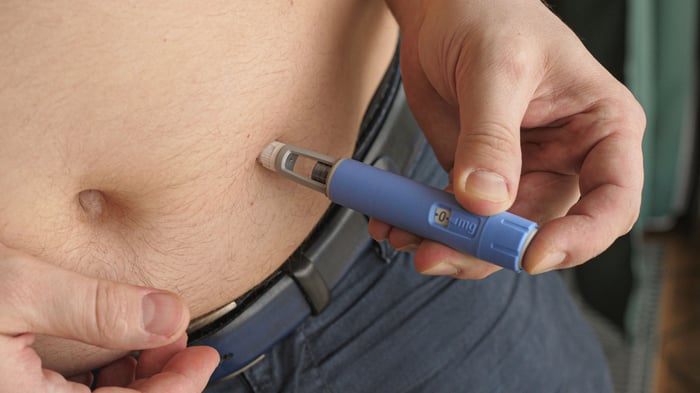
Image source: Getty Images.
The business and underlying science are well established
Those two titans are Novo Nordisk (NYSE: NVO) and Eli Lilly (NYSE: LLY), of course. The former makes Wegovy, while the latter manufactures Zepbound.
Both weekly injectables are based on the same underlying GLP-1 (glucagon-like peptide-1) science, which slows down the digestion of food while simultaneously suppressing appetite. Both pharmaceutical giants now offer an oral form of their weight-loss drug. In other words, a pill, although Lilly's GLP-1-based agonist pill is branded as Foundayo.
And this raises a fair question: How many options does the weight-loss drug market actually need? Or, said another way, how different could Viking's anti-obesity drug VK2735 (currently in phase 3 trials as a weekly injectable) be from the others in this category?
It's different enough to matter.
That's not necessarily easy to see at first blush. Like Wegovy and Zepbound, Viking Therapeutics' VK2735 is also GLP-1-based, but it's a dual agonist that incorporates GIP (glucose-dependent insulinotropic polypeptide) therapy into its weekly injectable dosing. A pill-based form of the same drug is currently in phase 2 testing as well, with phase 3 trials expected to begin next quarter.
Still, there's only so much differentiation that can be achieved using the same basic GLP-1 pathway.
In the pharmaceutical business, though -- when it comes to what people are willing to put in their bodies -- little things can matter in a big way. This is where VK2735 shines.
Viking's offering is different enough
Simply put, Viking's VK2735 enjoys a small but significant competitive edge on Wegovy and Zepbound. That's its tolerability combined with its efficacy in a fairly short period of time.
In trials of its injectable formulation, VK2735 achieved an average weight loss of up to 14.7% in just 13 weeks, outperforming other options already on the market. And importantly, most users were willing and able to stick with the treatment regimen. That's not been the case for Wegovy or Zepbound, though, with nausea and other gastrointestinal problems being reported by users of both, as well as for users of Lilly's Foundayo pills.
Viking Therapeutics hasn't fared quite as well with its orally administered version of VK2735. Like most of its comparable alternatives, its weight-loss pill suffered a relatively -- even surprisingly -- high dropout rate during its phase 2 testing. Roughly one-third of the trial's participants discontinued usage before the end of testing, in fact, upending the stock as a result when that update was released in August of last year.
Even in the wake of that steep sell-off, analysts remained largely optimistic. William Blair's Andy Hsieh called the sell-off "extreme and unwarranted," noting that lower doses of the pill could still prove effective and tolerable as a maintenance dose following the wind-down of weight loss from weekly subcutaneous injections, echoing what Viking Therapeutics' CEO Brian Lian said in the same update. That is, "The experimental maintenance arm of this study provides an encouraging signal that supports our belief that transitioning patients from higher doses, injectable or oral, to low oral doses represents a promising approach to weight maintenance therapy."
In other words, the drug works well enough. The company just needs to figure out the optimal way to get users started on their weight-loss journey and then keep them on board once their target weight has been hit. That's something that hasn't yet been directly clinically tested, but it's a paradigm most of the analyst community seems to believe will take shape, even if only pieced together by the marketplace itself.
Up for grabs is a piece of the anti-obesity drug market that Mordor Intelligence expects to grow from last year's $26 billion to more than $130 billion per year by 2031, as the industry refines its initial GLP-1 offerings and figures out how to best acquire and then retain paying customers.
Proactive rather than reactive
There's still significant risk here, of course, as is the case for any biopharma name that doesn't yet have a revenue-bearing product on the market. Things change. The FDA might end up seeing something nobody else has yet. Consumers might not fully understand why VK2735 could be a better option for them.
Nevertheless, it's telling that the vast majority of the analyst community remains firmly bullish on this admittedly volatile pre-revenue company. Not only is their consensus target price well above the stock's current price, but the vast majority of analysts covering Viking Therapeutics currently consider VKTX a strong buy. This suggests most of them anticipate encouraging Phase 3 trial data sometime next year, putting it on pace for a potential FDA approval no later than 2029.
As veteran investors can attest, however, biopharma stocks have a knack for perking up well before such milestones are met.
Should you buy stock in Viking Therapeutics right now?
Before you buy stock in Viking Therapeutics, consider this:
The Motley Fool Stock Advisor analyst team just identified what they believe are the 10 best stocks for investors to buy now… and Viking Therapeutics wasn’t one of them. The 10 stocks that made the cut could produce monster returns in the coming years.
Consider when Netflix made this list on December 17, 2004... if you invested $1,000 at the time of our recommendation, you’d have $498,522!* Or when Nvidia made this list on April 15, 2005... if you invested $1,000 at the time of our recommendation, you’d have $1,276,807!*
Now, it’s worth noting Stock Advisor’s total average return is 983% — a market-crushing outperformance compared to 200% for the S&P 500. Don't miss the latest top 10 list, available with Stock Advisor, and join an investing community built by individual investors for individual investors.
See the 10 stocks »
*Stock Advisor returns as of April 26, 2026.
James Brumley has no position in any of the stocks mentioned. The Motley Fool recommends Novo Nordisk and Viking Therapeutics. The Motley Fool has a disclosure policy.
Recommended Articles


