




I Bought Atlassian Stock Earlier This Month After Its 87% Plunge. Here's Why.
Key Points
Wall Street is worried that artificial intelligence (AI) will shrink the workforce and make popular software products extremely easy to replicate.
As a result, existing software companies like Atlassian have suffered a staggering decline in value over the past year.
I'm treating the software sell-off as a buying opportunity, and I recently added Atlassian stock to my portfolio.
- 10 stocks we like better than Atlassian ›
Over the past 12 months or so, many Wall Street analysts have operated under the assumption that artificial intelligence (AI) could disrupt some of the world's most popular software products. There are two reasons why:
- Companies might fire thousands of employees if AI makes the workforce more productive, resulting in less revenue for any software company that charges its customers on a per-user basis.
- AI allows businesses to rapidly build software tools without writing any code, so in theory, they could create their own versions of the tools they rely on each day.
Atlassian (NASDAQ: TEAM) is the creator of software products like Jira and Confluence, which are designed to streamline workflows by fostering collaboration among employees. Its stock has been one of the biggest losers during the software rout, hitting an all-time low of around $57 earlier this month, an 87% decline from its 2021 record high.
Will AI create the world's first trillionaire? Our team just released a report on the one little-known company, called an "Indispensable Monopoly" providing the critical technology Nvidia and Intel both need. Continue »
But I treated this as a buying opportunity and scooped up a few shares for my portfolio on April 10. The stock has since bounced nicely. Here's why I think a long-term recovery is on the table.

Image source: Getty Images.
Atlassian is aggressively leaning into AI
There are two primary reasons why I believe Atlassian will not only survive the AI era, but actually thrive. First, the company is embedding AI into Jira and Confluence through a platform called Rovo, which introduces a suite of new features to enhance their capabilities.
Jira was originally designed to help software developers track bugs and ship updates, while Confluence is a digital space for the entire organization, where employees can host critical documents and discuss work. Rovo includes a powerful search function for both apps, which can instantly locate information across the entire organization, even if it's stored in a third-party platform like Alphabet's Google Drive.
Then there is the Rovo chatbot, which can collaborate with employees to accelerate their workflows. For Jira, specifically, there is also an agentic AI solution called Rovo Dev, which is capable of writing and reviewing programming code, saving developers countless hours of manual work.
The second reason I think Atlassian will survive the AI era is because it offers more than just software. It provides the necessary data center infrastructure to run products like Jira in the cloud, in addition to security and technical support. These things cost a significant amount of money, so even if the average business could replicate a product like Jira by using an AI-powered coding tool, it doesn't mean it will have the resources to deploy it successfully.
Atlassian continues to grow nicely
Atlassian's annual run rate revenue topped $6 billion at the close of its fiscal 2026 second quarter (ended Dec. 31), which probably wouldn't have been possible if AI were severely disrupting its business.
In fact, the opposite appears to be happening. During the quarter, Atlassian's cloud business experienced an increase in net revenue retention rate to 120%, suggesting existing customers were spending 20% more money compared to the year-ago period. Management credited demand for the company's AI products for the result.
Moreover, the number of deals Atlassian signed that were worth at least $1 million in annual revenue doubled year over year in the second quarter, which suggests large organizations continue to flock to the company's software products.
Atlassian will report its third-quarter operating results on April 30. I'll be watching the usual metrics like revenue growth and net revenue retention, but I'll also watch for an update on Rovo adoption. Despite being just two years old, the platform had already amassed over 5 million monthly active users as of Dec. 31, which is an early sign Atlassian's AI strategy is working.
I bought Atlassian at a record low valuation
Atlassian's price-to-sales (P/S) ratio was under 3 when I bought its stock on April 10, which was the cheapest level in its 11 years as a public company. Its P/S ratio has ticked higher over the last couple of weeks as bargain hunters swooped in to buy the stock, but it's still attractive at this level in my opinion.
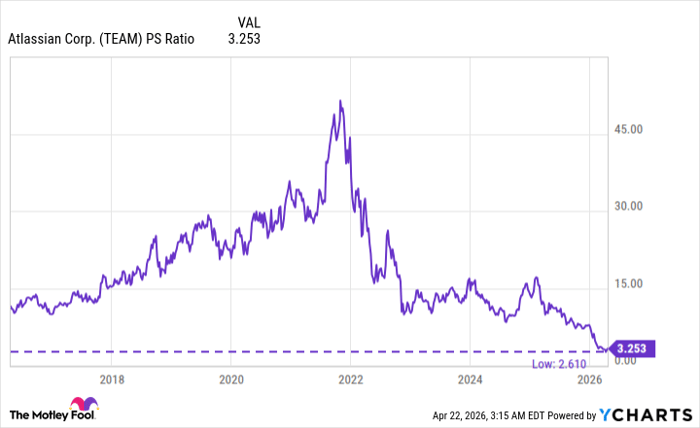
TEAM PS Ratio data by YCharts
I don't think Atlassian's plunging stock price matches the strength of its business, which is why I believe a recovery is inevitable. At worst, if AI does shrink the global workforce, the company might have to rethink its per-seat pricing structure and come up with something consumption-based instead, which should alleviate any concerns about a future decline in revenue.
As long as Atlassian's business continues to grow, I'll likely remain a long-term shareholder.
Should you buy stock in Atlassian right now?
Before you buy stock in Atlassian, consider this:
The Motley Fool Stock Advisor analyst team just identified what they believe are the 10 best stocks for investors to buy now… and Atlassian wasn’t one of them. The 10 stocks that made the cut could produce monster returns in the coming years.
Consider when Netflix made this list on December 17, 2004... if you invested $1,000 at the time of our recommendation, you’d have $498,522!* Or when Nvidia made this list on April 15, 2005... if you invested $1,000 at the time of our recommendation, you’d have $1,276,807!*
Now, it’s worth noting Stock Advisor’s total average return is 983% — a market-crushing outperformance compared to 200% for the S&P 500. Don't miss the latest top 10 list, available with Stock Advisor, and join an investing community built by individual investors for individual investors.
See the 10 stocks »
*Stock Advisor returns as of April 26, 2026.
Anthony Di Pizio has positions in Atlassian. The Motley Fool has positions in and recommends Alphabet and Atlassian. The Motley Fool has a disclosure policy.
Recommended Articles


