




Got $10,000? Lockheed Martin Could Be a Defense Powerhouse That Outlasts Trump's Term
Key Points
Lockheed Martin disappointed investors with flat sales and falling profits in its Thursday report.
But the defense prime contractor is investing in production expansion that could grow missile sales three to four times.
- 10 stocks we like better than Lockheed Martin ›
Lockheed Martin (NYSE: LMT) reported its earnings results for the first quarter of its fiscal year 2026 on Thursday before markets opened, a period that included one full month of U.S. combat operations in and around Iran. The results were not what you'd expect.
Lockheed missed analyst forecasts for Q1 revenue of $18.3 billion, reporting only $18 billion in sales. Earnings were an even bigger miss for the defense giant, with profit per share of only $6.44, versus analysts' forecast of $6.74. By the time trading closed for the day Thursday, investors had sold off Lockheed stock by nearly 5%, and the stock continued to fall on Friday.
Will AI create the world's first trillionaire? Our team just released a report on the one little-known company, called an "Indispensable Monopoly" providing the critical technology Nvidia and Intel both need. Continue »
But here's the biggest surprise: Despite the miss, Lockheed stock might actually be a buy.
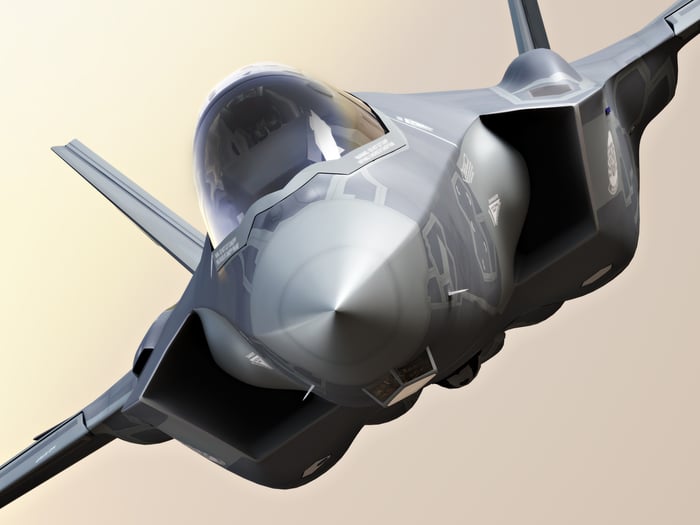
An F-35. Image source: Getty Images.
President Trump on defense
President Donald Trump spent much of his first term complaining about Lockheed Martin's high prices and talking down its marquee product, the F-35 Lightning II stealth fighter jet, which he called "not very good." In his second term, the president first seemed ready to take up where he left off, vowing in February 2025 to "cut our military budget in half" -- but that didn't last long.
By early 2026, Trump had changed his mind. Instead of cutting spending, he demanded Congress pass a $1.5 trillion defense budget. At the same time, though, the president complained about the very companies he's planning to shower with Pentagon riches -- defense companies like Lockheed -- demanding they increase production, cancel dividends and share buybacks, cut executive salaries, and sacrifice profit margins in the nation's interest.
At the time, I warned this could have an impact on Lockheed Martin's profit margins, and that's exactly what we're seeing in this week's report.
Lockheed Martin's first-quarter earnings
It takes time for a company to increase production capacity. Time, and also capital investment, which must be sunk into the business before sales can ramp up to drive revenue and earn profit. With Lockheed just starting the ramp-up phase, its sales were nearly flat in Q1 2026 -- $18 billion, the same as last year's Q1.
Capital expenditures, meanwhile, grew more than 12% to $511 million, pushing Lockheed into negative free cash flow for the quarter, and its operating profit margin declined 160 basis points to 11.7%. Net profit margin declined 110 basis points to 8.3%. Between flat sales and depressed profit margins, Lockheed's per-share profit fell 12.5% year over year.
What's next for Lockheed Martin stock?
So, not a great quarterly report; you can see why investors might have been upset with Lockheed. And yet, consider what could come next for this defense prime contractor.
Over the course of Q1, Lockheed "pioneered a number of commercially inspired, long-term business arrangements with U.S. government leadership," said CEO Jim Taiclet. Taiclet said the company "signed several framework agreements to accelerate and scale munitions production, including advanced Patriot Missile, THAAD, and PrSM [Precision Strike Missiles]."I like the words "accelerate" and "scale" for investors, as they seem to promise both more revenue from missile sales and improved profit margins on those sales. Annual production rates for at least some of Lockheed's missiles are expected to grow three- or even fourfold.
What's more, because the supply agreements Lockheed signed with the Pentagon are all "multiyear," these improvements in sales and profit margins could drive Lockheed profits higher for years, not quarters, and far beyond Trump's second term.
The improvements may look small at first; Lockheed predicts it will grow sales only 3% to 6% in this first year of the ramp-up. But the improvements in profitability could compound quickly. Lockheed is forecasting full-year 2026 earnings between $29.35 and $30.25 per share -- at the midpoint, that's as much as 37% growth versus 2025 profits. Meanwhile, thanks to this week's sell-off, Lockheed stock is trading below 26 times earnings -- and less than 18 times trailing free cash flow as I write this.
Sounds like a bargain to me. If you've got $10,000 to invest that you don't need for anything in the short or medium term, Lockheed Martin is worth a look.
Should you buy stock in Lockheed Martin right now?
Before you buy stock in Lockheed Martin, consider this:
The Motley Fool Stock Advisor analyst team just identified what they believe are the 10 best stocks for investors to buy now… and Lockheed Martin wasn’t one of them. The 10 stocks that made the cut could produce monster returns in the coming years.
Consider when Netflix made this list on December 17, 2004... if you invested $1,000 at the time of our recommendation, you’d have $498,522!* Or when Nvidia made this list on April 15, 2005... if you invested $1,000 at the time of our recommendation, you’d have $1,276,807!*
Now, it’s worth noting Stock Advisor’s total average return is 983% — a market-crushing outperformance compared to 200% for the S&P 500. Don't miss the latest top 10 list, available with Stock Advisor, and join an investing community built by individual investors for individual investors.
See the 10 stocks »
*Stock Advisor returns as of April 25, 2026.
Recommended Articles


