




Here's Where Interest Rates Could Be Headed This Year if Trump Gets His Way -- and Here's Who'd Benefit
Key Points
The federal funds rate has been kept steady over the Federal Reserve's last two sessions.
When interest rates are lower, borrowing becomes cheaper, stimulating industries that rely on loans.
Interest rate changes add to the cyclical nature of the banking industry.
- These 10 stocks could mint the next wave of millionaires ›
The Federal Reserve (Fed) is the central bank of the United States, responsible for keeping the monetary system running as smoothly as possible. One of its biggest jobs is setting the federal funds rate, which influences the cost of borrowing for people and businesses.
The Fed is an independent agency, not a political institution, so the president can't control the rates himself, though President Donald Trump is always pushing boundaries and has threatened to fire Fed Chair Jerome Powell before the end of his term next month.
Will AI create the world's first trillionaire? Our team just released a report on the one little-known company, called an "Indispensable Monopoly" providing the critical technology Nvidia and Intel both need. Continue »
During a recent Fox Business interview, Trump was asked if he thinks rates will be cut more this year, and he responded, "When Kevin gets in, I do." Trump was referring to Kevin Warsh, his nominee to replace Powell. (The Senate confirms Fed chairs.) So, it's clear the president wants rates lowered. What happens if he gets his way?
Image source: Getty Images.
The interest rate journey over the past few years
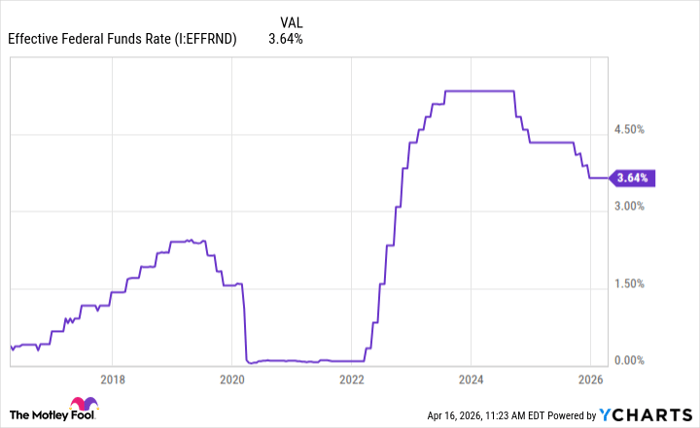
The U.S. went a good stretch with extremely low interest rates. From March 2020 to February 2022, the fed funds rate stayed at 0.25%. However, the rate was then consistently raised to help fight inflation, and by July 2023, it had jumped to 5.25%, where it remained until August 2024.
The interest rate is now in the 3.5% to 3.75% target range (3.64% at the time of this writing) after the Fed kept it unchanged at its last two meetings.
Effective Federal Funds Rate data by YCharts
What industries benefit from interest rate cuts?
But what if Trump's pick gets in and the Federal Open Market Committee lowers interest rates? Real estate would be one of the main beneficiaries. When interest rates decline, mortgage rates follow suit, making homeownership more affordable. The difference between paying 5% versus 3% on a mortgage could easily be tens of thousands of dollars over time, so many people delay buying homes until rates are more favorable.
The same applies to the auto industry, where lower rates mean cheaper car loans, ideally leading to more sales for dealerships and manufacturers.
Tech and growth stocks also tend to flourish with lower interest rates because many of their valuations are based on future earnings, which become more valuable with lower rates. Safer investments also become less attractive at lower rates, driving investors back to the high-growth opportunities offered by the tech sector.
Low interest rates weren't the primary cause, but they surely helped fuel the tech sector's huge growth over the past decade or so, when they hovered just above 0% for much of the time.
What industries could be hurt by interest rate cuts?
The banking industry could be one of the first to see its businesses affected by rate cuts because a large part of its business is taking the money customers deposit (in checking or savings accounts), paying customers interest on it, and then lending it back out at a higher interest rate (mortgages, personal loans, business loans, etc.).
This is called "net interest income," and it can be reduced by lower interest rates because banks earn less on their loans. Sometimes they'll lower the rates they pay on deposits, but it's generally much slower, and they can only go so low before losing customers.
You shouldn't invest in a stock based on what might happen with interest rates, but it's always smart to think about what might happen, who might benefit, and who might lose.
Where to invest $1,000 right now
When our analyst team has a stock tip, it can pay to listen. After all, Stock Advisor’s total average return is 994%* — a market-crushing outperformance compared to 199% for the S&P 500.
They just revealed what they believe are the 10 best stocks for investors to buy right now, available when you join Stock Advisor.
See the stocks »
*Stock Advisor returns as of April 20, 2026.
The Motley Fool has a disclosure policy.
Recommended Articles


