




The Iran War Shock Just Emphasized Exactly Why Patient Investors Keep Winning
Key Points
The S&P 500 index dropped 8% during the Iran war, but quickly regained those losses and reached new all-time highs.
The U.S. stock market delivered positive gains in 75% of years between 1980 and 2023, and has never delivered negative returns in any 20-year period.
- These 10 stocks could mint the next wave of millionaires ›
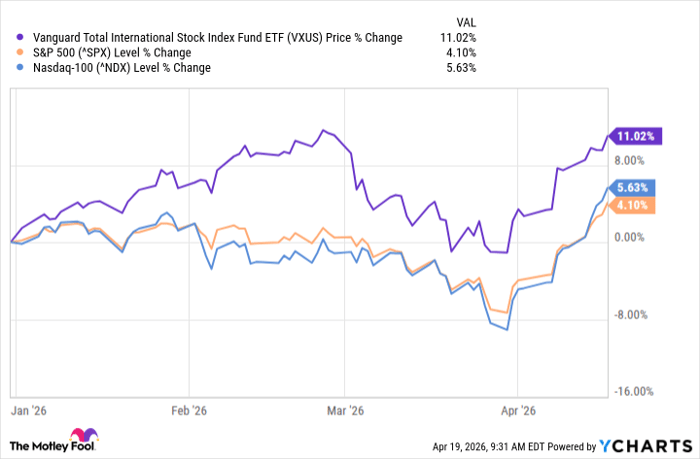
For the past several weeks, the Iran war has been the biggest story in the stock market. After U.S. airstrikes on Iranian targets started on Feb. 28, the S&P 500 index dropped by about 8% over the course of the next month through March 30. Some people might have felt tempted to sell stocks, or to delay their next retirement account contribution until the news headlines felt safer and things settled down.
But in the past few weeks, since hitting that March 30 low, the stock market has rallied. The S&P 500 has gained more than 12% since March 30. With recent announcements about a ceasefire, peace talks, and the possible reopening of the Strait of Hormuz for oil and gas shipments, more investors are turning to optimism.
Will AI create the world's first trillionaire? Our team just released a report on the one little-known company, called an "Indispensable Monopoly" providing the critical technology Nvidia and Intel both need. Continue »
The S&P 500 and tech-heavy Nasdaq-100 index reached new all-time highs on Friday. The rest of the world's stocks are also surging. The Vanguard Total International Stock ETF (NASDAQ: VXUS) is almost back to its pre-war highs and has gained 12% since March 30.
Data by YCharts.
As of this writing, it's unclear if the Iran war ceasefire will continue to hold. But whatever happens in the next few days or weeks with the Iran war, the stock market has once again shown an enduring lesson for investors: In the long run, the stock market tends to bounce back fast. When people can avoid overreacting to short-term shocks and bad news, they can benefit from long-term gains in share prices.
Let's look at a few key reasons why patient investors tend to make money in the stock market, no matter what bad news is happening in the world.
Stocks usually go up (eventually)
The Deutsche Bank Long-Term Asset Return Study analyzed 200 years of data to show how different investments perform in the long run. According to this research, for the past 200 years, global stocks have delivered real average annual returns (after inflation) of 4.9%. In the past 100 years, U.S. stocks have done better than this -- delivering real average annual returns of 7.2%.
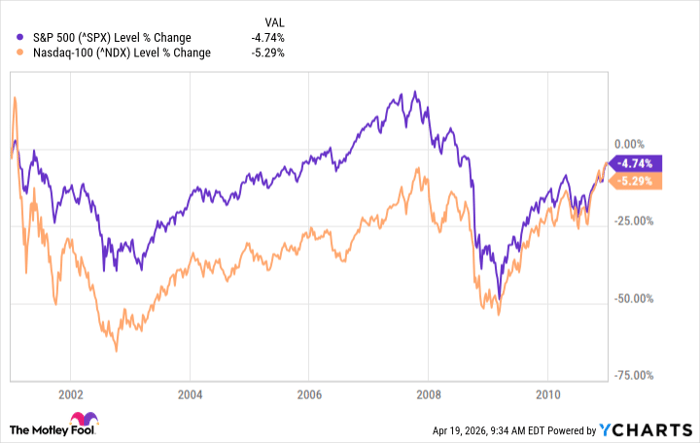
Stocks can have bad days, bad years, and bad decades. The 2000s, after the dot-com bubble and the Global Financial Crisis and Great Recession, were mostly a "lost decade" for the U.S. stock market. From January 2001 to January 2011, the S&P 500 had cumulative negative returns of about 4.7%, and the Nasdaq-100 was down 5.3%.
Data by YCharts.
But most of the time, in the long run, the stock market goes up. How long is the "long run"? Let's call it: 12 to 20 years. According to iShares research, looking at data from 1936-2025, the U.S. stock market has never had negative returns in any single 20-year period. And since 1972, U.S. stocks haven't been cumulatively negative for any period longer than 12 years. Other research from J.P. Morgan analysts shows that from 1980 to 2023, the S&P 500 delivered positive annual returns in 75% of those calendar years.
On any given day when you buy stocks, no one knows what will happen next for any individual company, industry, country, or the entire stock market. There are no guarantees. But in the long run, after several years, the stock market tends to deliver positive returns for diversified, patient investors.
The economy is more resilient to oil shocks than it used to be
One big fear about the Iran war was that it would lead to 1970s-style oil price shocks and high inflation. Many investors might have had mental images of Americans stuck in line at gas stations. It's true that the Iran war has caused fuel shortages for airlines and has brought pain to consumers, especially in Asian countries that are highly reliant on Middle East oil and gas.
But for the most part, the energy price shocks of the Iran war aren't as painful as most people might expect. The economy has become much more energy-efficient since 1970 and is less dependent on foreign oil. This trend can be tracked through an economic metric called "energy intensity," which measures how much oil and gas are required to generate a given level of economic growth.
Energy is a fuel for the economy, as it's needed for everything that humans do, from powering farms and factories to filling gas tanks in vehicles. But according to recent research from Standard Chartered, the world is less energy-intensive than it was in the 1970s. Between 1970 and 2022, the global economy's "energy intensity" dropped by 58%. That's a good sign that economic growth (and higher stock prices) can continue, even if oil prices stay higher than they were before the Iran war.

Image source: Getty Images.
Investing advice: "Don't do something -- just stand there."
When the world is in crisis, oil prices are spiking, and news headlines are all about the stock market going down, it's easy for people to get seized with a sense of urgency to take action. There's often a feeling among investors to "don't just stand there, do something!"
But this urge to act is often misguided. It can cause people to sell stocks too soon, miss out on buying stocks through regular dollar-cost-averaging, and make moves based on short-term fear that are harmful to building long-term wealth.
Jack Bogle, founder of Vanguard, believed that instead of being impatient and reacting to headlines, most investors should do the opposite. One of his famous quotes about investing was: "Don't do something -- just stand there."
Instead of being tempted to sell stocks, move money to cash, or make big changes to portfolios based on short-term news, it's often best for investors to sit tight. Don't hit "sell" on your stocks. Don't make big changes to your investing plan. Keep buying and holding a diversified portfolio of stocks and ETFs that you believe in. And let the economy work for you in building long-term wealth.
Where to invest $1,000 right now
When our analyst team has a stock tip, it can pay to listen. After all, Stock Advisor’s total average return is 994%* — a market-crushing outperformance compared to 199% for the S&P 500.
They just revealed what they believe are the 10 best stocks for investors to buy right now, available when you join Stock Advisor.
See the stocks »
*Stock Advisor returns as of April 20, 2026.
JPMorgan Chase is an advertising partner of Motley Fool Money. Ben Gran has positions in Vanguard Total International Stock ETF. The Motley Fool has positions in and recommends JPMorgan Chase and Vanguard Total International Stock ETF. The Motley Fool recommends Standard Chartered Plc. The Motley Fool has a disclosure policy.
Recommended Articles


