




The Best AI Stock to Buy Now: Micron vs. Nvidia
Key Points
Nvidia's business continues to grow quickly.
Micron is thriving on the memory chip shortage.
- 10 stocks we like better than Micron Technology ›
Nvidia (NASDAQ: NVDA) has been the star of the show since the artificial intelligence (AI) build-out began in 2023. Its stock has risen 1,240% (and counting) since then, but it has been fairly stagnant over the past few months. The stock is only up 9% in the past six months, although it has rallied a significant amount over the past few weeks.
In its place, Micron (NASDAQ: MU) has provided much better performance. Over the past six months, its stock has risen 150%. Since 2023, it has risen 830%. While not quite as impressive as Nvidia's rise, it's still a pretty eye-popping return in just a few years.
Will AI create the world's first trillionaire? Our team just released a report on the one little-known company, called an "Indispensable Monopoly" providing the critical technology Nvidia and Intel both need. Continue »
The question is, which one of these two is the best AI stock moving forward? After all, each is integral to the continuous success of AI.

Image source: Getty Images.
Nvidia and Micron operate in different segments of the same market
Nvidia and Micron are not competitors. In fact, Nvidia is a client of Micron's. Nvidia makes GPUs (graphics processing units), the most widely used computing units for training and running AI models. GPUs are special because they can process multiple calculations in parallel, but to do this, they need memory chips.
Micron makes memory chips, ranging from those used in a cellphone to high-bandwidth memory (HBM) chips used in AI. Unlike Nvidia's GPUs, which can differentiate themselves from the competition with performance increases, memory chips are fairly commoditized. There isn't a lot that separates Micron's products from its peers, so it operates in more of a commoditized market. Commodities see their price rise when demand is great and supply is short, and that's exactly where memory chips find themselves.
During its latest conference call, Micron noted that it can only fulfill about half to two-thirds of demand in the medium term. That's a major limitation and showcases how in demand memory is.
So, memory chip prices will stay elevated in the meantime, which will lead to booming growth for Micron.
Micron's growth rates are faster than Nvidia's
You'll find few investors who have a gripe with Nvidia's growth rates. In Q4, it delivered 73% year-over-year growth, and Wall Street analysts expect 79% growth in Q1 and 85% in Q2. That underscores the need for Nvidia's GPUs, but Micron's growth rate is far faster.
Two quarters ago, Micron's revenue totaled $13.6 billion. In its last quarter, it was up to $23.9 billion. Next quarter, they estimate $33.5 billion in revenue. Essentially, Micron's revenue grew 150% in nine months. This is simply an incredible growth rate and outpaces Nvidia's by far.
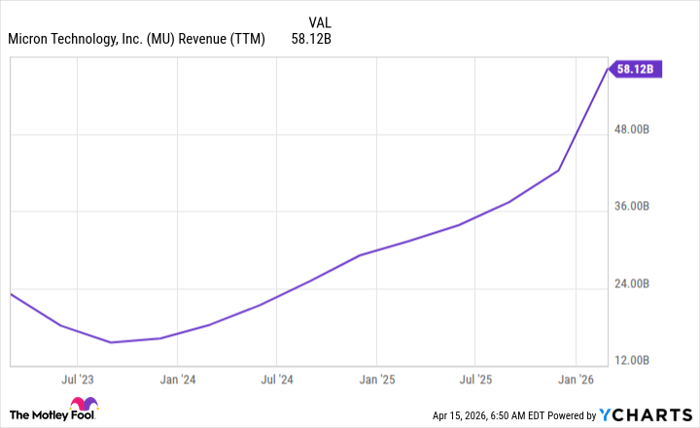
MU Revenue (TTM) data by YCharts
But revenue growth isn't everything; investors must also consider valuation.
Micron's stock is far cheaper than Nvidia's
Because both companies are growing at such a rapid pace, using a forward-looking metric makes the most sense. From this standpoint, Micron's stock looks far cheaper than Nvidia's.
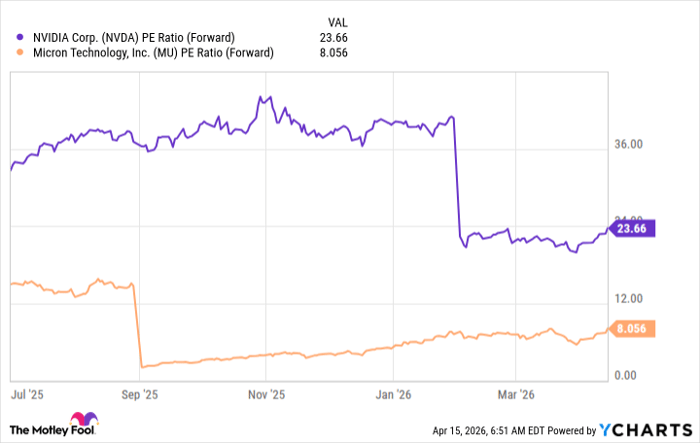
NVDA PE Ratio (Forward) data by YCharts
While Micron's stock looks like it trades for a third of the price of Nvidia's, the reason for this gap is the cyclical nature of Micron's business. Micron and its peers are racing to bring online new production capacity, which will decrease the price of memory by flooding the market with supply. That may not happen for a few years, so Micron could still be growing rapidly for years to come.
So, which one is the better investment? All signs point to Micron, and I think that Micron will likely have a better one-year performance than Nvidia. However, Nvidia looks like a far better investment over the long term, as its GPUs will still be in demand long after the memory supply crunch is sorted out.
Together, I think they make up important components of a well-diversified AI investing portfolio, and both can make sense for all investors. Still, you must keep a close eye on memory prices if you're going to invest in Micron.
Should you buy stock in Micron Technology right now?
Before you buy stock in Micron Technology, consider this:
The Motley Fool Stock Advisor analyst team just identified what they believe are the 10 best stocks for investors to buy now… and Micron Technology wasn’t one of them. The 10 stocks that made the cut could produce monster returns in the coming years.
Consider when Netflix made this list on December 17, 2004... if you invested $1,000 at the time of our recommendation, you’d have $524,786!* Or when Nvidia made this list on April 15, 2005... if you invested $1,000 at the time of our recommendation, you’d have $1,236,406!*
Now, it’s worth noting Stock Advisor’s total average return is 994% — a market-crushing outperformance compared to 199% for the S&P 500. Don't miss the latest top 10 list, available with Stock Advisor, and join an investing community built by individual investors for individual investors.
See the 10 stocks »
*Stock Advisor returns as of April 19, 2026.
Keithen Drury has positions in Nvidia. The Motley Fool has positions in and recommends Micron Technology and Nvidia. The Motley Fool has a disclosure policy.
Recommended Articles


