




TQQQ: Only One Special Type of Investor Should Buy This ETF
Key Points
The ProShares Ultra Pro QQQ has delivered average annual returns of 39.3% in the past 16 years -- but leverage brings bigger risks as well as rewards.
There’s no guarantee that the Nasdaq-100 will outperform the rest of the stock market in the future.
Leveraged ETFs are not the right fit for most long-term investors.
- 10 stocks we like better than ProShares Trust - ProShares UltraPro Qqq ›
Investing in tech stocks is not for the faint of heart. The tech-heavy Nasdaq-100 index has delivered more than 1,000% gains for investors in the past 15 years. But buying shares of the world's most innovative companies also brings risk, volatility, and occasional big short-term declines.
The ProShares Ultra Pro QQQ (NASDAQ: TQQQ) offers investors a way to get even bigger returns from the Nasdaq-100 -- but with added risk. This is a leveraged ETF that uses borrowed money to buy stocks. Its investment goal is to deliver three times the daily performance of the Nasdaq-100.
Will AI create the world's first trillionaire? Our team just released a report on the one little-known company, called an "Indispensable Monopoly" providing the critical technology Nvidia and Intel both need. Continue »
When tech stocks have a good day, this ETF can put bigger numbers in your brokerage account. But if the Nasdaq-100 index declines or a tech bubble bursts, the power of leverage can hurt your investment returns.
Let's take a closer look at TQQQ and see which investors should buy it -- and who should stay away.

Image source: Getty Images.
TQQQ: How it works and who should buy it
The ProShares Ultra Pro QQQ is a leveraged ETF that magnifies the daily performance of the Nasdaq-100. It has achieved average annual returns (by net asset value) of 39.3% since the fund's inception in February 2010. That number is impressive.
During the past five years, TQQQ has gained about 100% to outperform the Nasdaq-100, which has gained about 87%. That's solid out-performance, but not as stellar when you consider the bigger declines in TQQQ along the way. When you look at the performance charts, this leveraged ETF goes through wider ups and downs than the Nasdaq-100 itself.
When tech stocks have a good day, TQQQ goes even higher. But when tech stocks go down, TQQQ goes down even more. In the past five years, TQQQ was down about 69% at the end of December 2022, down about 18% at the start of January 2024, and down about 26% in April 2025.
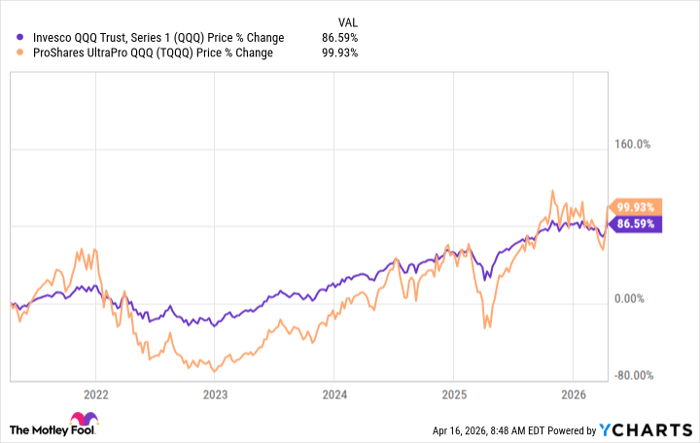
QQQ data by YCharts
With a leveraged ETF, the highs are high, but the lows are low. Not every investor can stomach such big drawdowns.
So, who should buy TQQQ? This fund is a better fit for professional investors and day traders. It lets those investors make short-term bets based on what they believe will happen with the Nasdaq-100 in the near term. This ETF can be a vehicle for those higher-risk speculative trades.
But most other investors should choose different stock ETFs. Here's why.
Tech stocks don't always go up -- or beat the S&P 500
The past 16 years since the Global Financial Crisis and Great Recession have been exceptionally good for tech stock investors. But if you look at the Nasdaq-100's longer-term performance trend, the returns are less impressive.
The Invesco QQQ Trust ETF (NASDAQ: QQQ) is one of the most popular Nasdaq ETFs that tracks the Nasdaq-100, and the fund was launched in March 1999. In the 27 years since the fund's inception, QQQ has delivered average annual returns (by net asset value) of 10.07%. That's about in line with the long-term S&P 500 average return of 10% per year.
There's no guarantee that tech stocks will always beat the rest of the stock market. What if tech stocks go through a prolonged downturn? Buying the Nasdaq-100 with leverage could expose you to bigger long-term losses. Most long-term investors saving for retirement are likely better off buying QQQ or a different low-cost index fund without using leverage. Leave TQQQ to the professionals.
Should you buy stock in ProShares Trust - ProShares UltraPro Qqq right now?
Before you buy stock in ProShares Trust - ProShares UltraPro Qqq, consider this:
The Motley Fool Stock Advisor analyst team just identified what they believe are the 10 best stocks for investors to buy now… and ProShares Trust - ProShares UltraPro Qqq wasn’t one of them. The 10 stocks that made the cut could produce monster returns in the coming years.
Consider when Netflix made this list on December 17, 2004... if you invested $1,000 at the time of our recommendation, you’d have $581,304!* Or when Nvidia made this list on April 15, 2005... if you invested $1,000 at the time of our recommendation, you’d have $1,215,992!*
Now, it’s worth noting Stock Advisor’s total average return is 1,016% — a market-crushing outperformance compared to 197% for the S&P 500. Don't miss the latest top 10 list, available with Stock Advisor, and join an investing community built by individual investors for individual investors.
See the 10 stocks »
*Stock Advisor returns as of April 18, 2026.
Ben Gran has no position in any of the stocks mentioned. The Motley Fool has no position in any of the stocks mentioned. The Motley Fool has a disclosure policy.
Recommended Articles


