




Is This the Biggest Game-Changer in Lilly's 150-Year History?
Key Points
Eli Lilly could expand the weight loss market with its latest launch.
The company should remain the leader in this niche.
There are plenty of reasons to invest in the stock.
- 10 stocks we like better than Eli Lilly ›
Why do some companies last over 100 years when many struggle to get to double digits? One important factor in business longevity is innovation. Corporations that develop and market groundbreaking products are more likely to thrive over the long term. That's one key reason Eli Lilly (NYSE: LLY), a pharmaceutical company, has been around for 150 years. The drugmaker has been a leader in the diabetes market for a long time and has made numerous breakthroughs in that space. More recently, Eli Lilly has become the top player in the weight-loss medicine market. And the company's latest launch in that niche is yet another important one. Let's see what it could mean for the company's future.

Image source: Getty Images.
Will AI create the world's first trillionaire? Our team just released a report on the one little-known company, called an "Indispensable Monopoly" providing the critical technology Nvidia and Intel both need. Continue »
Expanding access to weight loss drugs
Let's first state the problem that Eli Lilly is trying to address. Obesity is considered a worldwide epidemic due to its growing prevalence in recent decades and the fact that it is linked to many conditions, including diabetes, cardiovascular issues, some forms of cancer, and more. It is particularly pronounced in the U.S., where a significant percentage of the adult population is either overweight or obese, and 40% is prediabetic.
Recent breakthroughs in the GLP-1 area have helped address this issue. Eli Lilly's tirzepatide, marketed under the brand Zepbound for weight loss, is the leading therapy in this niche. But due to spotty third-party coverage for the medicine, its high price for cash-paying patients, its need for subcutaneous administration, and the restrictions it entails (including stringent storage requirements), the adoption of Zepbound and similar medicines is arguably tracking behind what it could be.
Enter Foundayo, an oral GLP-1 treatment that was recently approved for weight loss. Foundayo probably isn't as effective as Zepbound. However, it will be a cheaper, needle-less option for cash-paying patients. It also comes with less restrictive storage requirements. This may help with treatment adherence, at least for patients who do not like needles.
The market opportunity
Foundayo wasn't the first oral GLP-1 medicine indicated for weight loss. Oral Wegovy hit the market earlier this year. It experienced significant traction and rapid adoption early on. Oral Wegovy seemed to bring many patients who were hesitant to start weight loss treatment out of the woodwork.
This is an important finding for Foundayo, as it suggests that Eli Lilly's new medicine won't simply compete with Zepbound -- it will complement it. Even though it's cheaper, it could generate enough sales volume in the next five years to meaningfully move the needle for Eli Lilly. Analysts are optimistic, with some estimating that Foundayo could rack up sales of around $1 billion to $2 billion this year alone.
If it can get to these levels in eight months after approval, imagine what it will be able to do by 2030. Foundayo will have to contend with some challengers even beyond oral Wegovy. Many biotech companies are developing competing medicines, including oral formulations. However, Foundayo also performed well in helping lower A1C levels in patients with diabetes.
Further, unlike oral Wegovy, it can be taken without food or water restrictions. Newer therapies will have to do a lot of work -- and post impressive efficacy numbers across diabetes and obesity -- to seriously challenge Foundayo.
Eli Lilly is still a buy
Foundayo and Zepbound highlight the significant opportunity Eli Lilly has in the weight-loss market. And the company's GLP-1 portfolio is probably one of its most important breakthroughs in its long and storied history, at least in recent memory. And the best news: There is plenty of upside left. Tirzepatide could reach the highest peak ever seen in the pharmaceutical industry by 2030, according to some projections. Newer therapies, like Eli Lilly's triple agonist, retatrutide, could target other niches of the weight-loss space.
Meanwhile, the company's revenue and earnings, which have grown at a good clip in recent years (and much faster than those of its similarly sized peers), should continue to move in the right direction.
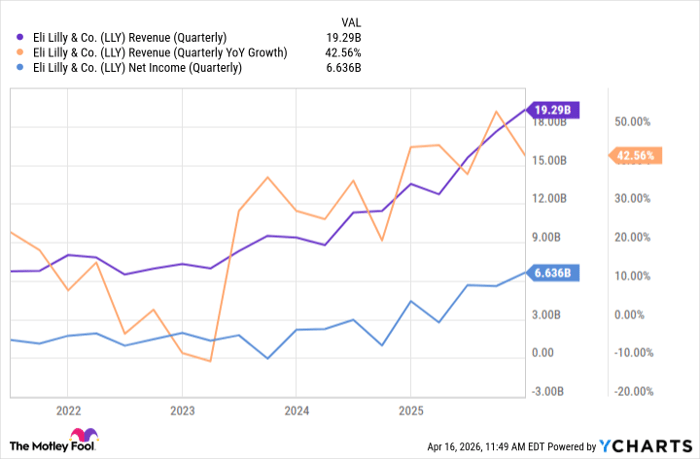
LLY Revenue (Quarterly) data by YCharts
Lastly, Eli Lilly's innovative qualities extend far beyond its work in weight loss. The company's lineup and pipeline features products and candidates across oncology, immunology, and more -- it boasts some billion-dollar drugs in these areas. And the stock is a great pick for income seekers, too, given that its payouts have grown by 239% over the past decade. Eli Lilly is a fantastic stock to buy and hold.
Should you buy stock in Eli Lilly right now?
Before you buy stock in Eli Lilly, consider this:
The Motley Fool Stock Advisor analyst team just identified what they believe are the 10 best stocks for investors to buy now… and Eli Lilly wasn’t one of them. The 10 stocks that made the cut could produce monster returns in the coming years.
Consider when Netflix made this list on December 17, 2004... if you invested $1,000 at the time of our recommendation, you’d have $581,304!* Or when Nvidia made this list on April 15, 2005... if you invested $1,000 at the time of our recommendation, you’d have $1,215,992!*
Now, it’s worth noting Stock Advisor’s total average return is 1,016% — a market-crushing outperformance compared to 197% for the S&P 500. Don't miss the latest top 10 list, available with Stock Advisor, and join an investing community built by individual investors for individual investors.
See the 10 stocks »
*Stock Advisor returns as of April 17, 2026.
Prosper Junior Bakiny has positions in Eli Lilly. The Motley Fool has no position in any of the stocks mentioned. The Motley Fool has a disclosure policy.
Recommended Articles


