




Will Stocks Crash Under Trump? Here's What History Suggests.
Key Points
The war in Iran is hurting economies across the globe.
The current situation has historical parallels that could give us clues about what comes next.
- 10 stocks we like better than S&P 500 Index ›
Donald Trump's election victory in 2024 came with great fanfare on Wall Street. Some investors and analysts were excited about the prospects of lower business taxes and deregulation, which can help juice corporate earnings. Some of these factors may have played a role in sending the S&P 500 index up by an impressive 17.9% in 2025. That said, Trump's second year in office is shaping up to be a whole different can of worms.
Markets were able to shrug off Trump's haphazard tariff policy and frequent pressure on independent institutions like the Federal Reserve. But the effects of the recent war in Iran might be too damaging to overlook. Let's look at some historical precedents to decide what might happen next and if stocks will crash before Trump leaves office.
Will AI create the world's first trillionaire? Our team just released a report on the one little-known company, called an "Indispensable Monopoly" providing the critical technology Nvidia and Intel both need. Continue »
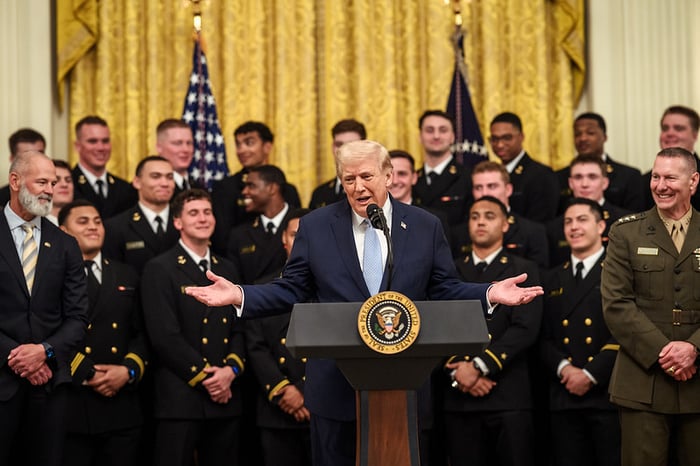
President Donald J. Trump delivers remarks at a Commander in Chief Trophy presentation for the U.S. Naval Academy's Navy Midshipmen football team, Friday, March 20, 2026, in the East Room of the White House. (Official White House Photo by Joyce N. Boghosian)
Higher energy costs could trigger stagflation
Oil prices jumped following U.S. and Israeli strikes on Iran. The Islamic Republic of Iran is responsible for around 4% of global oil production, and it responded to the attacks by mostly blocking the Strait of Hormuz, a transit point for 20% of global oil consumption as well as substantial volumes of fertilizer and natural gas. And now, the U.S. is blockading the Strait of Hormuz.
The current situation is reminiscent of the 1973 Arab oil embargo and the 1978 Iranian revolution, which led oil prices to double between 1979 and 1980. Both Middle East crises led to an economic state known as stagflation, where rising inflation is coupled with low growth.
The economy could face a similar challenge today because inflation makes it difficult for the Federal Reserve to boost growth by lowering rates. Meanwhile, if benchmark rates remain high, that could increase borrowing costs throughout the economy, making consumer mortgages more expensive and starving businesses of the capital they need to expand. This generally has a negative effect on stock prices.
Equities trade at historically high valuations
All this is happening as stock valuations are already stretched to near historic highs. The cyclically adjusted price-to-earnings (CAPE) ratio is an important stock market valuation tool that smooths out corporate earnings per share (EPS) over a 10-year period to account for the business cycle.
With a CAPE ratio of 38, the S&P 500 is trading at a level not seen since the dot-com bubble of the early 2000s. This trend has a lot to do with optimism about generative artificial intelligence, which is encouraging big tech companies to pour capital into advanced compute hardware.
That said, we don't know how the war in Iran might wind down or when the Strait of Hormuz might be opened. If capital continues to get more expensive, that would reduce investors' appetite for speculative, unprofitable stocks. And, if the situation continues to push the price of energy up, that will make it more expensive to run data centers, which could crimp the AI boom. Recently, industry leader OpenAI closed down its video generation tool Sora. And this could be the canary in the coal mine as the industry becomes more cautious about cash burn and long-term risk.
Will stocks crash in the remaining years of Trump's second term?
The war in Iran could wreak havoc on Wall Street, and many investors might be tempted to sell their stocks and buy shares of oil companies. But this might not be the best long-term strategy. Oil prices don't need to rise any further to put the global economy in an extremely uncomfortable position. And if enough countries tip into recession this year, that could actually send prices back down to earth by reducing demand relative to supply.
As for stocks, buying and holding tends to deliver the best returns relative to trying to time the market. Corrections can be brutal, but the market has historically always bounced back. The ongoing dip in the S&P 500 could eventually become an opportunity to buy quality stocks at a discount.
So, will stocks crash under Trump? Maybe, but smart investors will be looking past Jan. 20, 2029.
Should you buy stock in S&P 500 Index right now?
Before you buy stock in S&P 500 Index, consider this:
The Motley Fool Stock Advisor analyst team just identified what they believe are the 10 best stocks for investors to buy now… and S&P 500 Index wasn’t one of them. The 10 stocks that made the cut could produce monster returns in the coming years.
Consider when Netflix made this list on December 17, 2004... if you invested $1,000 at the time of our recommendation, you’d have $580,872!* Or when Nvidia made this list on April 15, 2005... if you invested $1,000 at the time of our recommendation, you’d have $1,219,180!*
Now, it’s worth noting Stock Advisor’s total average return is 1,016% — a market-crushing outperformance compared to 197% for the S&P 500. Don't miss the latest top 10 list, available with Stock Advisor, and join an investing community built by individual investors for individual investors.
See the 10 stocks »
*Stock Advisor returns as of April 16, 2026.
Will Ebiefung has no position in any of the stocks mentioned. The Motley Fool has no position in any of the stocks mentioned. The Motley Fool has a disclosure policy.
Recommended Articles


